The Bramblewick Townhouse Left Vacant After Hillside Trade Decline
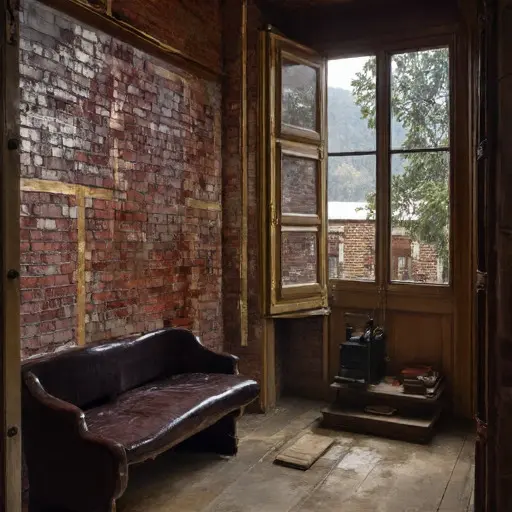
The Bramblewick Townhouse was constructed in 1902 for the Halden family, village merchants who managed hillside trade routes connecting woodland settlements with the lower valley markets. Built along a narrow cobblestone street that curved through moss-softened retaining walls and stone culverts, the townhouse was designed to maximize vertical efficiency within a constrained footprint. Its deep aubergine brick façade, interspersed with pale limestone bands, created a rhythmic layering that emphasized height while maintaining visual balance within the dense village fabric.
Inside, the Halden household maintained a tightly organized domestic and commercial routine. Samuel Halden managed trade accounts and goods distribution between hillside farms and valley buyers, while his wife Clara oversaw correspondence and household logistics. The townhouse functioned as both residence and accounting office, with records frequently moving between floors due to the building’s vertical stacking. For several decades, the house remained stable, supported by consistent local trade activity and small-scale regional exchange.
Early signs of decline
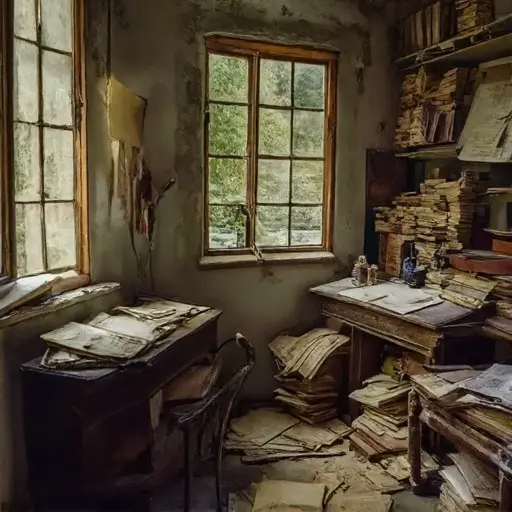
By the early 1930s, changes in regional commerce began to affect the hillside village economy. Larger market centers in the valley absorbed much of the trade that once passed through Bramblewick, reducing the volume of goods handled locally. As a result, Samuel Halden’s commercial workload diminished, and financial pressure gradually increased. Maintenance within the townhouse became less consistent, with repairs to masonry and ironwork delayed and interior upkeep reduced to essential areas only.
As economic activity slowed, the townhouse’s vertical structure began to feel less active. Upper rooms were closed off to conserve heating, and daily operations were compressed into fewer floors. The rhythm of movement through the building diminished, and correspondence that once circulated regularly became increasingly sporadic. Outside, the village continued its quiet existence, but the townhouse gradually lost its role as a commercial node within it.
Final abandonment phase
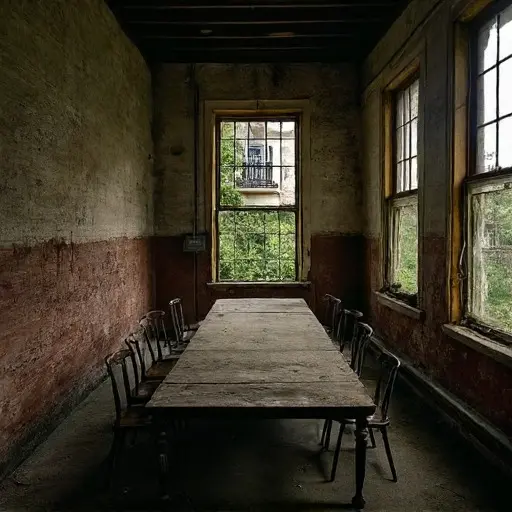
By the late 1940s, Bramblewick Townhouse was no longer actively occupied. The Halden descendants had relocated to larger urban centers for employment, and no sustained return to the village property was recorded. Utility services were discontinued after prolonged arrears, and the structure was left without maintenance or oversight. Moist hillside air and forest proximity accelerated interior aging, with dampness affecting wood, masonry, and iron fittings throughout the narrow vertical structure.
No formal transfer of ownership was completed, and village records became fragmented over time. The townhouse remained physically intact at the edge of the wooded hillside settlement, but no restoration or reoccupation occurred. It persists as an abandoned structure slowly softened by encroaching forest and village quiet, its once precise vertical life reduced to stillness within the cobblestone curve of the hillside.