The Ellery Manor Left Vacant After Orchard Harvest Collapse
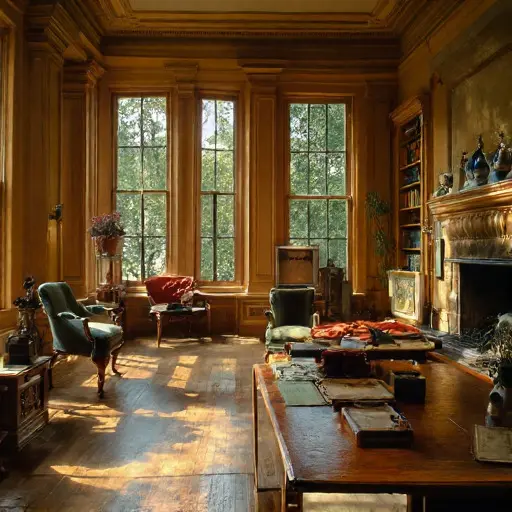
The Ellery Manor was constructed in 1904 for the Whitmore family, agricultural estate managers responsible for coordinating orchard production across the valley basin. Set among ordered rows of ancient fruit trees stretching toward distant hills, the manor was deliberately integrated into its cultivated landscape. Its warm-toned handmade brickwork in ochre and rose hues blended with the orchard palette, while pale sandstone detailing emphasized structural clarity around entrances and window recesses.
The house was designed as an extension of agricultural rhythm, with architecture and land management functioning as a single system.
Inside, the Whitmore household maintained a disciplined operational structure. Charles Whitmore oversaw orchard yield distribution and trade contracts, while his wife Anne managed estate correspondence and seasonal labor coordination. The manor functioned as both residence and administrative center, with agricultural records, harvest logs, and land management documents circulating continuously between rooms. For many years, the estate remained stable, supported by consistent fruit production and regional trade demand.
Early signs of decline
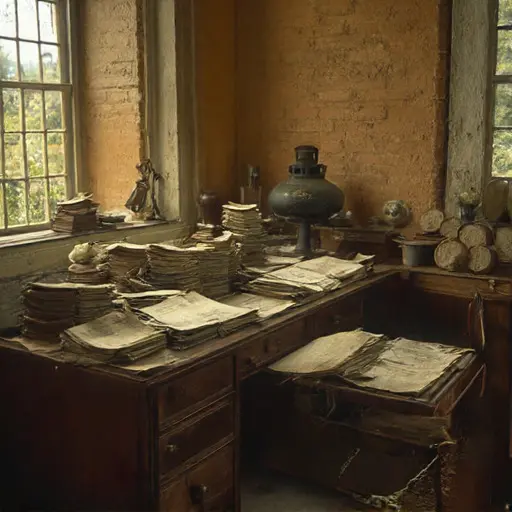
By the early 1930s, shifts in agricultural pricing and distribution networks began to impact orchard profitability. Larger commercial producers and centralized supply chains reduced demand for independently managed estates like Ellery Manor. Income declined gradually, leading to deferred maintenance across both the manor and surrounding orchard infrastructure. Irrigation channels were repaired less frequently, and sections of the estate were allowed to return to semi-wild growth.
As financial pressures increased, household operations became more constrained. Rooms within the manor were closed off to conserve heating, and documentation processes slowed significantly. The once continuous flow of agricultural records became fragmented, with delayed correspondence accumulating in study spaces. Outside, orchard rows remained structured but less intensively managed, their former precision softening under reduced labor and oversight.
Final abandonment phase
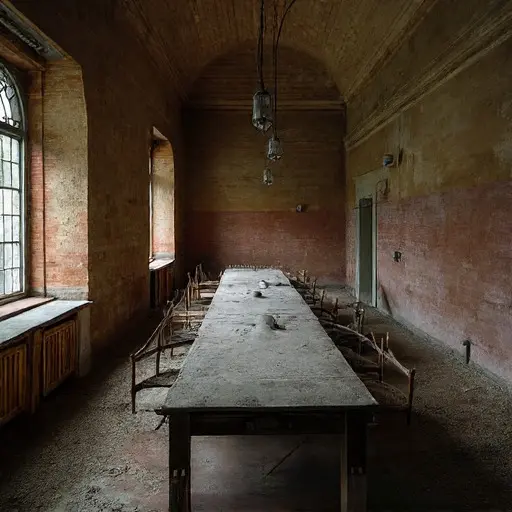
By the late 1940s, Ellery Manor was no longer actively occupied. The Whitmore descendants had relocated to urban agricultural administration roles, and no sustained return to the estate was recorded. Utility services were discontinued after prolonged arrears, and the building was left without maintenance or oversight. The surrounding orchard continued to grow in irregular cycles, with reduced pruning and harvesting allowing sections to become partially overgrown.
No formal transfer of ownership was completed, and estate records gradually fragmented. The manor remained physically intact within the orchard valley, but no restoration or reoccupation occurred. It persists as an abandoned structure slowly absorbed by the shifting agricultural landscape, its once precise harmony between architecture and cultivation gradually dissolving into quiet neglect.