The Alderwick Manor Left Vacant After Heathland Decline
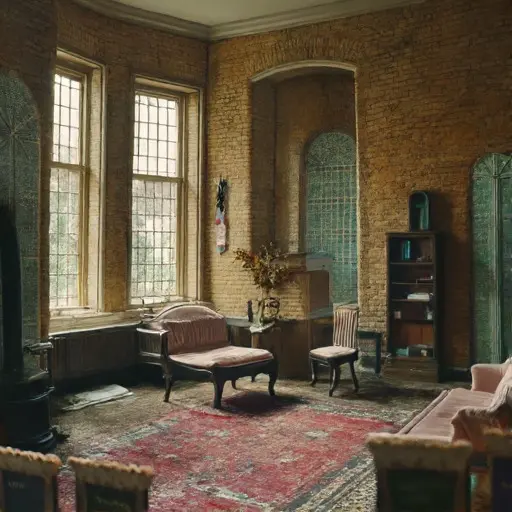
The Alderwick Manor was constructed in 1907 for the Harrington family, land survey administrators who oversaw boundary mapping across the surrounding heathland estates. Though designed in a Victorian style, the manor emphasized precision over ornamentation, its pale buff brickwork and glazed ceramic bands in muted teal and burgundy arranged in deliberate geometric sequences. The staggered architectural volumes created a sense of controlled asymmetry, while the interlocking slate roof planes reinforced the impression of a structure carefully adapted to the rolling terrain rather than imposed upon it.
Inside, life followed a structured and methodical rhythm. Arthur Harrington managed survey documentation and estate correspondence from the central hall study, while his wife Edith oversaw household logistics and seasonal provisioning. The manor functioned as both residence and administrative hub, with maps, property records, and land valuation documents circulating regularly between rooms. For the first decades of its existence, the house remained stable, supported by consistent institutional work tied to land regulation and regional development.
Early signs of decline
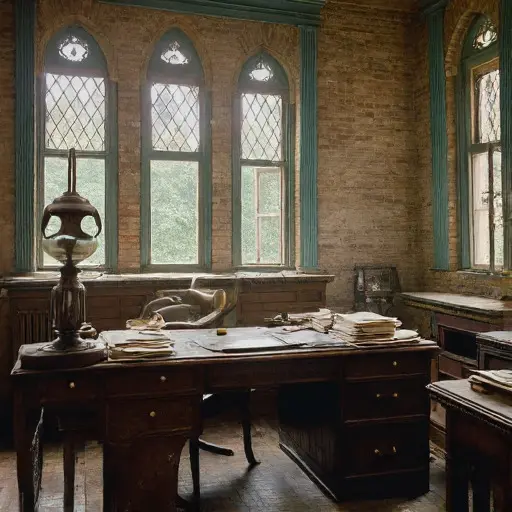
By the early 1930s, shifts in land management policy and the consolidation of regional survey departments began to reduce the Harrington family’s administrative role. Funding for independent estate mapping diminished, leading to delayed payments and reduced operational scope. Maintenance within the manor was gradually deferred, with decorative repairs postponed indefinitely and sections of the staggered structure closed off to conserve heating resources.
As the decade progressed, the manor’s internal rhythm slowed noticeably. Unopened correspondence accumulated in study corners, and recordkeeping became inconsistent. Rooms that once supported active documentation work were repurposed for storage or left idle. Outside, the heathland continued its slow ecological cycles unchanged, but inside the manor, a sense of administrative and domestic contraction took hold.
Final abandonment phase
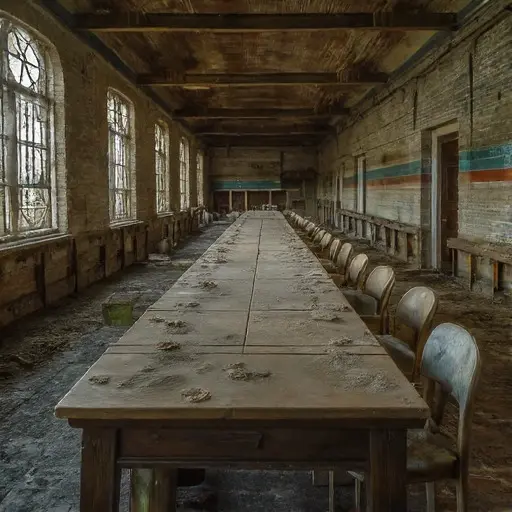
By the late 1940s, Alderwick Manor was no longer actively occupied. The Harrington descendants had relocated to urban administrative centers, and no consistent return to the property was recorded. Utility services were discontinued after extended arrears, and the building was left without maintenance or oversight. Wind and moisture from the heathland began to infiltrate through aging seals, accelerating interior decay and weakening wooden structural elements.
No formal transfer of ownership was completed after abandonment, and records regarding the estate became fragmented over time. The manor remained physically intact within the rolling heathland, but no restoration or reoccupation occurred. It persists as an abandoned structure slowly softened by vegetation and weather, its once precise architectural language gradually absorbed back into the landscape.