The Beechwood Manor Left Silent Beneath the Ancient Forest
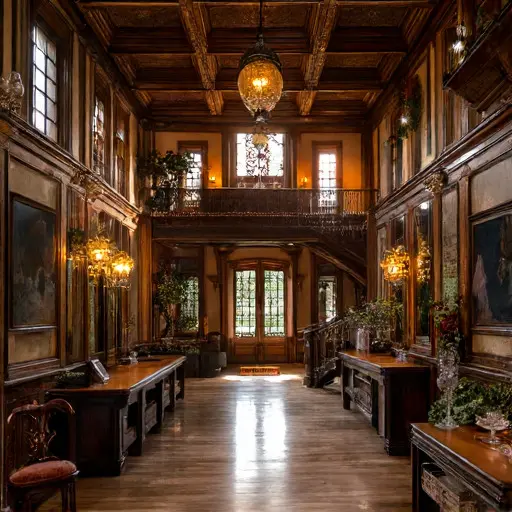
Beechwood Manor was completed in 1903 within a secluded grove of mature European beech trees on the edge of an old woodland estate. Commissioned by the Ashcombe family, the residence was intended as a permanent country home rather than a seasonal retreat. Built from honey-colored sandstone with dark walnut timber framing beneath an elaborate charcoal slate roof, the manor expanded across the clearing through interconnected wings, conservatories, galleries, and projecting bays instead of relying on imposing height.
The estate prospered during its first two decades. Arthur Ashcombe managed a successful timber brokerage while his wife Eleanor supervised extensive gardens that blended naturally into the surrounding forest. Their three children grew up among conservatories filled with rare plants, libraries overlooking the woodland, and broad verandas where family gatherings were held throughout the warmer months. Estate books reveal careful attention to maintenance, with regular payments for gardeners, carpenters, roof repairs, and seasonal improvements.
The carefully designed grounds reflected the family’s appreciation for both cultivation and the surrounding forest. Flowering borders gradually gave way to moss-covered walls and woodland paths, allowing the ancient beech grove to remain an integral part of the estate rather than something separated from it. The house seemed permanently anchored to its landscape.
Financial pressures begin to reshape the estate
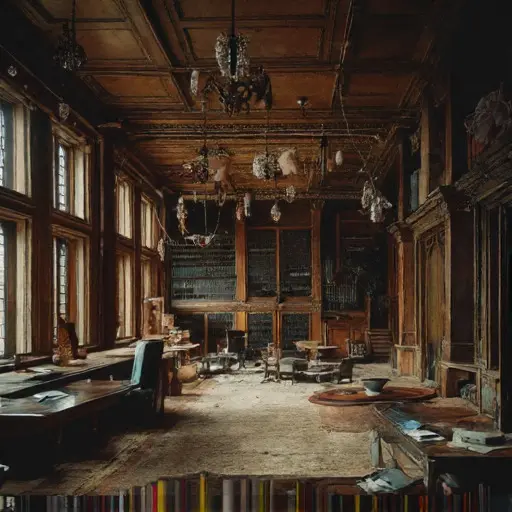
The economic uncertainty that followed the late 1920s struck the Ashcombe family’s finances with increasing severity. Timber demand weakened, several long-standing contracts were cancelled, and maintaining a large rural estate became progressively more expensive. Household staff were reduced year after year, leaving once-busy wings closed to conserve heating costs.
Maintenance became selective. Conservatories requiring constant repairs were abandoned first, followed by guest rooms that remained locked for entire seasons. Garden accounts recorded fewer purchases of plants and tools, while invoices for roof repairs and stonework accumulated without payment. Letters preserved among the estate papers reveal growing concern over outstanding taxes, insurance premiums, and mortgage obligations.
During the Second World War, two of the Ashcombe children settled permanently elsewhere after military and civil service assignments. Arthur’s declining health and Eleanor’s inability to oversee the extensive property alone accelerated the contraction of daily life within the manor. Entire corridors were shut behind locked doors, and furniture from unused rooms was consolidated into the remaining occupied spaces.
The gradual abandonment of Beechwood Manor
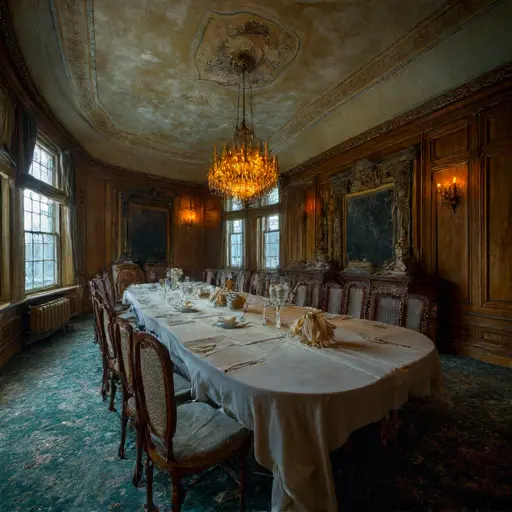
Following Arthur Ashcombe’s death in 1946, the remaining heirs faced inheritance disputes and substantial financial obligations. None possessed the means or desire to restore the increasingly costly estate, and several attempts to arrange a sale ended without success. Essential repairs were postponed indefinitely, insurance lapsed, and legal proceedings concerning ownership remained unresolved for years.
By the close of the 1940s, Beechwood Manor had been fully abandoned. The surrounding gardens slowly merged with the woodland they had once complemented so carefully, while weather entered through neglected roofs and unused chimneys. Estate records, unpaid bills, family letters, and maintenance ledgers remained scattered throughout the interior, quietly documenting the gradual decline of a house that had never suffered a single dramatic catastrophe—only decades of mounting financial pressure, shrinking family presence, and deferred maintenance. No restoration followed, no heirs returned to live there, and the manor still stands empty beneath the ancient beech trees, continuing its slow deterioration within the forest that has patiently reclaimed its silence.