The Blackwood Intervals Manor
A quiet Victorian manor rests in a damp lowland forest where saturated earth, tangled ferns, and scattered wildflowers spread across gently uneven ground. The forest feels recently washed by rain, with moisture still clinging to bark, stone, and leaf. The house is deeply grounded in this environment—architecturally plausible and structurally sound—yet shaped by a long, uneven history of additions that subtly distort its overall logic without breaking realism.
The building reads as a layered accumulation of eras rather than a single design. Its main volume is clad in deep matte black timber siding, heavy and weather-softened, absorbing light rather than reflecting it.
Attached to it are secondary wings rendered in chalky white plaster and sections of worn oxblood-red brick, producing a recurring triad of black, white, and dark red across the structure. These tones appear in irregular distribution, as if each renovation used available materials without concern for stylistic unity, yet the result remains unexpectedly coherent.
Windows are placed with quiet inconsistency—tall sash openings grouped in some areas, isolated single frames in others—each aligned to interior needs rather than exterior symmetry. The glass is intact but dulled, carrying soft reflections of trees and sky. Iron fixtures throughout the facade are predominantly blackened, with intermittent rust blooms and occasional repainted segments that hint at sporadic maintenance over decades.
The roof is steep and complex, composed of intersecting slate planes in varying states of age. Some sections are dark and smooth, others faded to ash gray or streaked with reddish mineral staining. Chimneys rise in uneven clusters—thick, narrow, tall, short—each structurally functional but visually distinct, reinforcing the sense of incremental construction over time.
Around the manor, the grounds remain simple but clearly once tended. Grass grows thick and uneven, pressing against stone edges and old pathways. A sagging clothesline stretches between two weathered posts, holding damp garments in subdued tones—charcoal coats, off-white linens, and faded crimson cloth—barely moving in the still air. Nearby, a rusted metal table sits partially swallowed by vegetation, surrounded by broken chairs sinking slowly into the soil.
An abandoned swimming pool lies off to one side, intact in form but filled with rainwater, floating leaves, and irregular algae patterns that drift across its surface. Scattered across the yard are stone statues of human figures—some upright, others tilted or partially buried—weathered into soft abstraction but still recognizably human in form.
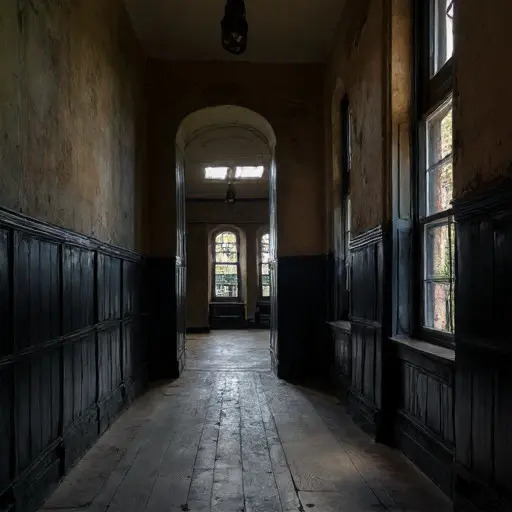
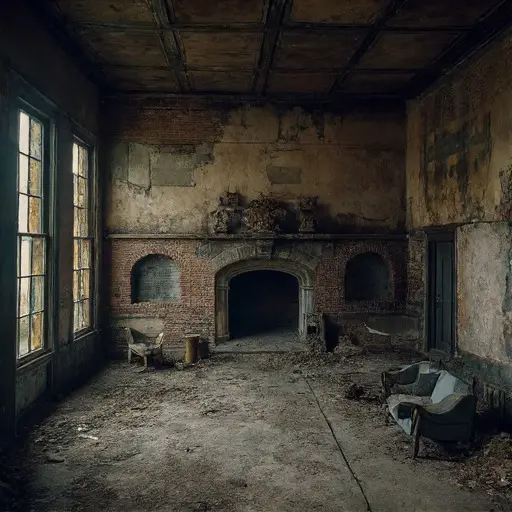
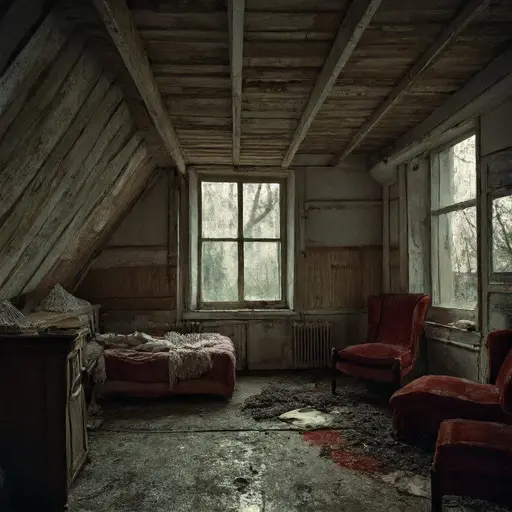
The atmosphere is overcast and evenly diffused, with soft light flattening harsh contrasts and emphasizing texture over drama. The house feels entirely real and physically coherent, yet marked by decades of uneven growth and quiet neglect, resulting in a grounded Victorian manor whose subtle architectural irregularities give it a restrained, believable sense of surreal history within a living forest.