The House of Quiet Intervals
A secluded Victorian residence sits within a broad inland basin where shallow wetlands spread across a patchwork of reeds, slow water channels, and pale clay flats that glisten faintly under an overcast sky. The landscape feels neither fully wild nor fully managed, as if it once belonged to a forgotten drainage system that has gradually lost its purpose while still holding its shape.
The house itself is a long, horizontally composed Victorian structure, extended repeatedly over time into a sequence of connected wings that step gently across the terrain. Rather than a single dominant facade, it presents multiple frontages—each slightly offset, each retaining its own architectural logic—creating a continuous but subtly fractured domestic form. Despite this irregularity, the building remains visually coherent, grounded in consistent proportions and materials.
The exterior is a restrained combination of faded ochre brick, pale gray stucco, and sections of weathered timber siding stained into soft tones of driftwood brown and desaturated olive. These materials shift in tone depending on moisture and light, giving the impression of a building that absorbs its environment rather than standing apart from it. Stone lintels and sills are simple but precise, their edges softened by time and wind-driven sediment.
The roofline is an extended rhythm of low gables and shallow hips, clad in slate tiles that vary from deep charcoal to muted blue-gray. Chimneys rise intermittently along the length of the house, some aligned with original sections, others marking later additions, creating a quiet historical map of expansion. Nothing appears decorative for its own sake; every form suggests utility first, adaptation second.
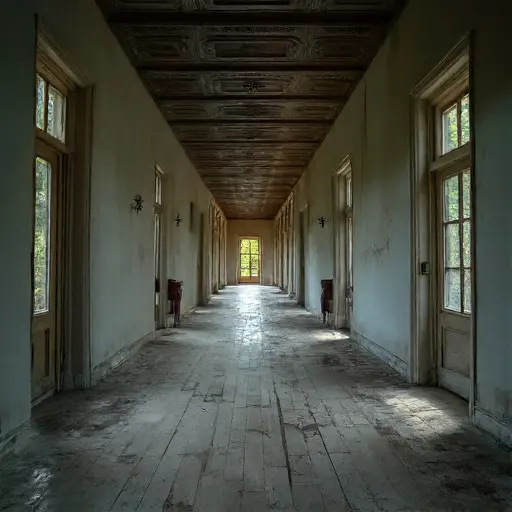
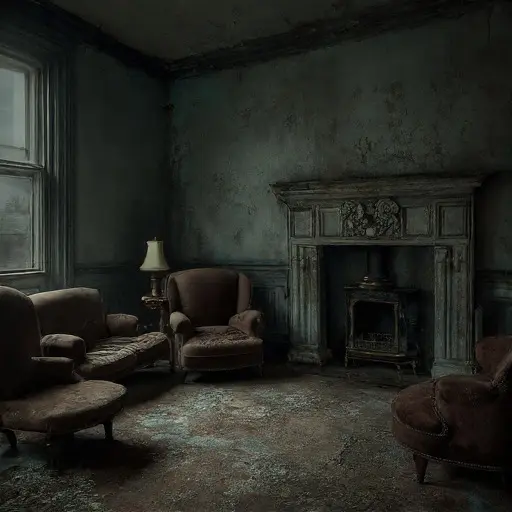
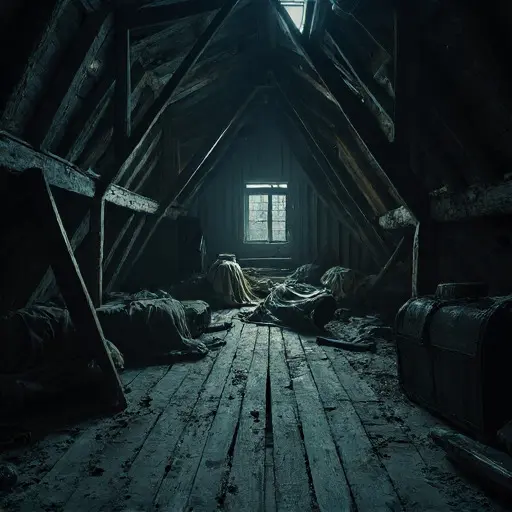
Around the house, the wetland terrain presses close but never overwhelms it. Narrow drainage channels trace irregular lines through the reeds, occasionally reflecting fragments of sky and roofline. Clusters of willow and alder trees stand at measured distances, their forms leaning slightly with the prevailing wind, reinforcing the sense of slow environmental pressure rather than dramatic encroachment.
The atmosphere is quiet, cool, and evenly diffused, with no strong directional light. Everything feels suspended in a state of long-term stillness—an architectural presence shaped by gradual expansion, environmental pressure, and unhurried time, resulting in a Victorian house that feels fully real, slightly imperfect, and completely unhurried in its abandonment.