The Orchard House of Forgotten Seasons
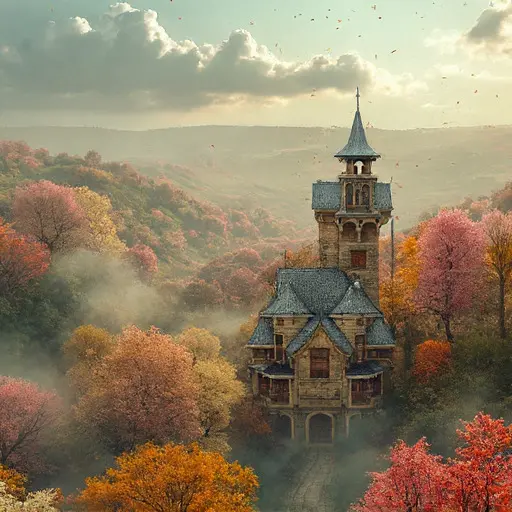
A House Held Within Blooming Distance
In the middle of an endless orchard, where rows of pear, cherry, and apple trees roll gently across low hills, a long-abandoned Victorian house rests beneath a soft silver sky. Petals drift constantly through the air, gathering along stone paths and window sills like quiet evidence of seasons that never stopped passing.
The landscape feels suspended in a kind of floral continuity—always blooming, always shedding, never arriving at an end.
Within it, the house does not interrupt the orchard but settles into it, as though it were planted rather than built.
A Fragmented Victorian Composition
Unlike traditional estates designed around symmetry or a single focal façade, this house unfolds as a sequence of interconnected courtyards. Each section appears to have been added in a different generation, forming a layered architectural history visible in its very silhouette.
Towers rise beside sunrooms. Covered walkways cross open-air gardens. Gallery corridors connect unexpected corners. The result is a structure that feels simultaneously grand and village-like, as if multiple Victorian homes had slowly grown into one continuous organism.
From above, the composition reads like a carefully unplanned map—an elegant patchwork of lived decisions, additions, and forgotten expansions.
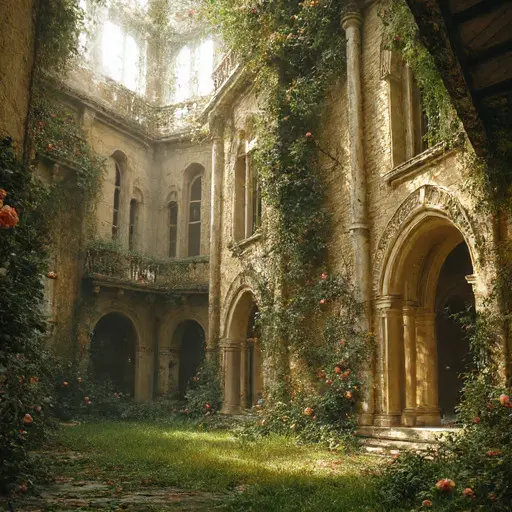
Weathered Elegance in Bloom
The exterior is finished in faded cream-painted brick, softened by time into a warm, chalky tone. Accents of weathered cedar and pale stone trace the edges of windows, arches, and balconies, giving the structure a quiet material depth.
Victorian ornamentation still survives, though gently eroded by decades of wind and bloom. Arched window frames, carved wooden fretwork, and delicate brackets remain visible, but they feel less like decoration and more like memory preserved in wood and stone.
Climbing roses thread themselves across the façade in loose, unrestrained patterns. They wrap around pergolas, drift through balcony railings, and spill into shaded corners where petals collect in soft piles.
Rooflines and Garden Bridges
Above the courtyards, the roofscape becomes a complex network of intersecting ridges and rounded glass canopies. Some panes are clear, others clouded with age, and many are partially veiled by flowering vines that have claimed the upper structure as their own.
Elevated garden bridges connect distant wings of the house, spanning open courtyards where grass and wildflowers now grow freely. These bridges feel less like infrastructure and more like pathways between memories, suspended above quiet green spaces where no one walks anymore.
Empty windows reflect the orchard in shifting fragments—branches moving in windless light, blossoms drifting across glass, and clouds slowly passing overhead.
A Place Where Architecture Becomes Season
Inside, the atmosphere is hushed and gently luminous. Light enters through layered courtyards and glass canopies, scattering softly across worn floors, faded wallpaper, and wooden beams shaped by time. Every room feels open to the orchard in some way, as if boundaries between interior and exterior were never fully established.
There is no sense of urgency here. Only continuity.
The orchard outside continues its quiet cycle of bloom and fall, while the house remains still within it—an architectural memory gradually softened by petals, light, and the patient passage of seasons.