The House That Bloomed Toward Every Horizon
A Residence Grown From the Meadow
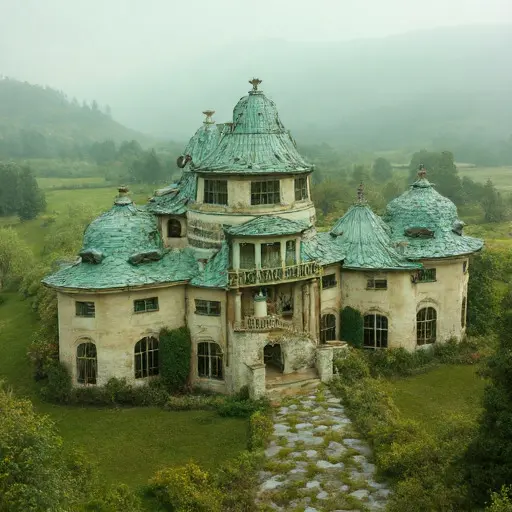
Far beyond the nearest road, where rolling hills fade into a veil of soft cloud and endless flowers sway beneath filtered daylight, stands a Victorian house that seems to have expanded according to curiosity rather than plan. Instead of rising upward in formal symmetry, it spreads across the meadow in a star-like arrangement of interconnected wings, each extending gently toward a different corner of the landscape.
From above, the structure resembles a botanical specimen unfolding its petals.
Every wing appears to have been added in response to a particular view—a distant hill, a flowering grove, a favorite sunset horizon. Decades of quiet expansion have transformed the house into a collection of harmonious directions, all connected by a central heart that remains hidden among the overlapping forms.
The exterior combines weathered pale sage-green timber with creamy limestone softened by time into delicate pastel tones. Together they create an appearance both elegant and welcoming, as though the house has slowly absorbed the colors of the meadow surrounding it.
Windows for Every Season
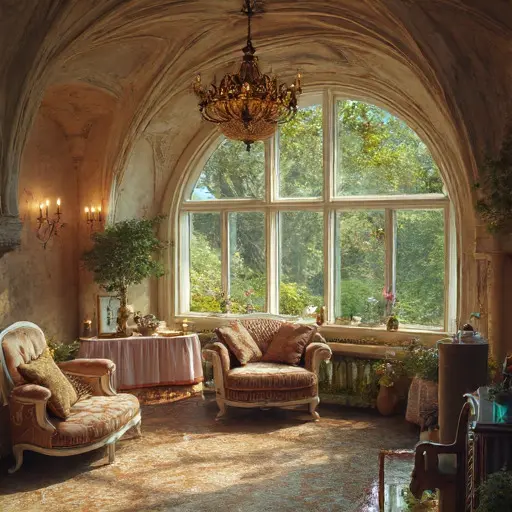
The windows refuse rigid order. Tall Victorian frames of differing heights and proportions are arranged according to interior experience rather than exterior symmetry. Some rise dramatically from floor to ceiling, opening views toward distant hills. Others nest comfortably within alcoves overlooking intimate gardens and flowering terraces.
Thin climbing vines carrying clusters of tiny white blossoms partially veil many panes. Their delicate stems weave through carved wooden frames decorated with floral motifs that have softened over decades of weather. The carvings no longer appear ornamental; they seem like natural extensions of the plants themselves.
Throughout the day, muted reflections of flowers, clouds, and meadow grasses drift across the glass. No interior glow escapes outward. Instead, the windows serve as quiet mirrors where architecture and landscape exchange their identities.
Roofs Like Frozen Waves
The most remarkable feature reveals itself from a distance. Rather than conventional Victorian gables, the house is crowned by a flowing landscape of overlapping curved roof sections that sweep across the structure like gentle waves captured in stillness.
Aged copper surfaces shimmer softly beneath the cloud-filtered sky. Time has transformed the metal into a palette of muted silver, pale turquoise, and weathered green, echoing both the surrounding grasses and the colors hidden within the meadow flowers.
The roofline never settles into repetition. Each curve rises and falls according to the volume beneath it, creating a sense that the building has grown organically over generations rather than being constructed all at once.
Conservatories and Flowering Boundaries
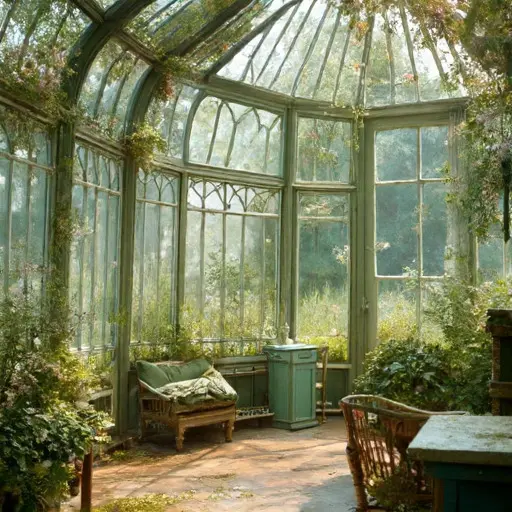
Several wings terminate in circular conservatory alcoves that project outward into the landscape. Their dusty glass walls catch fragments of sky and blossoms, creating subtle reflections that shift with changing light. Within them, forgotten wicker chairs and weathered tables remain positioned toward views that have never lost their beauty.
Stone terraces radiate outward from the house but never fully separate themselves from the meadow. Their edges soften gradually into grass, wildflowers, and low-growing herbs. Small flowering trees appear beside walls and pathways with such natural ease that it becomes impossible to tell whether they were planted intentionally or simply arrived and stayed.
The boundary between architecture and landscape dissolves everywhere. Terraces become gardens. Gardens become meadow. Meadow becomes horizon.
A Memory Preserved in Bloom
Beneath the blanket of thin cloud, daylight spreads evenly across every surface. Shadows remain soft and unobtrusive, allowing color, texture, and form to exist without dramatic contrast. The atmosphere feels suspended between past and present, neither abandoned nor inhabited, but quietly remembered.
The house stands at the center of countless flowers without dominating them. Instead, it participates in the landscape as another living form—one built of timber, limestone, glass, and copper rather than roots and stems.
Here, Victorian elegance has softened into something gentler. The architecture no longer seeks to command its surroundings. It simply blooms alongside them, resting within a timeless meadow where every path, terrace, and window seems to lead deeper into a beautiful memory.