The Embankment Arts and Crafts House Left to the Flood Lines
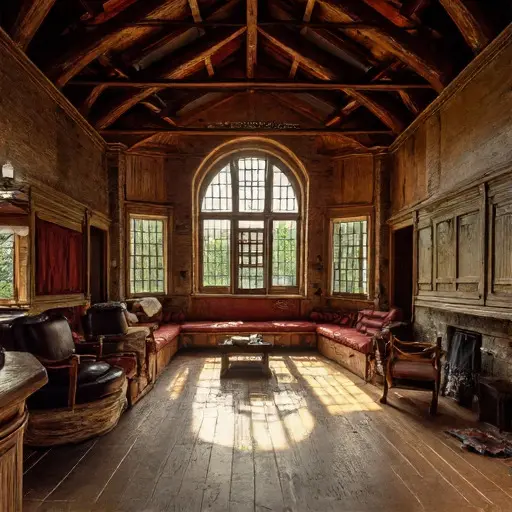
The Embankment Arts and Crafts House was completed in 1899 as part of a planned expansion along a newly engineered flood barrier system designed to protect low-lying agricultural land. Unlike earlier Victorian expressions of industrial confidence, this residence reflects the Arts and Crafts movement’s emphasis on material honesty, craftsmanship, and integration with landscape systems rather than dominance over them.
The house is constructed primarily from warm red brick, carefully varied in tone to avoid uniformity, and interspersed with hand-cut sandstone detailing that softens transitions between structural elements.
This combination creates a surface that feels inherently tactile, as though each section was placed with attention to texture rather than repetition. Over time, weathering has deepened the natural variation in brick coloration, reinforcing its handcrafted character.
The façade is intentionally asymmetrical but visually balanced. A recessed central entrance sits beneath a broad, shallow arch supported by tapered stone piers, creating a grounded and welcoming threshold. The heavy oak door, aged into a deep chestnut tone, retains simple wrought iron fittings and a small rectangular transom window that diffuses soft, indirect light into the interior hall.
Craft, proportion, and controlled asymmetry
To one side of the façade, a wide canted bay window projects across both floors. Its lower portion is anchored in stone, while the upper section is divided by timber mullions into tall, narrow panes. These panes remain intact but subtly warp the view of the exterior embankments, bending the linear landscape into softened geometry. On the opposite side, a lower service wing extends outward in simpler brickwork, with reduced fenestration and restrained detailing, clearly secondary in hierarchy but consistent in material language.
The roof is composed of steep slate slopes arranged in a complex but harmonious configuration of dormers, half-hips, and intersecting planes. Clay ridge tiles trace the roofline in darkened continuity, while clustered chimney stacks rise in paired formations, built from matching brick and finished with simple corbelled caps. The overall roofscape maintains visual unity through variation rather than strict symmetry.
The surrounding flood barrier system forms the defining context of the site. Long, geometric embankments stretch into the distance in parallel lines, intersected by shallow drainage channels that occasionally catch and reflect the sky. These engineered forms create a calm, rhythmic landscape that aligns unexpectedly well with the house’s measured proportions.
Vegetation follows the logic of the earthworks. Coarse grasses trace the slopes of embankments, small shrubs stabilize drainage edges, and occasional wind-shaped trees appear at controlled intervals. The environment reads as a designed system that has simply lost active maintenance rather than returning to wilderness.
Gradual withdrawal from flood system oversight
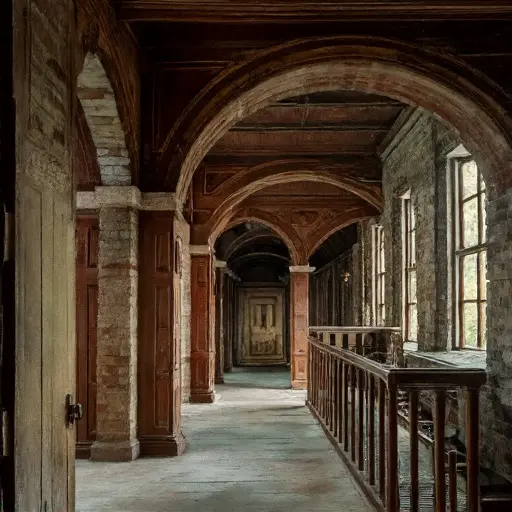
By the early 20th century, the flood barrier system underwent administrative consolidation under broader regional infrastructure management. As oversight centralized, localized residences associated with maintenance and observation gradually lost their operational role. The Embankment Arts and Crafts House transitioned from an active supervisory residence into an intermittent dwelling.
Despite reduced use, the building remained structurally sound due to its high-quality materials and careful construction. However, interior activity diminished steadily. Rooms once used for planning and oversight of the embankments fell into irregular use, while others were left untouched for long periods.
By the late 1940s, the house was fully vacated. No redevelopment or repurposing followed, as the surrounding engineered landscape remained functional without requiring local habitation.
Final condition along the flood embankments
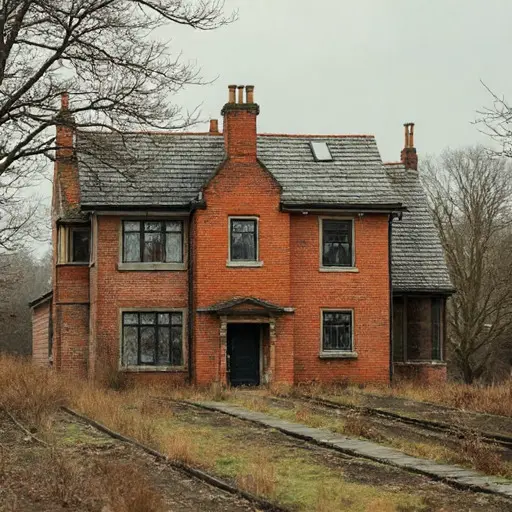
Today, the Embankment Arts and Crafts House remains abandoned and unchanged. No restoration has been undertaken, and no new use has been assigned. It stands quietly within the flood barrier system as a materially rich, carefully crafted Victorian residence—integrated into a designed landscape that continues to function without it.