The River Fork Stick House Left in Structural Silence
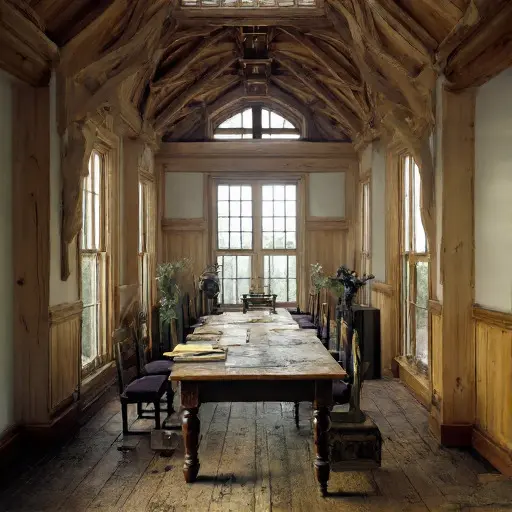
The River Fork Stick House was constructed in 1887 for a small family involved in river trade and gravel extraction along the branching water channels. Positioned precisely on a narrow promontory of compacted river gravel, the site was chosen for access, visibility, and control over the split waterways. The house reflects the Stick Style emphasis on structural expression, where the frame is not concealed but deliberately revealed as part of the architectural identity.
Its exterior is organized as a disciplined grid of dark timber strips laid over pale weathered siding. These vertical and horizontal members articulate the building’s skeleton with precision, creating a clear reading of load, spacing, and geometry. The cladding boards between them are narrow and evenly spaced, their paint eroded into soft bone white, pale gray, and muted sand tones that blend into the gravel and water landscape.
The façade prioritizes structure over decoration. Every element reads as part of the frame system: posts, braces, beams, and infill panels all remain visually distinct. This clarity gives the building a rational presence, as if its construction logic is permanently visible through its skin.
Order within the structural grid
The main volume is anchored by a tall central gable that rises slightly off-center, breaking symmetry just enough to acknowledge interior circulation. Its steep roof is clad in wooden shingles that have weathered into a uniform silver-gray patina, softening the geometry without obscuring it.
Beneath the gable, a narrow clerestory band runs horizontally, interrupting the vertical rhythm of the timber framing. This strip of glass reflects shifting tones of sky and water, tying the house visually to the surrounding river channels. Across the façade, windows are tall, rectangular, and minimally framed, reinforcing proportion rather than ornament.
A shallow wraparound veranda extends along the perimeter of the structure. Square posts are evenly spaced and connected with simple cross-bracing, creating a repeating structural cadence. The floorboards follow the same grid logic, extending the geometry outward toward the gravel edge without deviation.
The rear service wing is lower and simpler in execution, extending toward the water with less structural articulation. While it follows the same material palette, it lacks the pronounced framing system of the main volume, reading as a functional extension rather than a defining architectural statement.
The surrounding environment is shaped by flow rather than growth. Two slow river channels diverge around the promontory, their surfaces reflecting the house in elongated, broken horizontal bands. Gravel banks and sparse reeds follow water movement patterns, reinforcing the linear logic already present in the architecture.
Decline through reduction of function
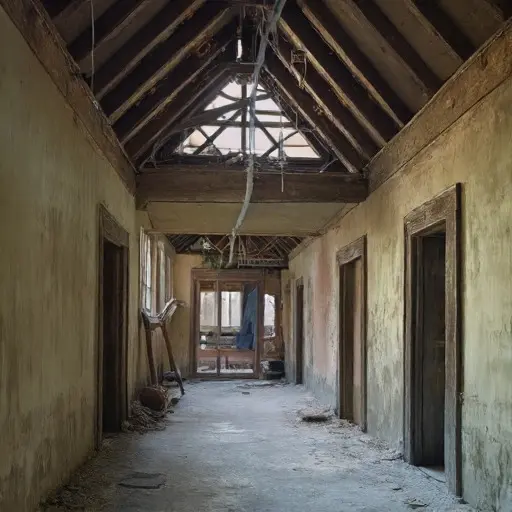
By the early 20th century, changes in river transport infrastructure reduced the importance of localized gravel and channel-based trade. As regional logistics centralized, the functional need for a residence at this precise fork diminished. The house remained occupied intermittently, but its role shifted from operational hub to secondary dwelling.
Maintenance gradually declined in parallel with this functional reduction. While the structural frame remained intact, repainting and surface upkeep became irregular, allowing weathering to deepen the tonal contrast between timber and siding. Despite this, the building’s exposed framework ensured that it retained visual clarity even as care diminished.
By the 1940s, the house was fully vacated. No demolition or repurposing followed, as its structural honesty and remote position made it neither obsolete enough to remove nor valuable enough to restore.
Final condition at the river fork
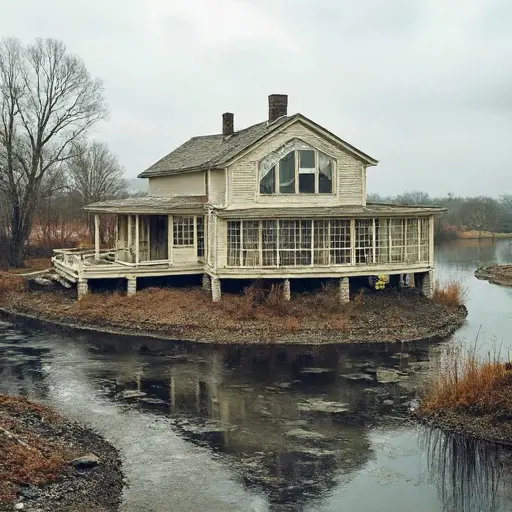
Today, the River Fork Stick House remains abandoned but structurally stable. No restoration has been attempted, and no new occupation has taken place. It stands as a clear example of Stick Style Victorian architecture preserved in situ—defined by its exposed framing logic, disciplined geometry, and quiet persistence at the meeting point of two slow river channels.