The Blackshore Promontory House Left Vacant Above the Basalt Terraces
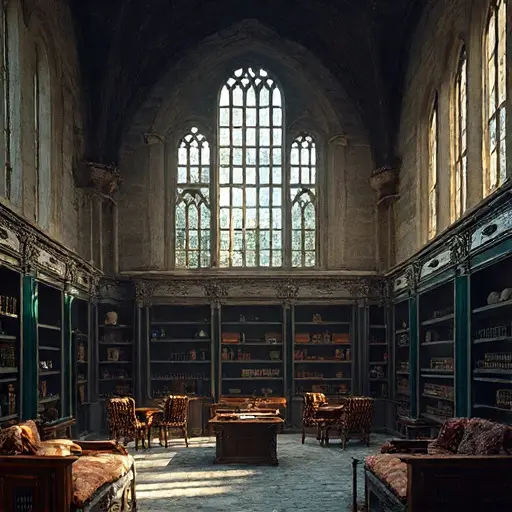
Blackshore Promontory House was constructed in 1884 for the Ellery family, who maintained modest commercial ties to coastal navigation services and inland trade routes along the adjoining sea basin. The residence was deliberately positioned on a narrow volcanic promontory, where basalt formations formed natural terraces descending toward the water. Rather than resisting the terrain, the house was designed to follow its contours, resulting in a flowing Gothic-Victorian structure integrated into the rock itself.
The exterior is composed of deep indigo brick interwoven with pale carved limestone, producing a strong two-tone rhythm that emphasizes verticality and layered depth. Tall lancet windows are arranged in clustered formations rather than strict grids, each framed with fine stone tracery that forms subtle pointed arches and organic trefoil patterns. The glass remains intact but gently rippled with age, reflecting the inland sea in fragmented tones of shifting color.
Upper levels feature semi-circular oriel balconies projecting outward from the façade. These are supported by slender corbels carved into abstract leaf forms, while delicate ironwork screens wrap around them in intricate organic patterns. From a distance, the balconies and tracery combine into a lace-like architectural texture that softens the building’s otherwise heavy masonry presence.
Architectural adaptation to landscape
The structure’s roofscape is steep and highly articulated, composed of intersecting slate gables arranged around a central tower. Copper ridge ornaments, now oxidized into deep sea-green, accent the roofline with subdued highlights. A tapered central spire rises above the composition, not dominating it but providing a visual anchor for the complex geometry below.
At ground level, the house transitions into carved stone terraces that step down toward the water. These lower levels include arched colonnades and sheltered walkways integrated directly into the basalt rock, blurring the boundary between architecture and geology. The building appears partially excavated and partially grown, as if shaped simultaneously by human design and coastal erosion.
The Ellery household lived closely tied to the rhythms of the inland sea. Daily life included monitoring water conditions, maintaining correspondence with regional shipping services, and managing small-scale trade logistics. The house functioned as both residence and observational point for coastal activity.
Gradual withdrawal from coastal operations

By the 1920s and 1930s, changes in regional transportation and shipping infrastructure reduced reliance on small coastal observation houses. Larger centralized ports and modern navigation systems gradually replaced localized monitoring functions. As a result, Blackshore House experienced a steady reduction in operational relevance.
Occupancy declined gradually rather than abruptly. Certain rooms were closed during off-seasons, and maintenance of the more remote stone terraces was reduced. The surrounding basalt formations remained stable, but coastal vegetation began to grow more freely in unused crevices, indicating a subtle shift from managed to semi-natural conditions.
Final abandonment phase
By the late 1940s, the Ellery family had relocated inland, and Blackshore Promontory House was fully vacated. No restoration program was proposed, and the property remained structurally intact due to the durability of its masonry construction and sheltered coastal position.
The house left behind
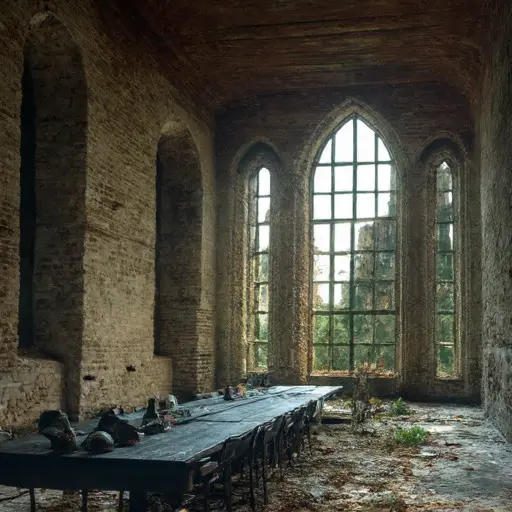
By the early 1950s, Blackshore Promontory House stood entirely vacant. No redevelopment or structural alteration followed its abandonment. The inland sea continued its slow reflective motion around the basalt terraces, while the Gothic-Victorian residence remained fixed in place—quiet, intact, and enduring within a landscape that had ceased to be inhabited.