The Millstone Terrace House Left Vacant on the Steep Stair Street
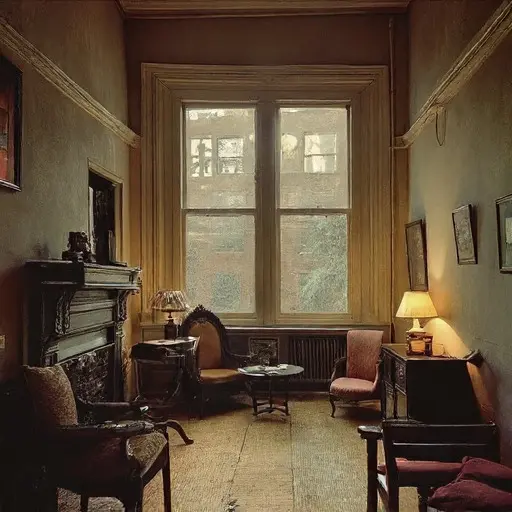
Millstone Terrace House was constructed in 1876 as part of a coordinated hillside development designed to accommodate expanding urban populations on steep terrain. Built in a continuous row of semi-detached Victorian homes, the residence reflects strict spatial efficiency rather than architectural flourish. Its warm red brick façade, laid in precise Flemish bond, follows the narrow constraints of the stepped street, rising vertically in disciplined alignment with its neighbors.
The structure consists of two main floors and a modest attic beneath a pitched slate roof. A shallow bay window projects from the ground floor, framed in timber that was originally painted cream but has since faded into a muted chalk tone. Above it, tall sash windows maintain strict vertical order, their proportions uniform across the façade. Brick arches above each opening provide subtle structural relief without decorative excess.
The entrance is elevated above the street due to the steep incline of the hillside. A short flight of stone steps leads up from the stair street, bordered by a simple iron railing that shows only light corrosion. The front door, painted deep green, bears uneven wear along its edges, revealing earlier paint layers beneath years of weather exposure. A small transom window above the door allows soft light into the entry hall.
Life in a dense hillside network
The original occupants, the Whitmore family, lived in close proximity to dozens of similar households stacked along the slope. Daily life was shaped by shared infrastructure: communal stair streets, narrow rear gardens, and retaining walls that defined the layered urban terrain. The house functioned as both private residence and part of a tightly interdependent residential system.
By the early 20th century, the neighborhood remained active but began to show signs of gradual demographic shift. Younger residents increasingly moved toward newer districts with improved transport links, while older homes remained occupied by long-term tenants and aging families. Millstone Terrace House continued to function as a stable household, but subtle changes in occupancy patterns began to emerge.
Gradual thinning of occupation
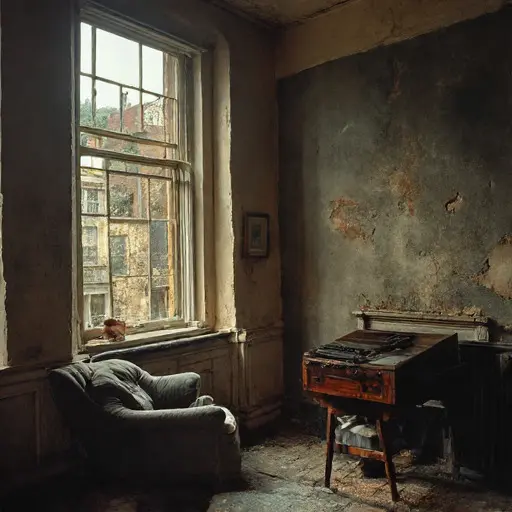
As urban migration patterns shifted in the 1930s, portions of the terrace row began experiencing intermittent vacancy. Some homes were subdivided into smaller rental units, while others were left partially unoccupied during seasonal transitions. Millstone Terrace House remained occupied longer than many of its neighbors, but its internal use gradually contracted to fewer rooms.
Maintenance of shared hillside infrastructure also declined. Retaining walls were repaired less frequently, and stair street surfaces began to show uneven wear. Vegetation remained limited, constrained by narrow plot sizes and stone boundaries, but small clusters of hardy grasses and shrubs began appearing in unused corners.
Final abandonment phase
By the late 1940s, the Whitmore household had fully relocated to a lower-density district with improved transport access and modernized housing. The decision was gradual rather than abrupt, reflecting broader patterns of urban redistribution rather than individual crisis. Once vacated, the property remained structurally intact but unoccupied.
The house left behind
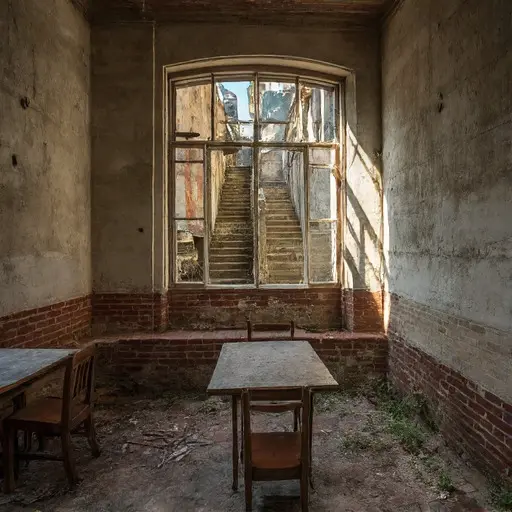
By the early 1950s, Millstone Terrace House stood completely vacant. No redevelopment program was initiated, and the terrace row remained structurally stable despite reduced occupancy across the district. The house endures as a precise example of Victorian hillside urban planning—dense, functional, and historically coherent—left behind as its residential network slowly thinned around it.