The House Between Water and Blossoms
A House That Spreads Instead of Rises
There is a quiet confidence in buildings that refuse to climb upward.
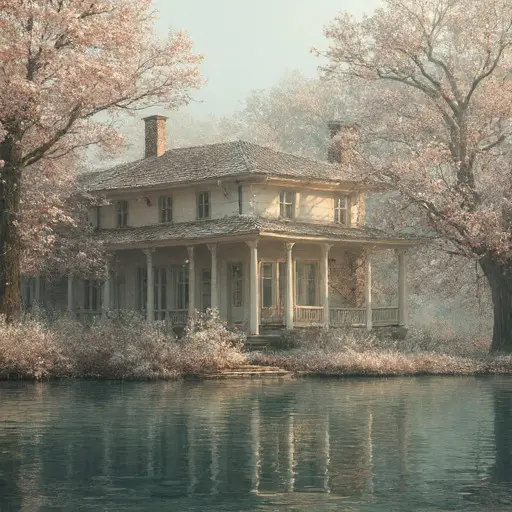
This abandoned Victorian family house sits on a narrow strip of land suspended between two opposing worlds: a mirror-still lake on one side and a dense wall of magnolia trees on the other. Together, they form a living corridor of reflection and bloom, where water and petals constantly rewrite the boundaries of the scene.
The house does not dominate this space.
It belongs to it.
Low, wide, and horizontally composed, it stretches outward in calm restraint rather than upward ambition. Pale cream stucco wraps a timber frame that subtly reveals itself beneath the surface, creating a soft vertical rhythm that stabilizes the otherwise elongated silhouette. Nothing feels exaggerated. Nothing feels forced.
Instead, the structure seems to exhale into the landscape.
Horizontal Architecture of Quiet Balance
Rather than a single vertical statement, the house unfolds in layered horizontal bands.
A central core anchors the composition, while two long wings extend outward like open arms reaching toward both water and forest. Each wing is lined with continuous rows of evenly spaced windows, their convex glass subtly distorting the outside world.
The lake appears slightly curved.
The trees bend gently inward.
Even the falling magnolia petals seem to drift in slow arcs rather than straight lines.
These optical distortions give the entire house a soft, breathing quality—as though the building itself is quietly inhaling the surrounding landscape.
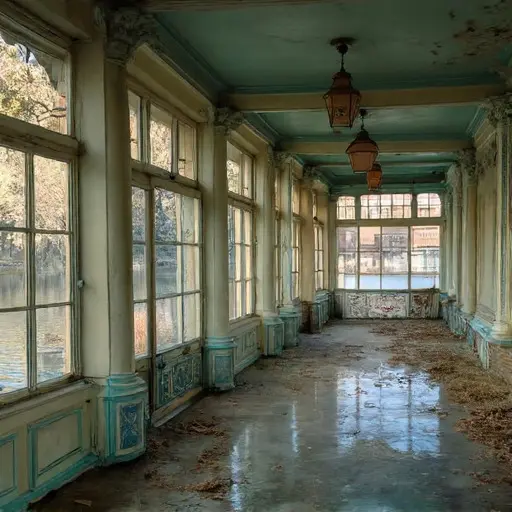
A long veranda runs uninterrupted along the full length of the structure. Thin white-painted columns support it at measured intervals, their surfaces aged into a warm ivory patina. Above, the ceiling is painted a muted teal that has faded unevenly over time, leaving soft gradients that shift between shadow and sky.
Lantern fixtures still hang from the beams, but none are lit. Their glass globes capture daylight instead, holding it like suspended droplets waiting for night that never comes.
A Roof That Refuses Drama
The roof is striking not for complexity, but for restraint.
Broad and shallow, it rests across the structure like a calm surface laid over water. Smooth slate tiles shift gently between cool gray and faint lavender, depending on how the light filters through drifting magnolia petals.
Two chimneys sit far apart at opposite ends of the building.
They do not compete.
They simply balance the composition, anchoring the horizontal expanse with quiet punctuation rather than dominance.
There is something deliberate in this simplicity.
As if the house, after years of change, finally chose stillness.
A Threshold That Becomes Landscape
At ground level, the architecture dissolves almost imperceptibly into its surroundings.
A carefully maintained stone terrace runs along the lake’s edge, its pale stones worn smooth by time and weather. From there, a narrow path continues without hierarchy or emphasis, simply following the contour of the water.
There are no fences.
No barriers.
No attempts to separate structure from nature.
The lake mirrors everything above it with almost unnatural clarity. Sky, trees, and fragments of architecture ripple together in a softened reflection that feels more remembered than observed.
Behind the house, magnolia trees form a dense, flowering wall. Their pale blossoms drift downward in slow, continuous snowfall, collecting along veranda edges and dissolving into shifting patterns with each passing breeze.
Branches bend gently over sections of the roof but never touch it, as if respecting an invisible boundary between growth and dwelling.
Interior Stillness and Light
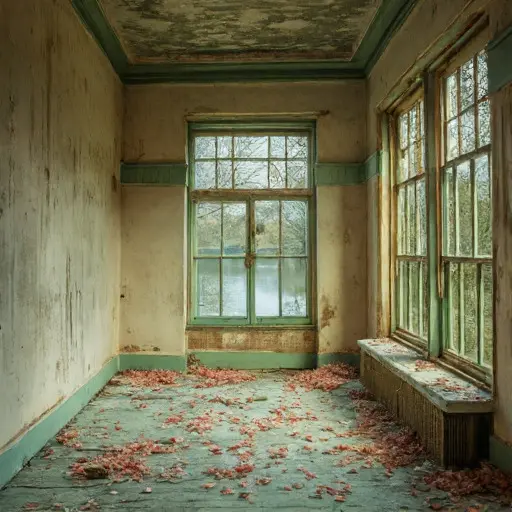
Inside, the house maintains the same quiet restraint as its exterior.
Rooms are wide rather than tall, shaped by horizontal flow instead of vertical emphasis. Light enters through long window bands, spreading across pale surfaces in soft gradients that shift with every movement outside.
The convex glass subtly bends the view of the lake, making the water feel closer than it is. Magnolias appear to lean inward, their blossoms suspended mid-fall as if time has slowed just enough to notice each one individually.
Wooden floors carry a warm, subdued tone, softened by decades of light exposure. Walls remain minimal, allowing the landscape itself to become the primary interior decoration.
There is no sense of abandonment in the usual sense.
Instead, there is continuity.
As if the house simply stopped needing occupants to remain complete.
A Place Held in Perfect Equilibrium
Nothing in this scene asserts dominance.
Not the lake.
Not the trees.
Not the architecture.
Everything shares weight equally, held in a delicate equilibrium between reflection and presence.
The magnolias continue to bloom.
The lake continues to mirror.
The house continues to stand—not as a monument, but as a quiet participant in the landscape’s ongoing rhythm.
And in that balance, the abandoned Victorian home feels less like something left behind and more like something carefully placed, then gently allowed to remain.