The Quarry Hollow House Resting in a Circular Amphitheater
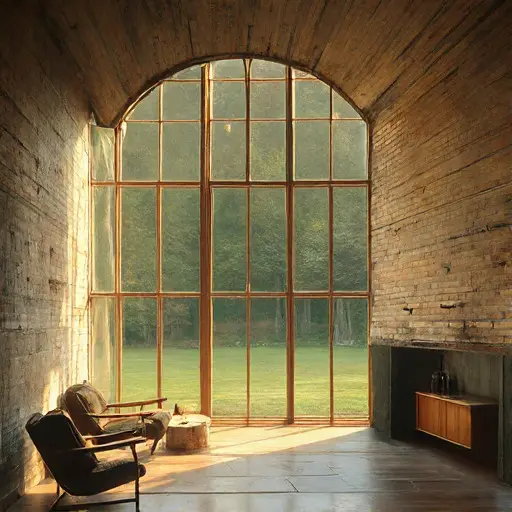
The Quarry Hollow House stood within a circular depression formed by an ancient stone quarry that had softened over centuries into a grassy amphitheater. The quarry walls were no longer harsh industrial cuts but layered slopes of earth and stone, draped in moss seams and thin trails of ferns that softened every vertical edge. At the center of this natural bowl sat the house—small, vertically focused, and carefully integrated into the curvature of the land.
Constructed from pale cream brick interlaced with thin horizontal courses of dark ironstone, the house carried a banded exterior identity that emphasized structure and rhythm. The layering of materials gave the façade a quiet geological logic, as if the building itself were an extension of the quarry strata rather than a foreign insertion.
The most distinctive feature of the house was its slight concavity. The façade bowed inward gently, most visible across the upper floors where the curvature subtly shaped the alignment of tall sash windows. These windows followed the arc of the wall, producing a faint impression of motion frozen into architecture—like a structure shaped by slow inward pressure over time rather than deliberate design alone.
Each window was framed in weathered brass that had darkened into a warm brown-green patina. The frames caught light in soft, subdued highlights that shifted depending on the angle of the sun within the quarry hollow. The glass remained mostly clear, with only faint age distortions that softened reflections of the grassy amphitheater outside.
A narrow central stairway rose along the exterior façade instead of being contained within it. Enclosed in a slender glass-and-iron shell, it functioned as a transparent vertical spine, connecting each level in a clean, uninterrupted sequence. Its presence reinforced the building’s layered rhythm without disrupting the concave continuity of the exterior wall.
The roof was compact and slightly flattened, composed of overlapping slate tiles ranging in tone from ash gray to desaturated olive. Two short chimneys sat close together near one side of the roofline, their brick softened by time but structurally intact. Subtle mineral streaks ran downward from the chimney bases, tracing natural weathering patterns like faint geological markings.
The quarry floor formed a circular lawn of fine grass shaped more by wind and topography than by human maintenance. Scattered stone remnants from the quarry were arranged in irregular rings, subtly echoing the curvature of the house above and reinforcing the sense of contained geometry within the hollow.
The interior held within a curved architectural shell
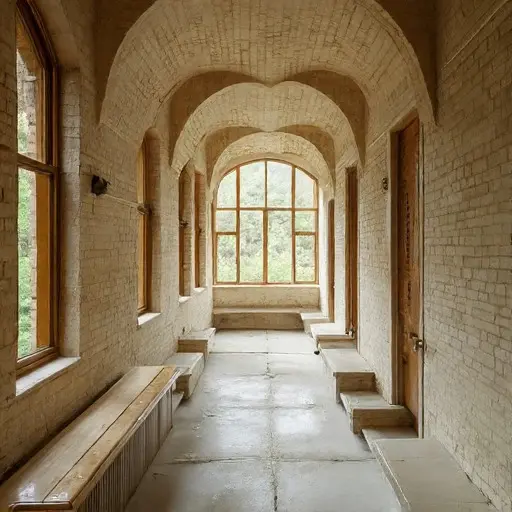
As the house entered its final decades of occupation, its decline was gradual and subdued. The quarry setting remained stable, and the structure itself showed little physical failure. Instead, abandonment unfolded through reduced presence—fewer occupants, fewer seasonal returns, and eventually long intervals of silence between visits.
Maintenance slowed but did not immediately cease, and the house retained its structural clarity even as human activity faded. The quarry amphitheater below continued to evolve naturally, its grass thickening and stone edges softening under constant environmental shaping.
Final stillness within the quarry bowl
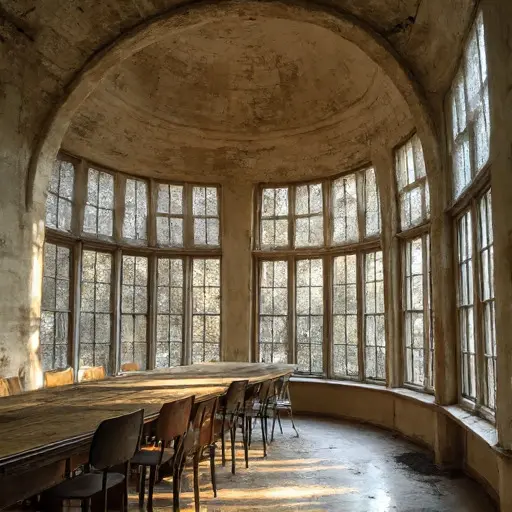
No restoration or return followed the final departure of its inhabitants. The Quarry Hollow House remains within its circular amphitheater of stone and grass, intact and quietly weathered, continuing to echo the curvature of the land without interruption, change, or human presence.