The Brick Courtyard House Left in Quiet Urban Stillness
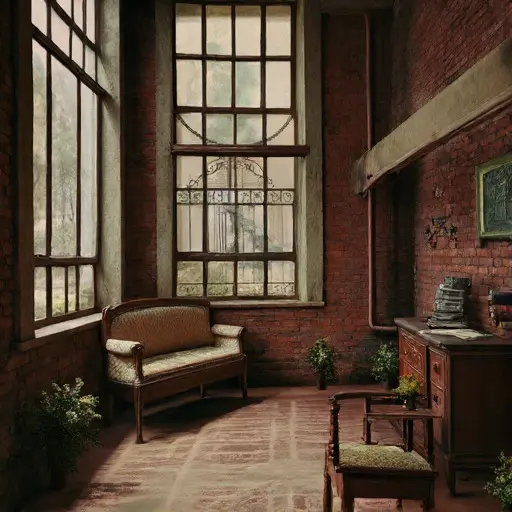
The Courtyard House stood tucked into a dense urban courtyard formed by surrounding brick buildings, where narrow passages opened suddenly into a hidden internal space within the city’s layered architecture. Built in 1890 for the Mercer family, the residence was compact and vertically focused, its deep red brick exterior darkened by age, soot, and time. Subtle bands of pale stone interrupted the façade, introducing horizontal structure that balanced the building’s strong vertical emphasis.
The structure possessed a carefully engineered but slightly unconventional proportion. The ground floor was narrower than the upper levels, causing the building to appear as though it gently expanded as it rose. This created a soft inverted visual effect—light at the base and more substantial above—giving the house a quiet architectural tension that remained stable rather than unstable.
Windows followed a strict vertical alignment but varied slightly in height from one level to another. This subtle irregularity introduced a human quality to the façade, preventing it from feeling overly mechanical or rigid. The glass panes were intact but softened with age, diffusing courtyard light into muted gradients rather than sharp reflections.
A narrow wrought-iron stairway clung to the exterior façade, not as a utilitarian escape but as a deliberate architectural feature. It wrapped halfway around the building before ending at a small enclosed landing fitted with frosted glass panels. The ironwork formed simple repeating circular motifs, now darkened and matte with age, standing out gently against the red brick surface.
Inside, the Mercer household maintained a structured urban domestic life. Harold Mercer worked in municipal records administration, while his wife Edith managed household correspondence and social obligations. The house functioned as both residence and quiet administrative node within the surrounding city blocks, its rooms arranged for efficiency, order, and steady routine.
Early financial strain
By the late 1920s, municipal restructuring and administrative consolidation reduced the stability of Harold Mercer’s position. While the household remained functional, financial resources for upkeep gradually diminished. Maintenance of exterior detailing slowed, and minor repairs to ironwork and masonry were deferred, allowing subtle weathering to accumulate across surfaces without structural compromise.
Gradual decline within the courtyard residence
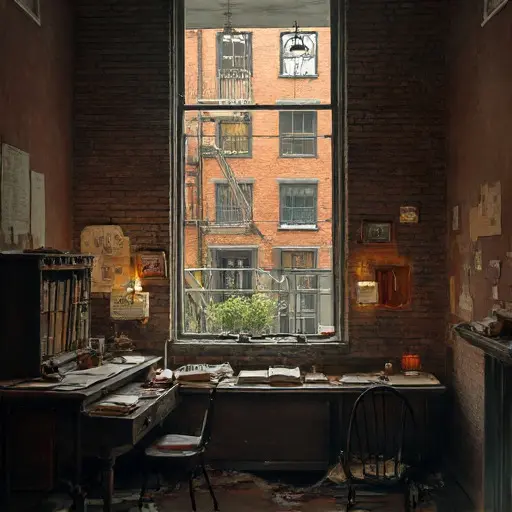
As financial pressure increased, the rhythm of life within the house began to slow. Certain rooms were closed seasonally to reduce heating and maintenance costs, and minor repairs were delayed or reduced in scope. The building remained structurally stable, but its lived cadence softened as fewer daily activities took place within its interior.
Over time, family presence diminished as younger members moved to other districts for employment and education. The house transitioned into intermittent occupancy, used primarily for administrative storage and occasional seasonal returns. By the early 1940s, it was no longer continuously inhabited.
Final abandonment phase
By 1947, the Courtyard House was no longer permanently occupied. Utility services were gradually discontinued after extended non-use, though no structural instability occurred. The red brick and pale stone bands remained intact, preserved by the sheltered conditions of the surrounding courtyard architecture.
The house left within the enclosed city space
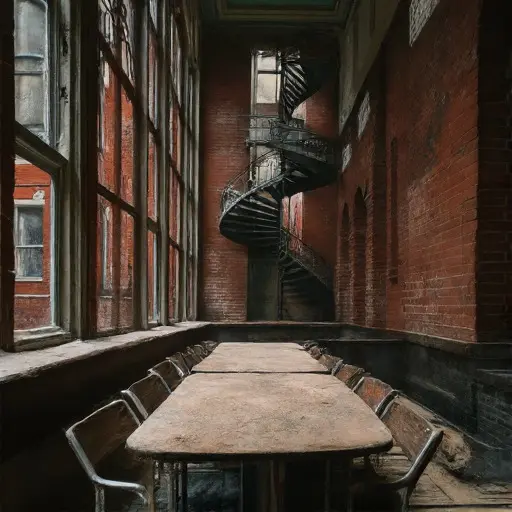
By the late 1940s, no formal ownership disputes or restoration efforts altered the Courtyard House. Legal responsibility remained inactive, and no occupants returned. The house remains within its enclosed urban pocket, quietly weathering under soft daylight filtered through surrounding buildings, preserving the memory of structured domestic life without interruption or return.