The Terraced Silence of the Basalt Canyon House
An abandoned Victorian family house stands within a narrow basalt canyon where pale green moss and shadowed stone walls form a naturally enclosed architectural stage. The structure is conceived as a “terraced façade” composition, where the exterior does not project outward but instead recedes in controlled steps, as if the entire building is slowly withdrawing into itself. Each layer pulls back from the one below it, producing a measured descent of form that mirrors the canyon’s own vertical pressure.
The façade is constructed from alternating horizontal bands of smooth limestone and enameled cast iron panels. The limestone carries a cool, desaturated ivory tone with faint mineral veining that reads like sediment frozen into architectural order.
Between these bands, cast iron surfaces appear in deep ink-black and forest green, now dulled by time into a soft matte finish that absorbs canyon light rather than reflecting it. With each ascending tier, the structure becomes slightly narrower, reinforcing the sensation of depth as a deliberate architectural strategy rather than a structural necessity.
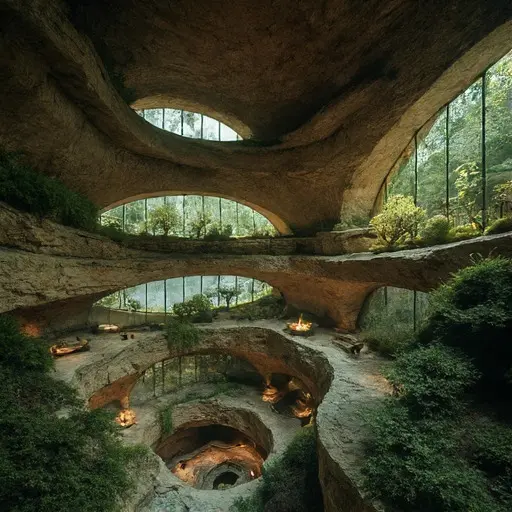
Windows are not individual openings but continuous horizontal bands embedded deeply within each terrace level. The glazing is lightly smoked, flattening contrast and blending exterior canyon walls, moss, and sky into slow-moving gradients of gray-green and stone-blue. Thin stone fins interrupt these bands at irregular intervals, creating subtle rhythmic breaks that prevent visual monotony while preserving the strict horizontal logic of the design.
The roof continues this stepped logic as a flattened sequence of offset stone and metal plates. Each plate aligns with a terrace below, creating a layered crown that feels more geological than constructed. Water is quietly managed through concealed channels between these levels, disappearing into narrow slots cut along the limestone edges, as if the building is internally eroding in a controlled and reversible way.
At ground level, the structure meets the canyon floor through parallel retaining terraces that extend outward in thin, subdued lines. These are partially buried by moss, gravel, and wind-deposited sediment, causing the architectural base to blur into the canyon geology. The transition is gradual enough that it becomes unclear where engineered structure ends and natural stone begins.
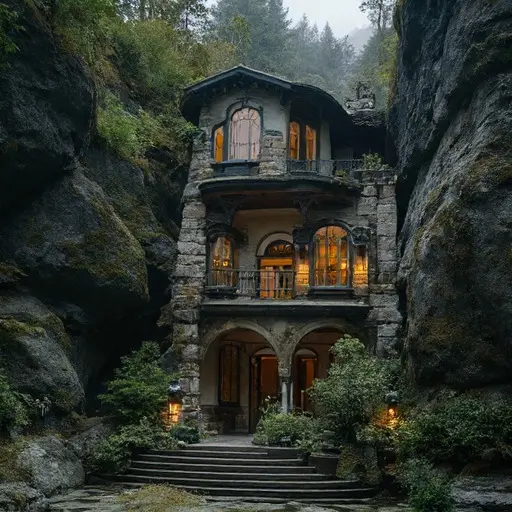
The canyon itself is tightly enclosing, with basalt walls rising on both sides in near-parallel vertical planes. Pale moss spreads unevenly across the stone, softening the harshness of the rock with organic irregularity. Light filters in from above in a thin, controlled strip, washing the terraces in a uniform coolness that emphasizes material stratification over volume or silhouette.
The atmosphere is still, compressed, and quietly layered, with every surface participating in a slow dialogue between recession and enclosure. The result is a grounded Victorian canyon house that feels carved backward into space—an architecture of withdrawal, depth, and horizontal stratification fully embedded within geological walls without repeating prior spatial or material systems.