The Spiral Orchard House
An abandoned Victorian family house stands within a dense orchard of dark-leaf fruit trees, designed in an unusual “spiral progression” layout where the structure wraps continuously around a central vertical core instead of presenting conventional façades. The building rises in a slow, controlled rotation, each level subtly offset from the one below, producing the impression of a grounded architectural helix embedded directly into the orchard floor. Rather than reading as stacked floors, the house behaves like a continuous movement made solid—an ascent you can trace visually as it coils upward through space.
The exterior is composed of finely laid terracotta brickwork in deep auburn tones, interrupted by vertical bands of glazed ceramic tiles in muted teal and pale bone white. These bands do not simply decorate the surface; they align precisely with the spiral geometry, reinforcing the sensation of upward motion through disciplined material continuity.
The glaze has softened with age, losing its initial brightness but retaining a subdued reflective quality that catches orchard light in quiet, shifting flashes—like fruit skin briefly turning toward the sun.
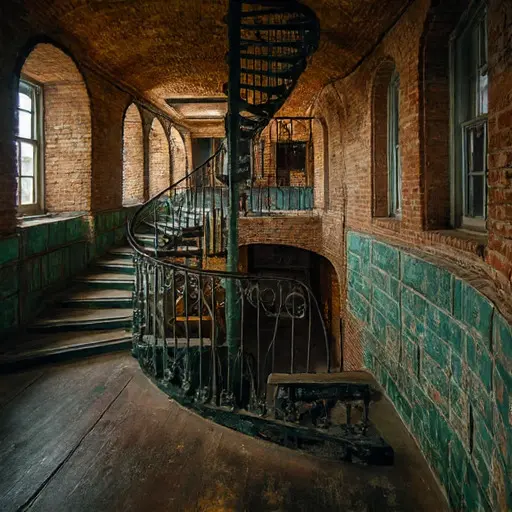
Windows follow the same rotational logic. Each opening is slightly rotated from the one beneath it, forming a continuous ascending ribbon of glazing that winds around the structure. Slender cast iron frames in dark graphite emphasize their linear precision, while the faint green tint of the glass bends and stretches reflections of surrounding foliage into elongated, layered distortions. From a distance, the window pattern reads less like discrete openings and more like a single continuous cut spiraling through the building’s skin.
The roof resolves into a compact circular crown composed of overlapping slate segments arranged in tight concentric rings. These rings subtly compress toward the center, guiding the eye upward to a small ventilated cupola with narrow louvered slits. The cupola acts as a quiet breathing point for the structure, releasing air through the spiral core. Chimneys emerge intermittently along the upper rotation, following the building’s helical logic rather than aligning vertically, as if orbiting the central axis.
The interior experience is defined by continuous curvature. Corridors never fully straighten; instead, they bend gently as they follow the spiral progression, creating a sense of slow ascent even on level ground. Rooms open like widened segments of the coil, their proportions subtly changing depending on their position in the rotation, with higher levels becoming lighter, narrower, and more acoustically open.
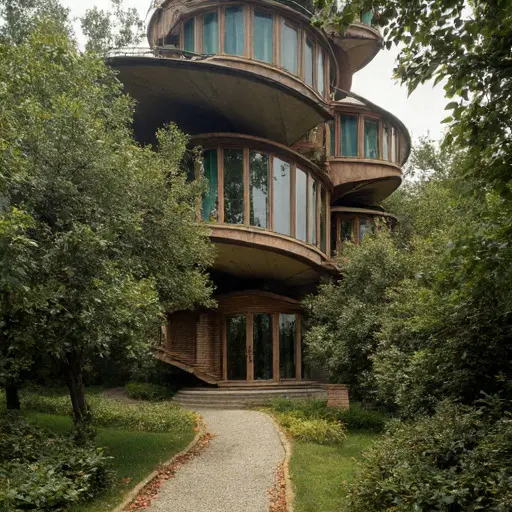
At ground level, the house meets a narrow gravel ring path that encircles its base before dissolving into the orchard soil. The transition between architecture and landscape is understated but deliberate: stone, gravel, and root systems blur into one another, allowing the spiral geometry to feel anchored rather than imposed. Fallen fruit collects along the edges of the path, echoing the circular rhythm of the building above.
The surrounding orchard is dense and quietly productive, with heavy branches of dark-leaf trees forming a textured canopy that filters sunlight into broken green-gold fragments. Air moves gently through the foliage, and the house responds visually through shifting reflections along its spiral glazing, reinforcing the sense of a structure in constant but frozen motion.
The atmosphere is calm, ordered, and softly luminous, emphasizing rotation, vertical continuity, and material rhythm. The result is a grounded Victorian orchard house that feels helically grown rather than constructed—an architectural ascent woven seamlessly into the natural cycles of orchard light, growth, and seasonal stillness without repeating prior spatial or compositional frameworks.