The Interlocked Meadow House
An abandoned Victorian family house stands alone in a wide open grassland plain, designed in an unusual “interlocking façade” composition where the exterior reads as two overlapping architectural skins sliding past one another. Instead of a single resolved envelope, the house appears caught in a state of structural overlap—two Victorian geometries slightly offset, each revealing and concealing the other in a controlled visual tension that changes as the wind moves across the plain.
The first layer is a pale limestone structure, carved in soft ivory, chalk beige, and faint silvery gray. It forms the more grounded architectural body: arched openings, thick corner masses, and deeply recessed window bays that give the impression of permanence and weight. The second layer is a darker, more expressive skin of glazed brick and timber framing, rendered in deep bottle green, muted crimson, and weathered indigo.
This outer layer does not fully align with the stone beneath it, instead sliding across it like a shifted memory of the same building—offset doorways, misaligned windows, and overlapping roof edges creating a subtle double-vision effect.
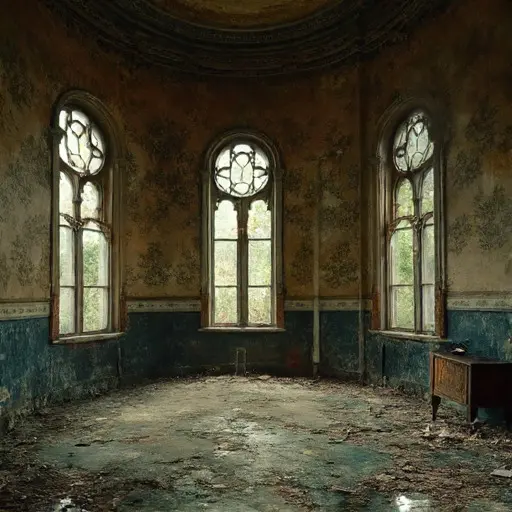
The architecture is organized as a central hall embedded within the limestone core, flanked by rooms that alternate between alignment and misalignment depending on which façade layer they belong to. In places, the two skins separate enough to form narrow transitional voids—thin corridors where light filters between stone and brick, producing a glowing seam of daylight that runs through the building like a structural fault line.
The roof continues this dual logic. One layer is a steep slate gable system in deep graphite, tied to the limestone core, while the second is a slightly rotated overlay of lower-pitched timber roof forms clad in dark stained shingles and oxidized copper strips. Where they intersect, the rooflines create broken ridges and doubled eaves, as if the house has been built twice at slightly different moments in time.
Windows emphasize the interlocking effect. Stone-aligned windows are tall, arched, and deeply set, framed in pale stone reveals, while the overlaid brick-and-timber skin introduces rectangular sash windows in dark painted frames of forest green and wine red. At certain points, both systems coincide, creating rare moments where arched and rectangular geometries briefly align before slipping apart again.
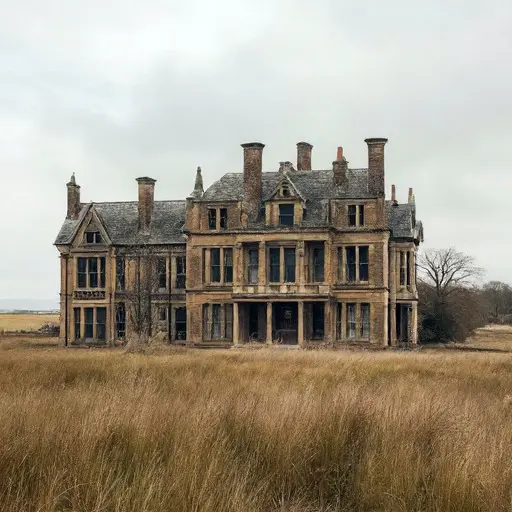
The entrance sits at the point of maximum overlap, where both façades briefly converge into a shared threshold. Here, a limestone arch is partially cut by a darker timber-framed porch that appears inserted after the fact, as if the house has been repeatedly re-entered through different architectural intentions. The door itself is heavy oak, reinforced with iron bands softened by rust, its surface marked by faint misalignment where the two structural systems meet.
Inside, the spatial experience is defined by shifting alignment rather than static rooms. Corridors subtly bend where façades drift apart, and walls occasionally reveal thin seams of exterior light where the two skins fail to meet perfectly. The effect is not instability, but layered continuity—an architecture that feels edited rather than constructed.
The surrounding grassland is vast and uninterrupted, with tall wild grasses bending in continuous waves across the plain. Wind passes freely through the structure, slipping between façade layers and producing faint tonal variations in light and shadow across the overlapping surfaces. From a distance, the house appears to shimmer between two architectural states, never fully settling into one.
The atmosphere is open, wind-swept, and quietly disjointed, emphasizing duplication, offset geometry, and material layering. The result is a grounded Victorian grassland house that feels doubled, interwoven, and subtly misregistered within its own architectural identity without repeating prior spatial or compositional systems.