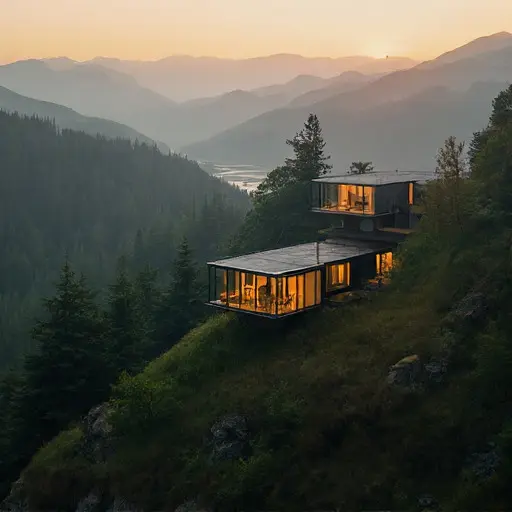
The Ridge of Separated Rooms
An abandoned Victorian family house stands on a quiet ridge overlooking a dense forest valley, designed in an unusual “fragmented pavilion” composition where the building reads as a constellation of slightly displaced yet carefully aligned structures. Rather than forming a single mass, the residence is split into three distinct pavilions, each given enough spatial independence to feel like its own building, yet positioned with precise visual continuity so the eye naturally reconstructs them as one architectural idea stretched across the ridge.
The first pavilion is faced in deep burgundy glazed brick, its surface subtly uneven where time and weather have dulled the original sheen into a darker, wine-stained gloss. The second volume is finished in pale jade-green stucco, smooth and softly reflective, catching forest light in a muted haze that shifts with passing cloud cover. The third is constructed in creamy limestone, finely tooled with horizontal scoring that emphasizes sediment-like layering, as though the building were partially carved from the ridge itself.
Together, these contrasting materials form a controlled fragmentation—each pavilion distinct, yet bound by Victorian proportions and restrained ornament.
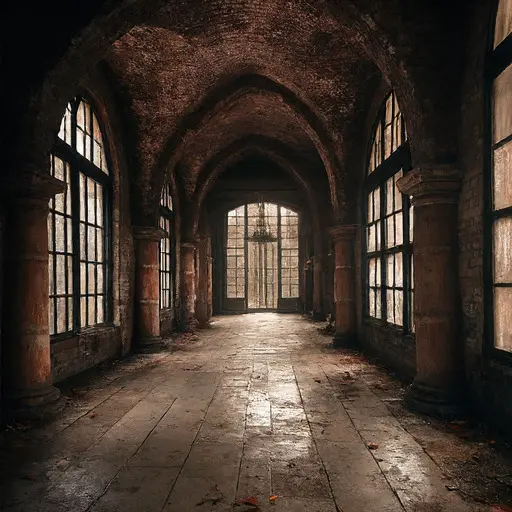
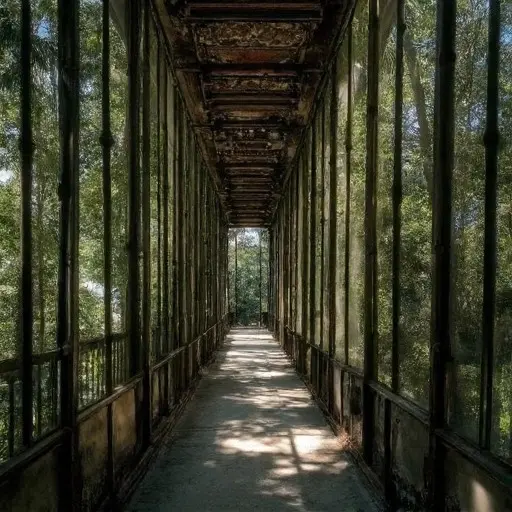
The connecting corridors act as deliberate voids between these solid forms. Elevated on slender iron frames painted matte charcoal, they contain tall glass panels that have aged into slight waviness, distorting the view like water held in suspension. Through them, the forest is constantly reframed—branches split into vertical streaks, sky fractures into pale bands, and the separation between pavilions becomes a visible architectural condition rather than a hidden structural necessity.
Rooflines shift from one volume to the next with careful intention. The burgundy brick pavilion carries a steep slate gable in deep graphite, its edges sharp against the sky. The jade stucco volume is topped with a low hipped roof sheathed in oxidized copper green, softened by patina and moss staining. The limestone pavilion ends in a flatter roofline edged with delicate iron cresting, once gilded but now reduced to a muted, tarnished gold trace. Seen together, the roofscape forms a broken skyline that mirrors the fragmentation of the ground plan below.
Window design reinforces this segmented logic. Each pavilion has its own rhythmic language: tall vertical sash windows in navy frames on the burgundy volume, softer green-framed openings on the jade stucco section, and evenly spaced limestone-cut apertures on the pale stone pavilion. Some windows project outward as shallow bays, catching wind and light differently depending on orientation, reinforcing the sense that each structure responds independently to its part of the ridge while still participating in a shared architectural grammar.
The ridge itself remains open and windswept, a thin plane of grass and scattered shrubs that allows the house to sit lightly against the sky. Between the pavilions, these gaps become as important as the structures—framing long views into the forest valley below, where trees form a dense, dark green descent that contrasts with the bright separation of the architecture above.