Basalt Plinth House of the Peat Moor Isle
Abandoned Victorian woodland house located within a vast peat moorland forest where stunted pines and contorted birch rise from saturated ground and black water pools collect between mossy hummocks, the structure designed as a compact yet richly articulated Victorian residence elevated on a massive basalt plinth that lifts it above the wetland like a deliberate architectural island suspended over decay and water.
The exterior is composed of strongly stratified materials that emphasize vertical separation from the unstable ground: a foundation of near-black basalt blocks with faint blue-green mineral sheen, a middle layer of lime-rendered masonry, and an upper structure of timber framing filled with patterned infill panels. The basalt base reads as dense and geological, shifting between charcoal black, deep slate gray, and subtle iron-blue highlights where moisture clings to the stone. Above it, the lime render softens into chalk white, warm ivory, and faint pistachio undertones, constantly modulated by peat humidity and overcast light. The timber framing introduces a more expressive Victorian register, painted in layered, weathered tones of deep vermilion, desaturated teal, and muted ochre, arranged in alternating geometric panel compositions that suggest incremental additions over time.
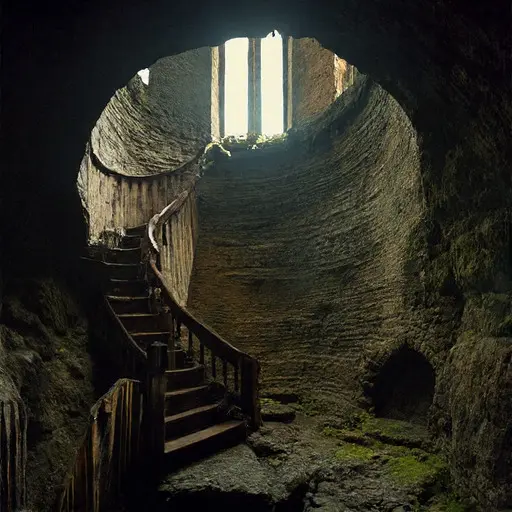
The building rises as a compact but visually complex massing: a central square core anchors the structure, flanked by two asymmetrical pavilion wings that step upward in staggered vertical offsets. One corner is marked by a narrow octagonal stair tower that rises above the rest of the house, capped with a steep slate roof that tapers into a thin, weathered finial. The overall silhouette feels adaptive and slightly uneven, as though the structure has slowly adjusted itself to shifting peat and settlement over decades.
The roofscape is tightly articulated, composed of intersecting steep gables, compressed ridge lines, and small dormer projections that break the mass into layered tiers. Slate tiles vary between deep graphite, storm-washed blue-gray, and patches of muted moss-green bloom. Copper ridge elements trace the geometry in broken lines, now oxidized into irregular turquoise streaks and warm bronze patches that subtly catch the low moorlight.
The façade is organized through controlled asymmetry: tall mullioned windows dominate the central block, while narrower grouped openings and elongated vertical slits punctuate the wings and stair tower. Window frames alternate between soft bone white, faded sapphire, and subdued burnt orange, creating a restrained but persistent rhythm across the elevation. Deep recesses in the lime render produce shadowed pockets that emphasize the thickness of the walls and the building’s elevated detachment from the wet ground.
The main entrance is raised on the basalt plinth and approached via a short stone stair cutting through reeds and damp grass. The doorway sits within a recessed lime-rendered arch, its proportions slightly compressed by the elevated foundation. The heavy timber door is finished in deep matte forest green, its surface worn smooth by wind, moisture, and time, with edges subtly silvered from prolonged exposure.
On the moor-facing side, a narrow enclosed veranda runs along part of the upper level, supported by iron brackets anchored deep into stone. Its glass panels reflect the peatland in fractured layers of dark water, muted vegetation, and pale sky, creating a constantly shifting horizontal collage driven by wind and surface movement.
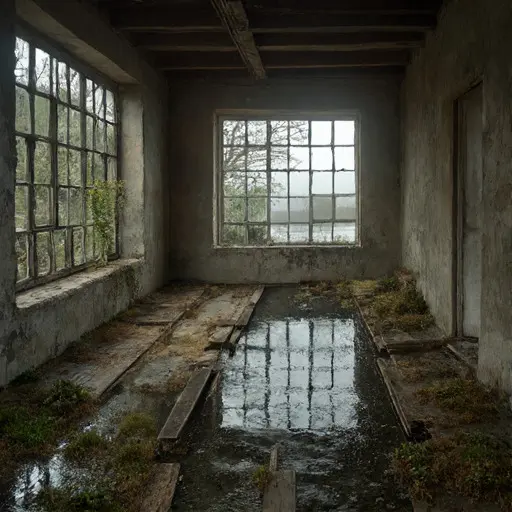
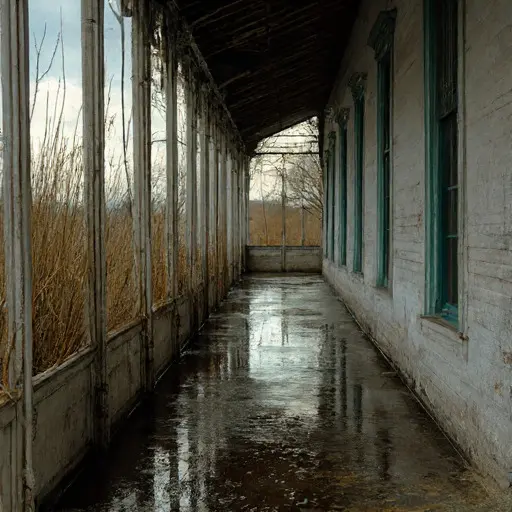
The surrounding peat moorland stretches outward in low, saturated expanses where water pools mirror the sky in broken, irregular patches. Sparse trees bend slightly in the wind, their roots embedded in unstable ground that shifts subtly with seasonal moisture.
The atmosphere is quiet, heavy, and diffusely luminous, with soft gray light flattening contrast and emphasizing texture, stratification, and elevation above the wetland surface. The result is a grounded Victorian woodland peat moor house that feels suspended, materially layered, and ecologically responsive without repeating prior architectural systems, spatial logics, or chromatic frameworks.