A house built where the earth remembers being cut
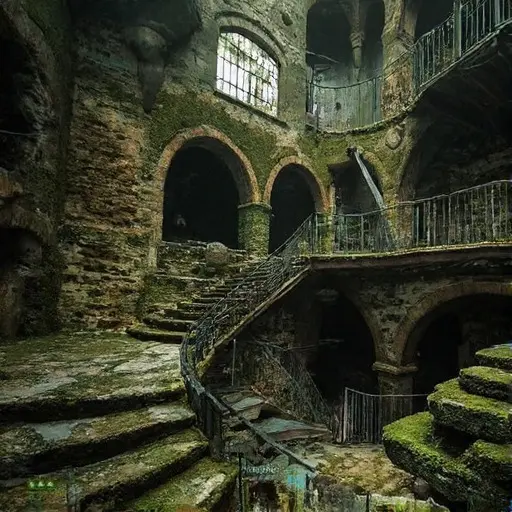
Inside one of the mid-terrace galleries, the room feels anchored directly into the quarry wall, as though it was never placed but uncovered. The stone retains visible chisel marks, aligned with the horizontal strata of the excavation, creating a subtle rhythm that guides the eye along the room’s length. Tall arched windows open toward the central reflective pool below, where light fractures into broken bands of gray-blue and muted green.
Iron balconies extend just beyond the openings, their oxidized latticework softened by moss and time, blurring the boundary between interior corridor and open quarry air.
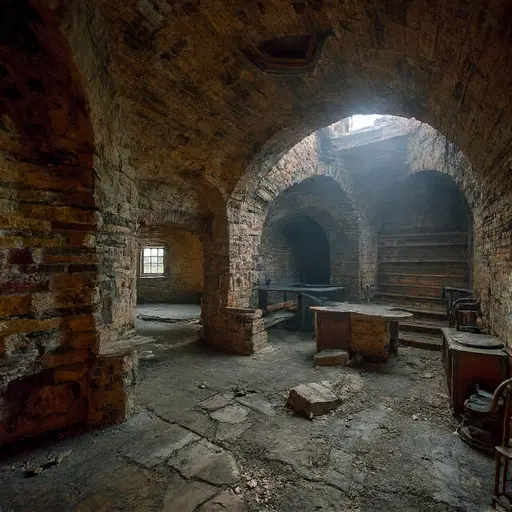
A more enclosed chamber sits deeper within the terraced structure, where brick infill and quarry stone interlock in softened layers of rust red, clay brown, and limestone gold. Cast-iron supports rise through the room like structural ribs, their surfaces darkened to near-black with faint bronze highlights. Furnishings are sparse but heavy, positioned as if resisting the humidity that seeps in from the quarry walls. Through offset openings, staggered terraces are visible at different heights, reinforcing the sense that the entire house is a vertical sequence carved into a descending geological staircase.
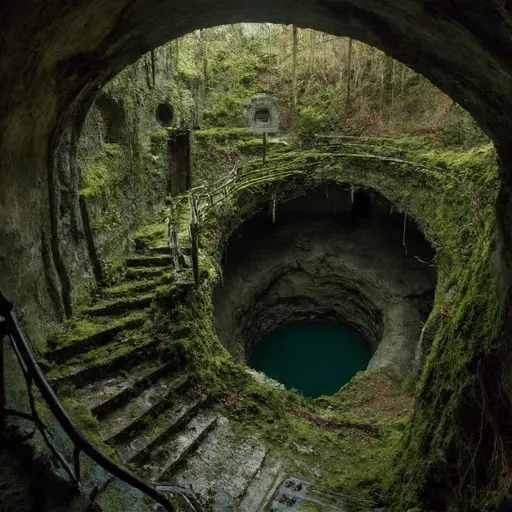
A narrow stairwell connects two terrace levels, descending along the quarry’s natural steps. Each stone tread is uneven but deliberate, following the original cut of the excavation rather than a standardized architectural plan. Iron bridges span gaps between ledges, their dark frames suspended over open vertical space where quarry drops fall into shadow. Below, the central pool reflects fragments of the house in distorted layers of stone, iron, and water. Light filters down from the quarry rim above, breaking into soft shafts that fade as they reach the lower terraces, giving the entire descent a suspended, echoing stillness.