The ring that learned to live inside stone
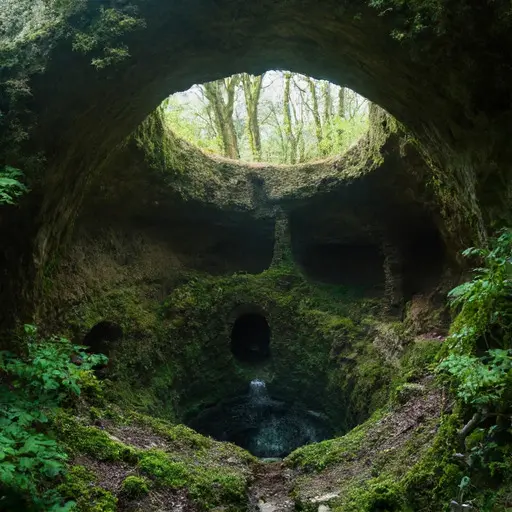
Inside one of the deeper embedded chambers, the room feels less constructed than revealed. Limestone walls rise in layered bands that still carry the memory of sediment pressure, their fossil-beige and pale gray tones uninterrupted except where carved apertures break into the sinkhole basin. The floor is uneven, following the geology beneath rather than any imposed geometry, and moisture lingers in the air as a constant, faint coolness.
Through the arched opening, the circular forest below appears in compressed perspective—trees rising like vertical brushstrokes against the curved stone wall.
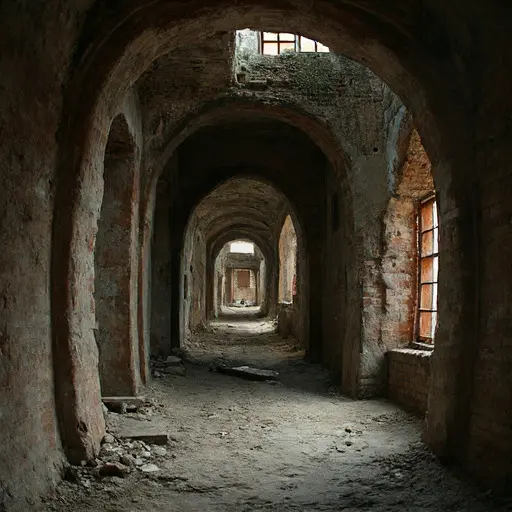
A narrow connecting passage links two chambers along the sinkhole’s inner circumference, functioning as both corridor and threshold between geological volumes. Here, limestone and brick interleave in uneven strata, the brick softened into burnt sienna and soot-brown shadows between pale stone bands. Slit windows are carved deep into the wall, their oxidized bronze frames almost merging with the rock itself. Light enters only in thin slices from above the basin, falling in vertical gradients that emphasize the curvature of the sinkhole rather than the corridor’s direction.
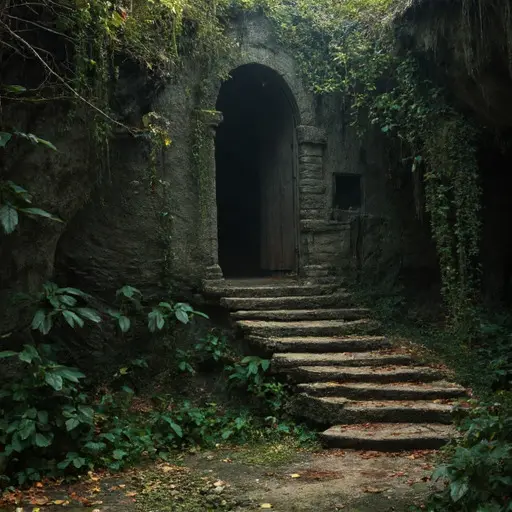
At the main entrance descent, the architecture begins as a transition rather than a threshold. A carved stone staircase winds downward from the forest floor into the sinkhole, its steps worn unevenly by time and moisture. The entrance door sits deeply recessed into the rock face, almost swallowed by limestone, its dark green-black wood reinforced with iron straps dulled into rusted bronze. Above and around it, vegetation spills over the rim—roots, moss, and trailing plants that blur the distinction between built entry and natural collapse. Mist drifts slowly downward from the opening above, softening every edge before it reaches the basin floor.