The Brackenfall House Left Vacant After Gorge Terrace Collapse
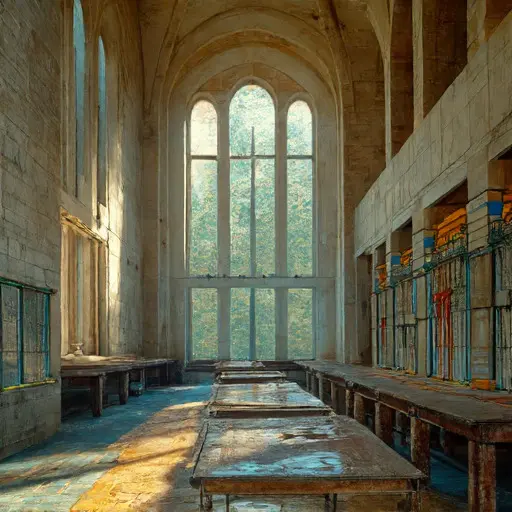
Brackenfall House was completed in 1904 within a wide terraced river gorge where centuries of water erosion had carved stepped stone levels into the cliff face. Designed by the Aldenwick family as both residence and geological observation post, the structure was built as a vertically stacked Victorian residence anchored directly into the gorge wall. Rather than occupying a single plane, the house rose in three distinct architectural layers, each offset to follow the natural terraces of the river-carved landscape.
The exterior combined pale limestone, dark basalt brick, and enamel-glazed panels arranged in a precise stratified system. Limestone formed the structural spine in warm ivory, soft sand, and pearl gray tones, while basalt introduced grounding horizontal bands of charcoal, ink blue, and smoky black. Between these, glazed panels in peacock green, luminous cobalt, and muted copper-red created measured highlights that caught and reflected the shifting light from the river below.
The building’s vertical organization defined its internal life. The lowest tier sat closest to the river, partially carved into the gorge wall and containing arched stone arcades designed to withstand seasonal flooding. Above this, the mid-tier served as the primary residential level, projecting outward with angular bay rooms, enclosed balconies, and the main entrance accessed by a carved stone stair rising from the middle terrace. The upper tier formed a compact crown structure with tall windows and a sculptural roofline that completed the vertical hierarchy.
Inside, the Aldenwick family lived according to the gorge’s layered environment. Dr. Samuel Aldenwick studied river sediment movement and terrace formation, while his wife Margaret managed household administration and scientific correspondence. Movement through the house followed vertical transitions rather than horizontal corridors, reinforcing the sense of living within a geological structure rather than above it.
Early financial strain
By the late 1920s, funding for private geological and hydrological research diminished as government institutions centralized river management systems. The Aldenwick family’s observational role became less relevant, and external support declined steadily. Maintenance of the vertically complex structure became increasingly difficult, particularly in the lower arcades exposed to seasonal flooding and constant moisture from the river below. Copper ridgelines along the roof began oxidizing into turquoise and bronze patina, while limestone surfaces darkened unevenly with water staining.
Gradual decline in the household
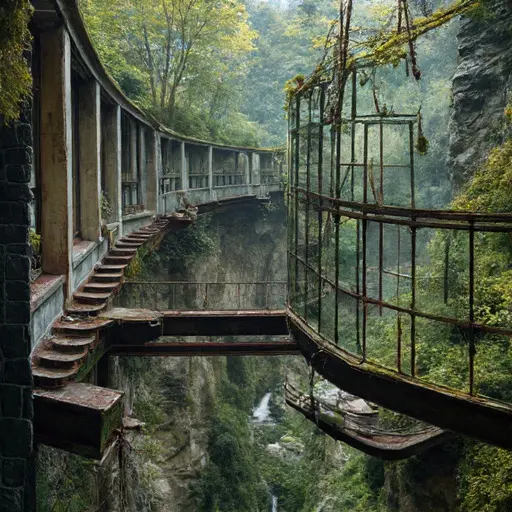
As financial strain increased, the lowest flood-level arcades were gradually abandoned due to persistent water damage and structural vulnerability. River moisture began infiltrating deeper sections of the building, and maintenance efforts shifted upward toward the mid-tier residential spaces. Entire rooms were closed off, and circulation within the house became increasingly restricted to fewer, more stable areas.
Family members gradually departed for academic and governmental positions in urban centers, where hydrological research had become institutionalized. By the early 1940s, only partial occupancy remained, primarily for archival storage and occasional monitoring visits.
Final abandonment phase
By 1946, Brackenfall House was no longer fully inhabited. Utility services were reduced and eventually discontinued due to sustained arrears and logistical difficulty accessing the gorge. Without maintenance, river spray and rising mist accelerated deterioration across all three tiers. Lower arcades were nearly submerged during seasonal surges, while upper windows became clouded and structurally weakened.
The house left empty
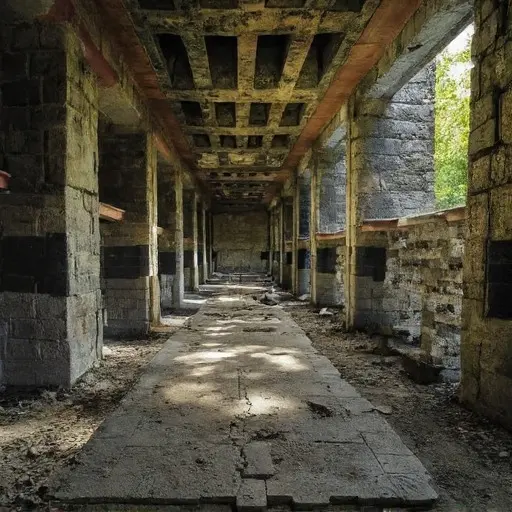
By the late 1940s, no formal ownership or maintenance of Brackenfall House remained. Legal responsibility for the estate dissolved among distant heirs who never returned to the gorge. No restoration was undertaken, and no institutional transfer occurred. The house remained embedded across the terraced cliff face, slowly deteriorating under river spray, mist, and geological erosion, its three-tiered structure gradually merging back into the vertical rhythm of the gorge.