The Ashcombe House Left Vacant After Woodland Enclosure Decline
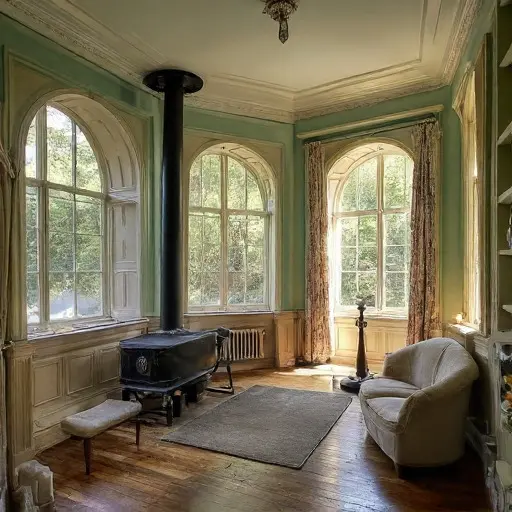
The Ashcombe House was completed in 1904 for the Larrington family, who managed forestry oversight and small-scale land stewardship within a vast woodland estate. The structure was deliberately placed at the center of a circular clearing formed by ancient fallen trees, whose decayed trunks had long since merged into a living ring of meadow grasses and flowering plants. Rather than imposing upon the forest, the house was designed to sit within it, its compact cruciform-like footprint formed by four short projecting corner bays extending from a strong central block.
Built from smooth stucco over masonry, the residence was finished in a rare but intentional Victorian palette: chalk white walls broken by pale aquamarine, muted lilac, and soft marigold panels that aligned with architectural transitions rather than decorative randomness. Over time, weathering softened these pigments into blended gradients, as rain and wind slowly erased sharp separations and replaced them with painterly transitions. The roof, a shallow intersecting hip-and-gable structure, carried slate tiles in shifting tones of gray-blue and charcoal, with occasional copper staining near repaired seams, while iron cresting along the ridge darkened into near-black with rusted joints.
Inside, life followed a structured yet quiet rhythm. Edward Larrington oversaw woodland boundaries, timber health, and land mapping, while his wife Clara maintained correspondence, household organization, and estate records. The house functioned as both residence and administrative point for forest management, its rooms filled with botanical notes, survey maps, and seasonal logging plans. In its early decades, Ashcombe House reflected stability shaped by careful ecological oversight and predictable forest cycles.
Early financial strain
By the late 1920s, forestry administration began to centralize under regional authorities, reducing the role of private estate oversight. The Larrington family’s responsibilities diminished, and income tied to woodland management contracts declined steadily. Maintenance across the house became increasingly irregular, and repainting of exterior panels was postponed indefinitely. Moisture from the surrounding clearing began to affect interior surfaces, softening plaster edges and dulling the once-vivid color segmentation.
Gradual decline in the household
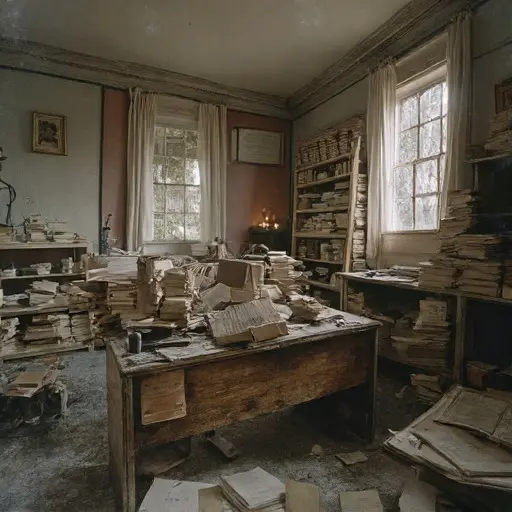
As financial strain increased, portions of the house were gradually closed off. Entire corner bays fell into disuse, their angled windows left uncleaned and gradually clouded by condensation and pollen drifting in from the clearing. Woodland oversight contracts were reduced to occasional inspections, and eventually discontinued altogether. The surrounding forest began to reclaim the clearing edges, with grasses and flowering plants spreading further into stone pathways and foundation lines.
Family presence also diminished over time. Younger members relocated to urban administrative centers, and visits became increasingly rare until they ceased entirely. The mansion shifted from an active estate hub to a partially maintained structure sustained by fading routines and delayed decisions.
Final abandonment phase
By the early 1940s, Ashcombe House was no longer fully inhabited. Utility services were reduced and eventually disconnected following prolonged arrears. Without maintenance, the circular clearing around the house became more densely overgrown, with meadow grasses and wildflowers pressing closer to the stucco walls. The ancient tree ring beyond the clearing remained intact, enclosing the structure in a natural amphitheater of green.
Final deterioration
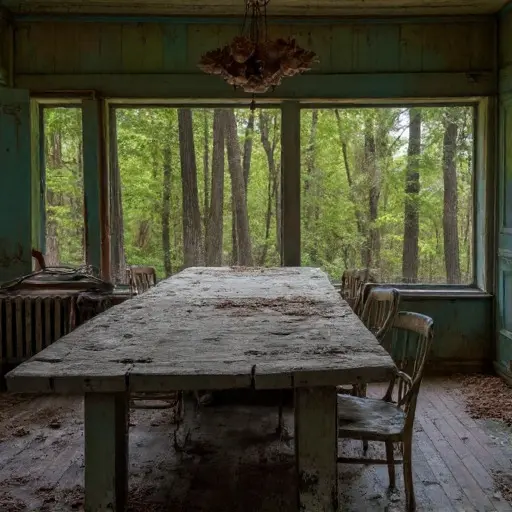
By the mid-1940s, no formal ownership or maintenance of Ashcombe House remained. Legal notices regarding the estate were repeatedly returned undelivered, and no heirs reestablished control of the property. The house persisted at the center of the woodland clearing in a state of quiet abandonment, slowly weathering as forest and meadow merged into its structure. No restoration or reoccupation followed, and the building remained an empty remnant of an estate fully absorbed back into the circular rhythm of the ancient trees.