echoes in the sandstone gorge
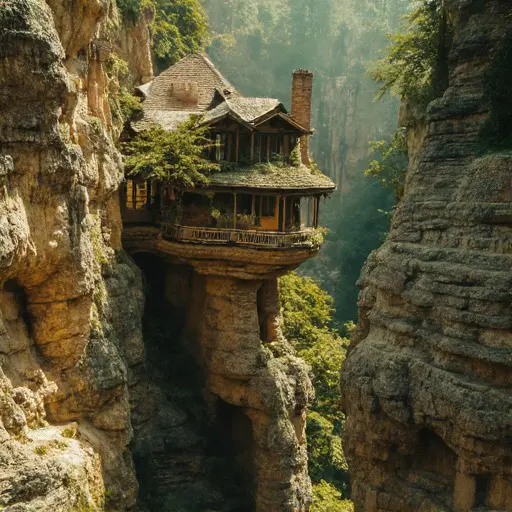
Abandoned Victorian woodland house set within a deep sandstone canyon where a narrow ribbon river cuts through layered rock walls and dense pockets of hanging vegetation, the structure built directly into the canyon face so that part of it is excavated into stone while the remaining volume projects outward above the rushing water below. The result is a highly integrated composition where architecture and geology feel continuous, as if the house emerged from the canyon rather than being placed within it.
The exterior is formed from a fusion of carved canyon stone and constructed masonry. The lower portions are almost indistinguishable from the natural cliff, shaped from warm sandstone tones of honey beige, dusty rose, and pale amber, all softened by erosion and mineral seepage. Above this embedded base, the built structure transitions into weathered brick and plaster surfaces tinted in subdued indigo, soft sage, and faded ochre.
Vertical mineral streaking runs across both natural and constructed surfaces, visually binding stone and architecture into a single stratified plane shaped by constant canyon moisture.
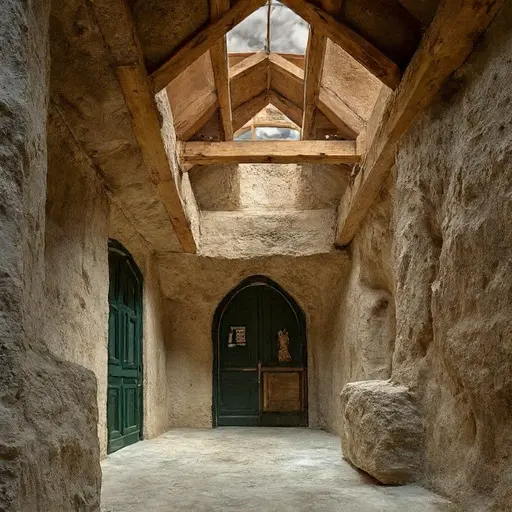
The roof is a split-level composition that follows the irregular geometry of the canyon edge. One side is anchored deeply into the rock, while the opposite side extends outward over the river gorge in a restrained cantilever. Slate tiles shift between dark basalt black, stormy blue-gray, and occasional oxidized copper flecks near aging metal joints. A narrow skylight ridge runs along the canyon-facing side of the roof, diffusing softened daylight into the interior and reinforcing the sense of depth within the embedded structure.
The façade is inherently asymmetrical due to the terrain. The cliff-facing side is composed of tall, narrow sash windows set deep into the stone, while the river-facing side opens with broader grouped windows that frame the gorge and moving water below. Window frames alternate in muted tones of chalk white, deep moss green, and desaturated terracotta, each one subtly faded by canyon wind, shadow, and mineral dust carried through the ravine.
The main entrance is carved directly into the sandstone portion of the structure, forming a recessed arched passage that feels both geological and architectural. The heavy wooden door sits deeply within this stone aperture, finished in dark forest green with iron fittings that have aged into a near-black patina, blending into the shadowed threshold of the canyon wall.
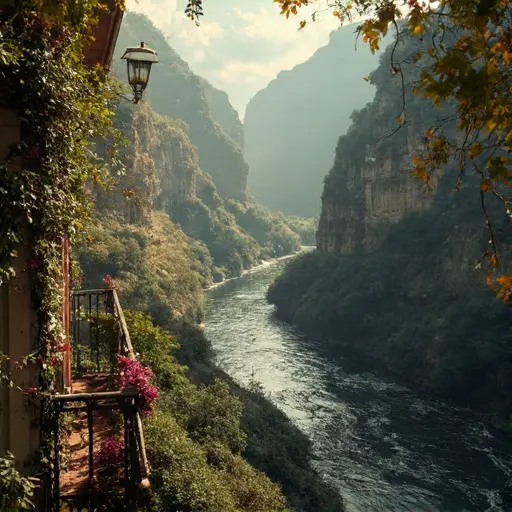
On the river-facing side, a cantilevered wooden balcony projects outward from the upper floor, supported by thick iron beams embedded into the canyon rock. Its weathered railings are simple and functional, softened in places by climbing vegetation that emerges from cracks in the stone and drapes along the edge, partially merging structure with canyon flora.
The surrounding environment is a vertical ecosystem of moss-covered ledges, hanging ferns, and small trees rooted in fractures of the canyon walls. Below, the narrow river moves quickly through the gorge, reflecting fragmented strips of sky, stone, and vegetation in shifting patterns of silver, green, and deep shadow. The atmosphere is cool, shaded, and acoustically resonant, with diffused light filtering from above and emphasizing vertical depth, geological layering, and the quiet persistence of the Victorian structure embedded within the canyon.