hollow pagodas of the terraced wetlands
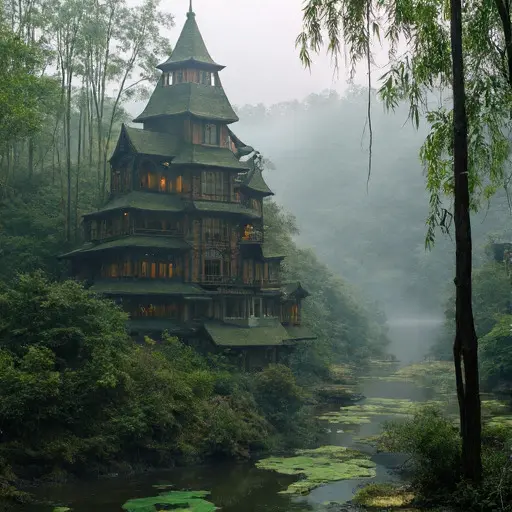
Abandoned Victorian woodland house situated within a dense bamboo-cedar transition forest on a gently rising hillside that overlooks a series of terraced spring-fed wetlands below, where shallow pools step down the landscape like natural mirrors catching fragments of sky and foliage. The structure is built as a compact but visually intricate residence with a central masonry core and multiple narrow vertical extensions that rise in staggered tiers, each one stepping slightly backward as it climbs, producing a layered silhouette that feels both architectural and almost botanical in its vertical rhythm.
The exterior is composed of finely cut pale sandstone at the base, its surface softened into warm ivory and faint honey-gray tones by constant humidity, transitioning into upper levels clad in vertically ribbed timber panels. These timber surfaces are painted in a restrained but vivid triadic palette of faded vermilion red, pale jade green, and soft sky blue. Over time, moisture and shade have caused the pigments to bleed subtly into one another, forming gradient transitions that blur the boundaries between architectural segments without erasing their structure.
Thin cream trim lines remain visible between panels, acting like faint graphic separators in a weathered composition.
The roof is a fragmented assembly of steep, intersecting gables and narrow intermediary roof strips, each section slightly offset from the next. Small slate tiles cover the entire system, shifting between ink-black, blue-gray, and moss-tinted green depending on exposure and age. Several thin roof spires rise from different tiers of the building, each capped with simple finials now darkened into oxidized bronze and softened copper tones, as if the entire roofscape has slowly aged into a unified mineral patina.
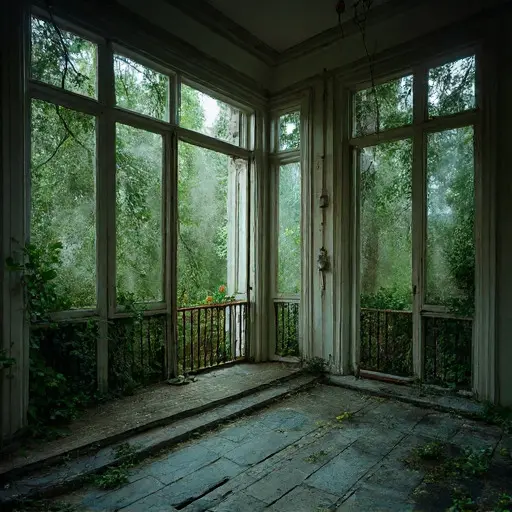
The façade emphasizes verticality through its window arrangement: tall, narrow sash windows are stacked in offset alignment across tiers rather than perfectly symmetrical grids. Each frame is painted in muted alternating tones of cream, pale gold, and subdued indigo, all softened by weathering. The glass reflects the wetlands below in fragmented, layered impressions of green water, silver light, and pale sky, giving the impression that the building is partially dissolving into its surroundings.
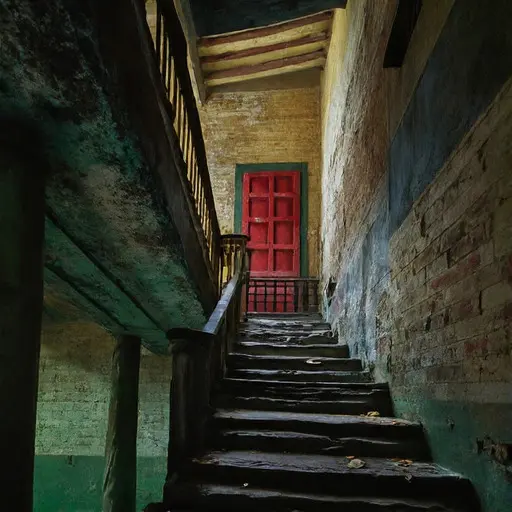
The entrance is embedded into the stone base on the hillside side, reached by a winding staircase carved into the slope itself. Moss-covered retaining walls flank the steps, dotted with small alpine flowers and damp ferns. The main door is a deep matte crimson wood panel with subtle carved geometry that has softened over time, making it feel like a saturated focal point emerging from a subdued natural palette.
On the valley-facing side, stacked balcony platforms project outward at different heights, supported by dark timber beams and thin iron braces that disappear into shadow beneath each level. The railings are delicate, painted in faded cream and pale turquoise, with sections overtaken by climbing vines and trailing ferns that hang like natural drapery between levels.
The surrounding environment is densely layered and humid, with bamboo groves interwoven with tall cedar trunks and mixed broadleaf forest. Below, the terraced wetlands form a stepped field of reflective pools, each one catching distorted reflections of the house and sky, broken by reeds and slow ripples from underground springs. Light filters through the canopy in soft shafts, flattening contrast while enriching color depth and vertical rhythm across both architecture and terrain.