The House Where Forest Meets Tide
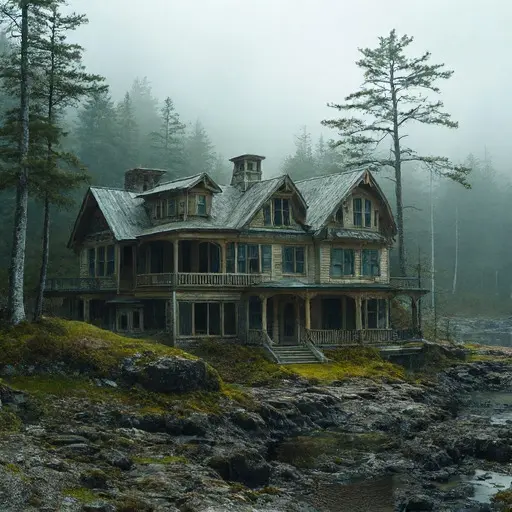
At the edge of a narrow coastal inlet, where freshwater forest runoff merges with the breath of the open sea, the house stands in a condition of quiet negotiation with the elements. It is neither fully inland nor fully maritime. Instead, it occupies the unstable boundary between forest and tide, shaped continuously by wind, salt, and shifting shoreline light.
The structure presents itself as a compact but carefully articulated Victorian residence. A central stone core anchors the composition, while two timber wings extend outward toward the water at slightly different angles. This subtle asymmetry feels intentional, as though each wing was adjusted over time to follow the slow drift of the coastline and the changing behavior of the inlet itself.
The base of the house is built from weathered gray limestone, its surface smoothed and dulled by decades of salt exposure. Above this grounded foundation, the upper levels transition into painted timber cladding, finished in a restrained maritime palette—faded sea-glass green, pale sand beige, and muted slate violet. These colors do not remain distinct for long; sea air and mist have softened their boundaries into gradual, watercolor-like transitions across the façade.
Iron detailing remains visible in small structural accents along corners, joints, and balcony edges. Once functional and precise, these elements have darkened into near-black forms, coated with a thin crust of oxidation that speaks to long exposure to coastal air. They act as subtle skeletal lines beneath the softened timber skin of the house.
The Salt-Worn Interior Threshold
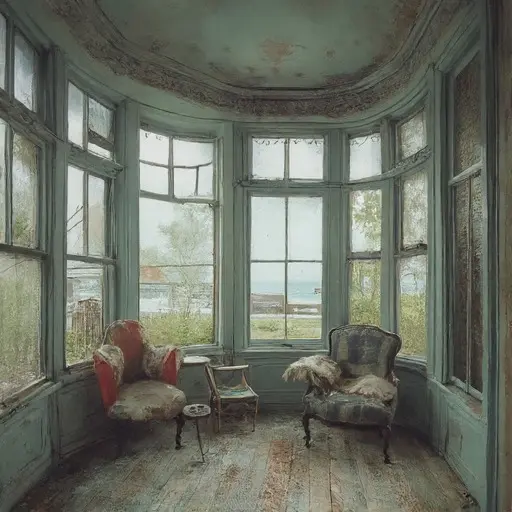
Inside, the atmosphere is shaped as much by the sea as by the structure itself. Tall sash windows in the central core open toward shifting water and tidal flats, where reflections break into fragments of silver, teal, and deep green. The interior palette mirrors the exterior weathering—fog white, faded aqua, and subdued coral gray tones softened further by damp coastal light.
Wooden floors have taken on a muted silvered finish, polished not by maintenance but by humidity, salt air, and time. Even in stillness, the house feels slightly in motion, as if responding to wind pressure and distant waves pressing against the inlet.
The Wind-Balanced Wings
The two timber wings define the character of the residence. One extends slightly lower and closer to the shoreline, while the other angles upward and back toward the forest edge. Together, they create a balanced tension between land and sea, forest and tide.
Their façades are organized with a calm but irregular rhythm of windows. Taller vertical panes dominate the central core, while narrower paired openings line the wings. Frames alternate between fog white, faded aqua, and subdued coral gray, each one weathering differently depending on exposure to salt spray and shifting light.
The Coastal Veranda
On the water-facing side, a long enclosed veranda stretches across one wing. Its slender iron-framed glazing curves gently with the architecture, forming a continuous visual connection to the inlet below.
The glass does not simply reflect the landscape—it fragments it. Horizontal bands of silver, teal, and deep green drift across its surface as tides shift and clouds pass overhead. Inside the veranda, the boundary between interior and exterior becomes uncertain, dissolving into layered reflections of forest, water, and sky.
Outside, a narrow elevated stone porch leads into the recessed entrance carved directly into the limestone base. The heavy wooden door, painted deep maritime blue, has softened at the edges into a silvery patina where wind-driven sand has slowly worn the surface.
Where Forest and Sea Overlap
The surrounding environment is a continuous negotiation between ecosystems. Dark conifers and pale birch trees descend toward rocky tidal flats, where pools of water collect between stone shelves and mirror fragments of the house above. The forest does not stop at the shoreline—it dissolves into it.
Mist moves constantly through this boundary zone. It rises from the sea, filters through trees, and settles against stone, softening contrast and flattening distance. At times, the house appears almost suspended within it, as if it belongs equally to land, water, and air.
From a distance, the structure feels modest and grounded. But up close, it reveals itself as something more precise—a Victorian residence shaped not only by architectural intention but by decades of environmental negotiation.
As tides shift and forest wind moves inland, the house remains quietly present at the edge of both worlds, holding its position between salt and soil, water and wood, memory and erosion.