The Strathwind Plateau House Left Empty on the Upland Grasslands
The Strathwind Plateau House stood on a wide upland expanse where wind-swept grasslands stretched between scattered groves of birch and pine. Built as a late Victorian experimental residence in 1903, it was designed for environmental observation and seasonal habitation by a small family of geological surveyors. Its placement on the plateau was intentional: exposed, elevated, and continuously shaped by prevailing winds.
The structure’s composition was compact but visually assertive. A central rectangular core anchored the building, while two asymmetrical wings projected outward, forming a subtle zigzag footprint that responded to directional wind flow. Rather than resisting the plateau’s conditions, the house was aligned with them, its form adjusted to minimize turbulence and maximize structural stability.
Materially, the house was defined by a striking horizontal stratification. Alternating bands of pale sandstone and dark volcanic brick ran across the façade, producing a layered geological effect. Over time, sandstone softened into warm ivory, pale gold, and ash-gray tones, while volcanic brick retained deeper rust-red, charcoal, and muted purple-black hues. The result was a naturally weathered but still legible structural pattern.
The roof system consisted of intersecting gables and offset ridges, covered in slate tiles that shifted between storm gray, deep slate-blue, and occasional copper-green oxidation. Small dormers punctuated the roofline irregularly, reflecting the incremental expansion of the house as needs changed across decades.
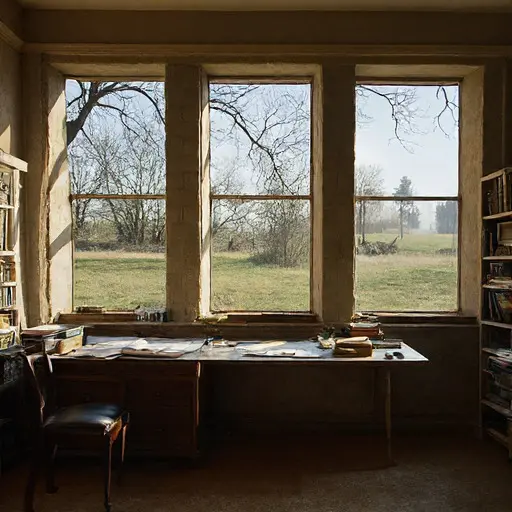
Inside, the house was organized around environmental study and long-term observation of upland weather systems. The central core contained shared living and analytical spaces, while the wings housed sleeping quarters and equipment storage. Large windows ensured constant visual access to the shifting grasslands and distant tree clusters.
Wind exposure and gradual abandonment
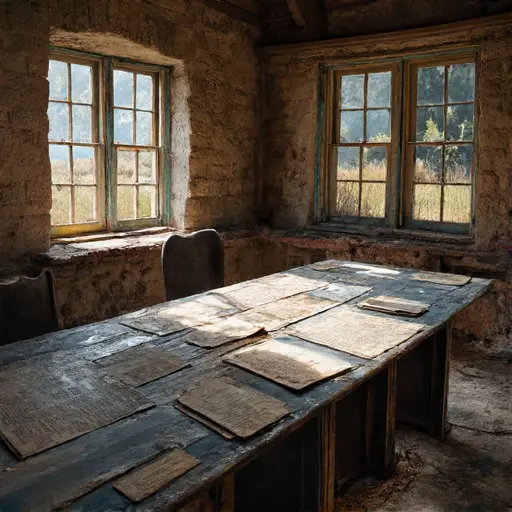
By the late 1920s, sustained habitation became increasingly difficult. The plateau’s constant wind exposure caused structural fatigue in exterior joinery and increased heating demands during colder months. Scientific funding for upland survey stations diminished, and the house gradually transitioned from active residence to seasonal occupancy.
As use declined, sections of the building were closed off to conserve energy and reduce exposure. The lee-facing conservatory became rarely used, and dormer rooms in the outer wings were abandoned first. Moisture and wind-driven dust slowly affected interior surfaces, softening edges of furniture and dulling painted finishes.
Despite these changes, the structure remained stable, its layered stone and brick composition continuing to resist full deterioration. The house retained its clarity of form even as human presence diminished.
Final abandonment on the exposed plateau
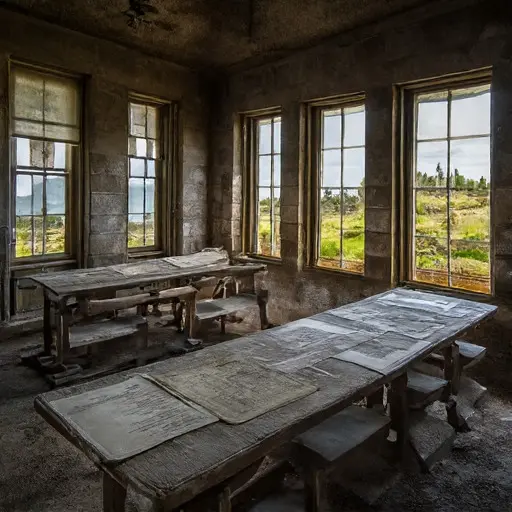
Following the final recorded occupation in the early 1930s, the Strathwind Plateau House was left without formal maintenance or restoration. The exposed location accelerated environmental interaction, with wind continuously shaping both exterior surfaces and internal air movement.
Sandstone bands softened further under constant abrasion, while volcanic brick retained structural depth but dulled in color saturation. Slate roofing remained largely intact, though minor shifts in alignment occurred along exposed ridges. Vegetation around the foundation became sparse due to wind exposure, with grass forming low, wind-combed patterns rather than dense growth.
Today, the house remains standing on the upland plateau, its zigzag form still clearly readable against the grasslands. It exists as a structurally coherent but uninhabited Victorian residence, continuously shaped by wind, light, and open terrain, maintaining its geological and architectural presence within the exposed landscape.