The Brackenford Creek House Left Vacant After Forest Bend Decline
The Brackenford Creek House was constructed in 1895 and gradually expanded over several decades by the Lorrimer family, who settled along a tight bend in a forest creek where the water split briefly around a gravel island before rejoining downstream. Originally a compact two-story brick dwelling, the house evolved through later additions, including a pale timber-and-glass extension that shifted its silhouette into an irregular, staggered form shaped by changing needs rather than unified design intent.
The original structure was built from warm clay-toned brick, chosen for its durability in the damp woodland environment.
Over time, exposure to moisture and shaded forest conditions softened its coloration, blending it into tones of muted earth and weathered stone. The later extension introduced lighter materials and increased light access, particularly through the creek-facing sunroom, which became a favored space for observation and daily administrative tasks.
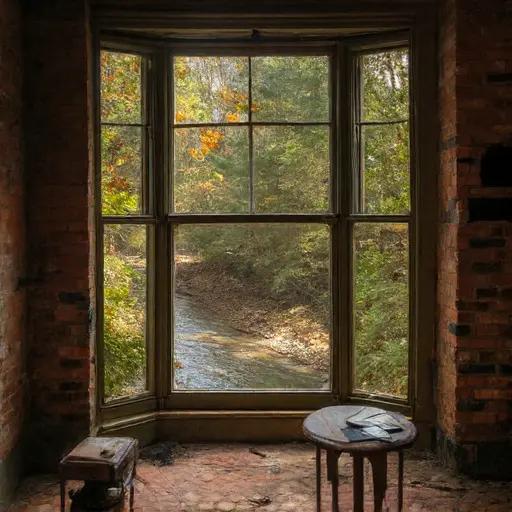
Inside, the household functioned as a small-scale forestry and land coordination base. Thomas Lorrimer managed timber permissions and creek access rights, while his wife Eleanor maintained correspondence and household administration. The bay window overlooking the creek served as both a workspace and observational point, allowing constant monitoring of water levels and seasonal woodland shifts.
Early financial strain
By the late 1920s, regional forestry operations began consolidating under larger commercial entities, reducing opportunities for small independent landholders. Creek access rights became more regulated, and timber yields from surrounding woodland decreased due to stricter environmental management policies and reduced cutting permissions. As income declined, maintenance of the house and its extensions became increasingly difficult to sustain.
Physical signs of strain emerged gradually. Slate tiles on the intersecting gables began to shift unevenly, and the square chimney darkened further from years of intermittent heating use. The pale olive paint on window frames faded irregularly, exposing earlier cream layers and revealing the building’s long maintenance history.
Gradual decline in the household
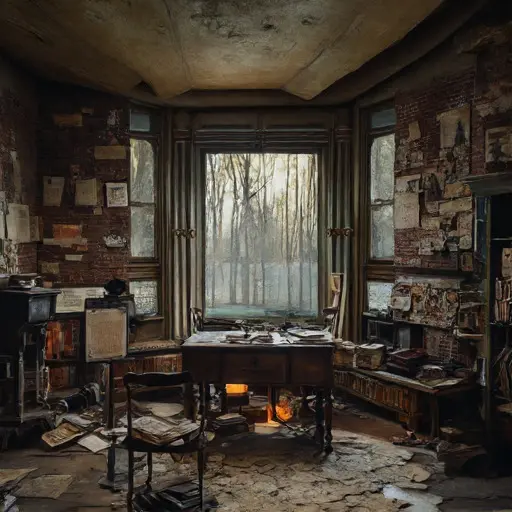
As financial pressures increased, portions of surrounding woodland management were gradually abandoned. Creekside maintenance was reduced, and fallen branches began to accumulate along the banks, occasionally forming natural bridges across shallow sections of water. The narrow stone path leading to the house became partially obscured by moss and damp soil, blending into the forest floor.
Family members gradually relocated to nearby towns where employment opportunities were more stable. Their departures reduced household capacity significantly, leaving fewer individuals responsible for managing both property and surrounding woodland rights. The sunroom extension saw decreasing use, while upper-floor rooms were progressively closed to conserve heating and maintenance resources.
Final abandonment phase
By the early 1940s, the Brackenford Creek House was no longer fully inhabited. Utility services were discontinued following prolonged financial arrears, and routine maintenance ceased entirely. Moist forest air and creek humidity entered freely through aging seals around windows and sunroom panels, gradually altering interior wood and metal surfaces. The building remained structurally intact but increasingly shaped by environmental exposure rather than human care.
Final deterioration
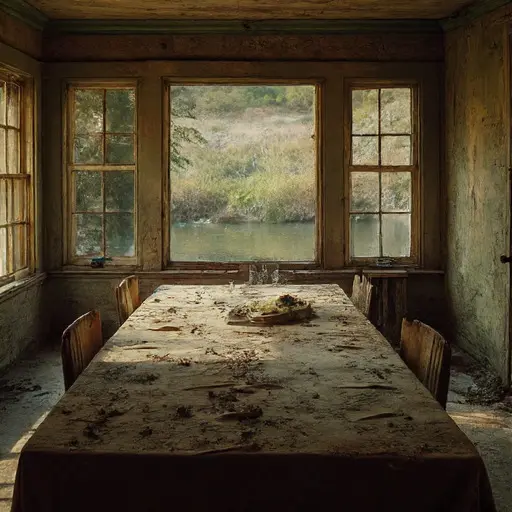
By the mid-1940s, no formal ownership or active maintenance of the Brackenford Creek House remained. Legal correspondence was repeatedly returned undelivered, and no heirs reestablished residence. The structure persisted within the forest bend in a state of quiet abandonment, slowly weathering under water, wind, and encroaching vegetation. No restoration or reoccupation followed. The house remains empty beside the creek, its staggered form gradually dissolving into the woodland environment that surrounds it.