The Birchline House Left Vacant Across Generations
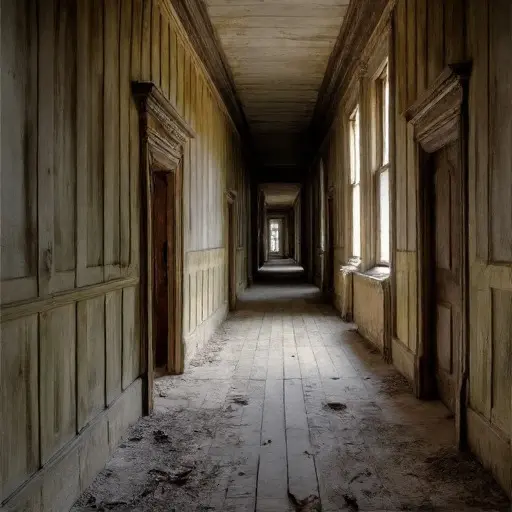
The house had never truly been a single design so much as a slow accumulation of lives. What began as a modest birchwood-edge family residence gradually extended itself outward in both directions, each generation adding rooms as needs shifted and families split. The central corridor, shown in the image, became the spine of this quiet expansion.
By the final years of occupation, it no longer functioned as a simple passage but as a record of separation—each doorway marking a household branch that once tried to remain connected under one roof.
Over time, the rhythm of movement changed. Footsteps grew less frequent, doors were left open longer, and the natural cold of the birch forest began to seep into the structure itself. The corridor became a place of pause rather than transit, where light arrived but rarely stayed.
Fragmented domestic wings
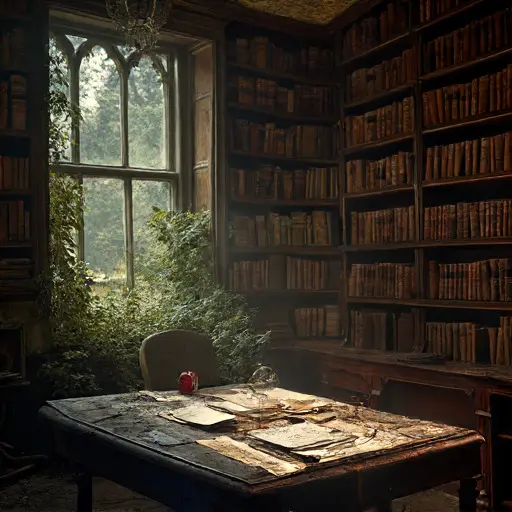
As the house expanded, each wing developed its own character. One became a study-heavy section, where documentation of land, family records, and correspondence accumulated across decades. Another held quieter domestic rooms that were gradually repurposed into storage as the household’s structure loosened. The study in the image reflects this transformation most clearly: a space that once demanded daily attention now reduced to static arrangement.
The abandonment was not abrupt. It arrived as diminishing visits, longer silences between visits to the house, and eventually the acceptance that certain rooms no longer needed to be entered at all. Books remained open longer than intended. Ink dried on pens left uncapped. The architecture preserved these pauses more faithfully than the people who created them.
Dissolution of shared space
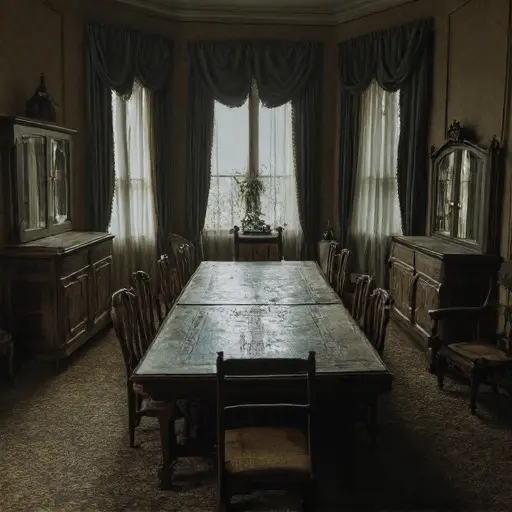
The dining hall marked the final stage of cohesion. Unlike the study wings, which could be abandoned gradually, this shared space required presence to function. As family members drifted away—some relocating, others simply ceasing to return—the room began to lose its purpose faster than the rest of the house.
In its final active years, meals became irregular, tables were set for fewer people, and eventually the arrangement of chairs itself became uncertain. The image captures this moment of suspension: a room arranged as if waiting for continuity that no longer exists.
When the last inhabitants left, nothing was formally closed. There were no clear departures, only the slow failure of return. Doors remained unlocked out of habit, then out of forgetfulness, and finally out of irrelevance.
The house now stands internally intact but functionally hollow, its long linear structure preserving every stage of its own unmaking. The birch forest beyond continues to grow undisturbed, and within the house, time moves only as dust settling across rooms that no longer expect occupation.