The Evershade Terrace House Left Vacant After Botanical Estate Decline
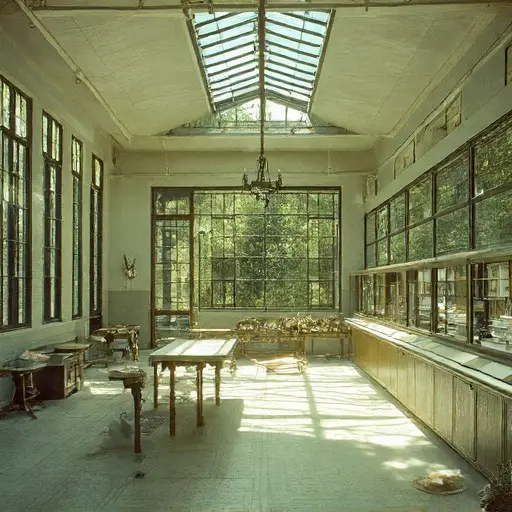
The Evershade Terrace House was constructed in 1887 as part of an experimental horticultural estate designed to test controlled botanical cultivation across layered terraced gardens. Unlike traditional Victorian residences, the structure was conceived as both living quarters and scientific observatory, integrating domestic space with botanical research facilities. Its pale glazed brick exterior—rendered in soft pearl and desaturated jade—was chosen for its ability to reflect and diffuse the shifting daylight conditions of the elevated terrace environment.
The building’s layout centered on a broad, low central hall used for botanical documentation and specimen preparation, flanked by two asymmetrical wings that housed living quarters and cultivation records. The elliptical stone arch framing the entrance was carved with botanical relief motifs, including vines, seed pods, and curling leaf forms, symbolizing the estate’s dual purpose as home and research environment.
The foundation plinth functioned as both structural base and irrigation system. Narrow channels embedded within the stone once distributed water across ornamental planting beds arranged around the house. Over time, these channels ceased operation and gradually filled with sediment and moss, preserving the geometry of the original system while rendering it inactive.
Early financial strain
By the late 1920s, funding for private horticultural experimentation declined as municipal and university institutions consolidated botanical research. The Evershade estate lost several key grants, and the maintenance of its extensive terraced systems became increasingly difficult. Skilled horticultural staff were reduced, and experimental cultivation plots were gradually scaled back or left unmanaged.
Within the house, research activity slowed significantly. Botanical records continued to be maintained, but fewer specimens were processed, and sections of the conservatory hall were left unused. The glazed brickwork began to show subtle crazing and fine surface fractures, a natural result of prolonged exposure to seasonal humidity changes across the elevated terrace.
Gradual decline in the household
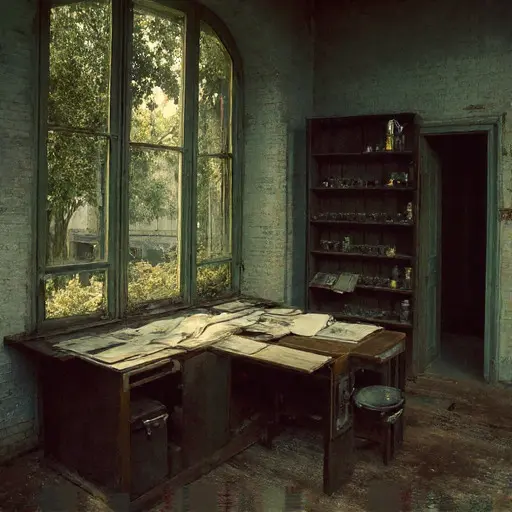
As institutional funding continued to decline through the 1930s, the Evershade Terrace House gradually transitioned from an active research facility into a partially maintained residence. Botanical experiments were discontinued or left incomplete, and irrigation systems embedded in the stone plinth were no longer serviced. Sediment accumulated within the channels, and moss began to trace their once-functional pathways with slow organic growth.
The surrounding terrace gardens, however, did not immediately collapse into disorder. Instead, they retained a faint echo of their original design, with plant growth following the geometry of earlier planting schemes. This created an unusual visual continuity between cultivated order and natural reclamation, reinforcing the estate’s lingering identity as a structured landscape rather than an abandoned one.
Final abandonment phase
By the early 1940s, the Evershade Terrace House was no longer actively inhabited. Administrative oversight ceased following the dissolution of the original funding consortium, and no successor institution assumed responsibility for the property. Without maintenance, the slate roof’s muted indigo-gray tiles began to shift subtly, and dormer openings remained unsealed, allowing wind and moisture to pass through upper levels of the structure.
Final deterioration
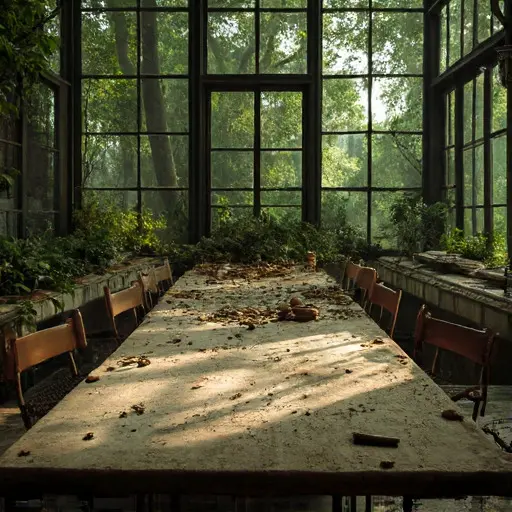
By the mid-1940s, no formal ownership or active stewardship of the Evershade Terrace House remained. Legal and institutional records regarding the estate were left unresolved, and no successor organization reinstated its botanical function. The structure persists today at the edge of the elevated terrace, slowly weathering under light, moisture, and time. No restoration or reoccupation followed. The house remains empty, absorbed into the continuity of the cultivated landscape, where architecture and overgrowth coexist in quiet, enduring equilibrium.