The Blackwell Courtyard House Left Vacant Within Urban Silence
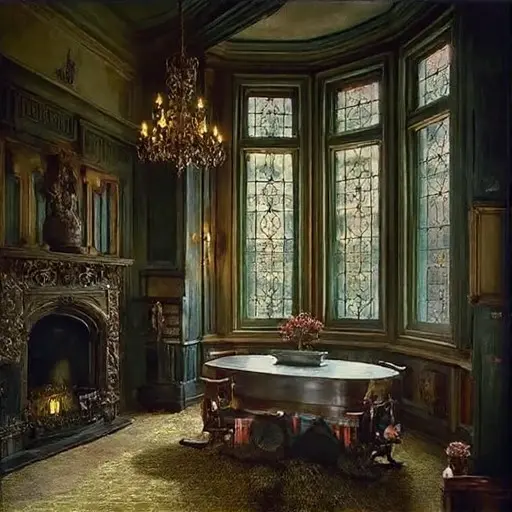
The Blackwell Courtyard House was completed in 1896 as part of a privately commissioned urban redevelopment project intended to integrate residential and civic architectural forms within a tightly enclosed historic district. Unlike standalone Victorian residences of the period, this structure was embedded directly into a dense courtyard system, surrounded on all sides by tall masonry buildings that formed a vertical architectural canyon. It was designed to function as both an upper-class townhouse and a semi-administrative residence for municipal estate affairs.
Constructed from polychrome brickwork in muted burgundy, soot-gray, and pale cream stone, the house was initially intended to reflect the layered civic identity of the district. Over time, these materials softened under urban weathering, creating a subdued tonal unity that blurred its original ornamental contrasts. The façade remained highly detailed, with stacked bay windows, terracotta floral panels, and cast-iron tracery forming a carefully balanced composition across three floors.
The household belonged to the Blackwell administrative family, who managed property holdings and civic contracts within the district. Henry Blackwell oversaw tenancy agreements and urban development correspondence, while Eleanor Blackwell maintained household records and hosted formal meetings with city officials and contractors. The house functioned as both private residence and operational office, deeply integrated into the surrounding architectural and administrative network.
Early financial strain
By the late 1920s, shifts in urban governance and the consolidation of municipal services reduced the need for privately managed administrative residences. The Blackwell family’s contractual influence declined steadily, and income tied to property coordination diminished. Maintenance of the ornate façade became increasingly difficult due to both cost and the constraints of the enclosed courtyard environment, where access for repairs required coordination with neighboring buildings.
As financial pressure increased, sections of decorative terracotta and ironwork were left untreated. Moisture accumulated in recessed architectural details, gradually softening carved motifs and dulling painted surfaces. The narrow wrought-iron balcony, once used for oversight of courtyard activity, began to show signs of structural fatigue in its supporting brackets.
Gradual decline in the household
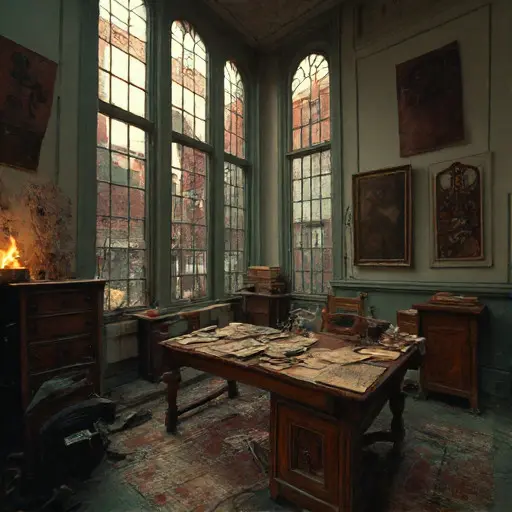
During the 1930s, the Blackwell household gradually withdrew from active administrative functions. Correspondence with municipal bodies became less frequent, and property coordination responsibilities were reassigned to external offices. Within the house, rooms previously used for civic meetings were repurposed or left unused. The courtyard-facing windows continued to admit diffused light from surrounding masonry walls, but interior activity diminished significantly.
The surrounding courtyard itself remained structurally intact but increasingly silent. Root growth beneath cobblestones subtly shifted the walking surface, while damp masonry absorbed years of atmospheric moisture. Despite this, the architectural enclosure preserved a strong sense of spatial definition, maintaining the house’s presence within the dense urban fabric.
Final abandonment phase
By the early 1940s, the Blackwell Courtyard House was no longer actively occupied. Utility services were gradually discontinued following prolonged financial arrears and administrative dissolution. Without maintenance, decorative elements of the façade continued to erode subtly, particularly in recessed terracotta panels and exposed ironwork. The external service stair remained structurally intact but unused, its vertical form emphasizing the building’s isolation within the courtyard canyon.
Final deterioration
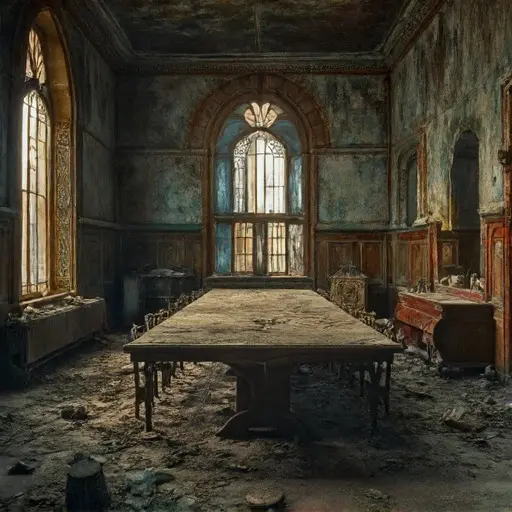
By the mid-1940s, no formal ownership or active management of the Blackwell Courtyard House remained. Legal notices were repeatedly returned undelivered, and no heirs reestablished residence within the courtyard district. The structure persisted as a silent component of the urban canyon, slowly weathering under damp masonry, limited light, and the enclosing presence of surrounding buildings. No restoration or reoccupation followed. The house remains empty today, embedded within the city’s dense architectural fabric, gradually fading into stillness and material memory.