The Ravenshollow Ridge House Left Vacant After Basin Fog Decline
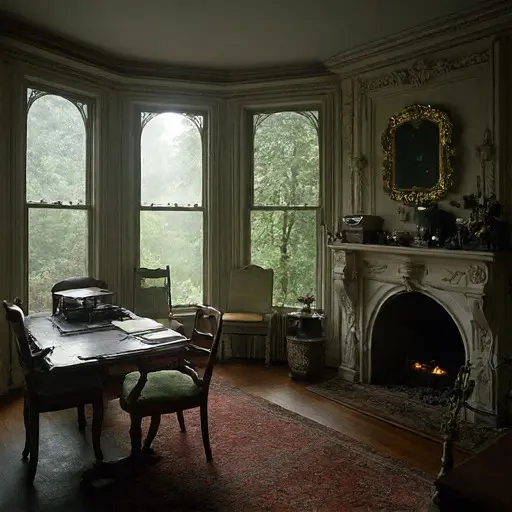
The Ravenshollow Ridge House was constructed in 1898 by the Ellery-Brooke family, who chose the elevated ridge above the woodland basin for its commanding view and isolation from nearby settlements. Designed in an ornate Victorian style, the house was intended to reflect both social stature and architectural ambition. Built primarily from pale stone and painted woodwork, its exterior palette—now faded into slate-green, dusty mauve, and cold ivory—was originally more vibrant, meant to contrast against the dense forest below and the shifting fog that frequently settled in the basin.
The structure was asymmetrical by design, with intersecting rooflines and steep gables intended to create a dynamic silhouette when viewed from below in the valley. The central bay window on the second floor served as the primary observational point for the family, overlooking seasonal changes in the forest canopy and the slow movement of fog across the basin floor. The veranda wrapping the front and side of the house functioned as a transitional space between interior domestic life and the elevated natural surroundings.
Early financial strain
By the late 1920s, the estate began to lose financial stability as agricultural holdings and minor land leases in the surrounding region became less profitable. Maintenance of the large and complex structure became increasingly difficult, particularly due to the constant exposure to damp air rising from the basin below. Decorative woodwork required frequent repair, but funding for such upkeep gradually diminished. Sections of the veranda and upper trim were left untreated, allowing moisture to subtly alter their structure over time.
Inside the house, rooms remained furnished but were used less frequently. Heating was restricted to central areas, and upper-level rooms were gradually closed during colder months. The ornate detailing that once symbolized refinement began to soften visually, as dust, humidity, and time reduced its sharpness without fully obscuring its presence.
Gradual decline in the household
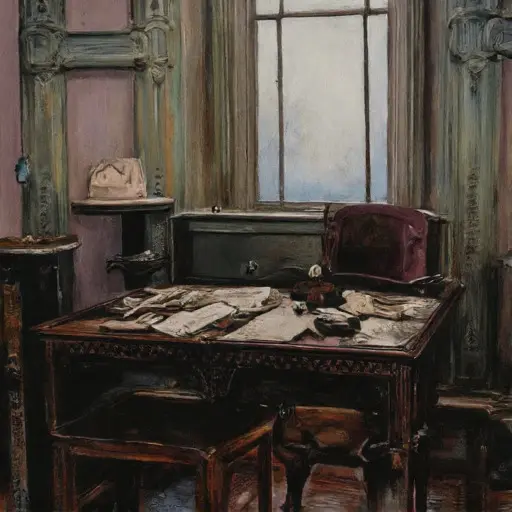
As financial strain increased through the 1930s, maintenance of the estate became increasingly inconsistent. Ornamental hedges around the property lost their formal shape, and the broken stone pathway leading to the entrance became partially obscured by encroaching vegetation. The veranda, once a prominent architectural feature, began to show uneven floorboard spacing due to prolonged exposure to seasonal humidity and temperature fluctuations.
Family members gradually relocated to urban centers, leaving fewer occupants to manage the increasingly demanding property. Administrative functions slowed significantly, and correspondence with landholders became sporadic. The house shifted from an active family residence into a partially maintained structure, sustained more by inertia than active stewardship.
Final abandonment phase
By the early 1940s, the Ravenshollow Ridge House was no longer fully inhabited. Utility services were reduced and eventually discontinued following prolonged financial arrears. Without maintenance, the roof’s patterned slate tiles began to shift and loosen, exposing sections of underlying structure to wind and fog. Chimneys remained intact but darkened with age, their rusted flues marking years of disuse.
Final deterioration
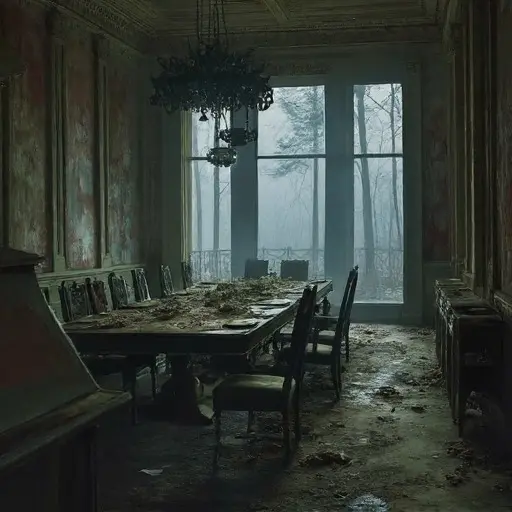
By the mid-1940s, no formal ownership or active maintenance of the Ravenshollow Ridge House remained. Legal notices were repeatedly returned undelivered, and no heirs reestablished residence on the ridge. The structure persisted above the fog-filled basin in a state of quiet abandonment, slowly weathering under constant moisture, wind, and settling stonework. No restoration or reoccupation followed. The house remains empty today, its ornate silhouette softened by time, standing above the drifting forest mist as a fading reminder of a family estate absorbed into the landscape.