A House Balanced on the Edge of Stone Silence
An abandoned Victorian family house stands at the edge of a quiet limestone cliff terrace where the land drops away into a broad, shallow basin filled with grasses, scattered shrubs, and pale stone outcrops. The environment is bright and stable, with clear daylight, soft wind, and long unobstructed visibility across the open terrain.
The house is a compact three-story Victorian residence constructed from alternating bands of pale limestone and thin courses of pale brick, creating a subtle striped masonry effect that gives the exterior a quiet visual rhythm. The materials are locally sourced, and their tones sit naturally within the surrounding stone landscape, blending cream, light gray, and faint warm beige.
The structure is arranged as a centered vertical block with two narrow lateral projections that extend only slightly from the main volume.
These projections are shallow and functional, containing small rooms rather than grand architectural gestures. The overall composition is stable and symmetrical without feeling rigid.
The roof is a low-pitched slate structure with a slightly flattened profile, its tiles aged into a muted range of blue-gray and softened charcoal. Instead of ornate roof detailing, the design emphasizes simplicity, with a single continuous ridge line and two chimney stacks placed evenly near the outer edges of the main block.
Windows are tall and evenly spaced across all floors, following a strict vertical alignment that emphasizes the building’s quiet orderliness. Each window is set within a simple stone frame, with slim wooden sashes painted in a faded pale gray-green. The glass reflects the basin landscape in subdued, slightly softened tones.
The main entrance is centered and modest, recessed slightly into the façade beneath a shallow stone arch. A simple wooden door painted in a desaturated ochre tone provides the only strong color accent on the exterior, though even this has softened with age.
A narrow stone terrace runs along the cliff-facing side of the house, bordered by a low retaining wall that merges directly into the natural limestone edge. This terrace functions as a transitional space between architecture and landscape, offering an uninterrupted view over the basin below.
Vegetation is sparse but natural, with grasses growing between stone joints and small hardy plants emerging along the terrace edges. The house is not overgrown, only lightly softened by time and exposure.
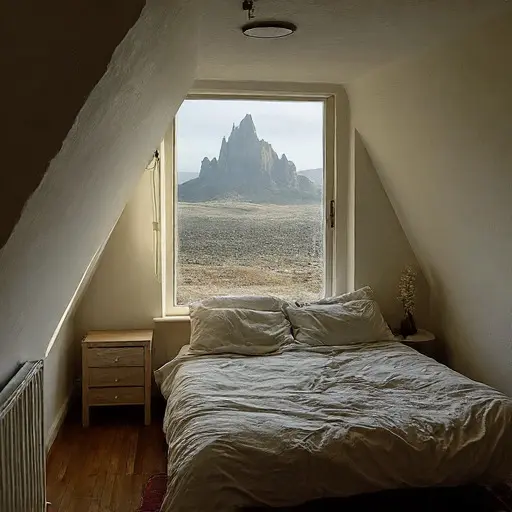
The surrounding basin is open and quiet, with layered stone formations and distant low hills forming a stable horizon. The atmosphere is calm, clear, and grounded—an abandoned Victorian family house shaped by stone and terrain, resting quietly at the edge of a limestone landscape in enduring stillness.
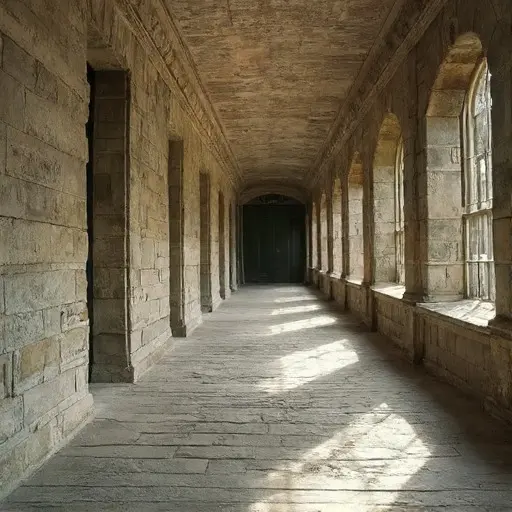
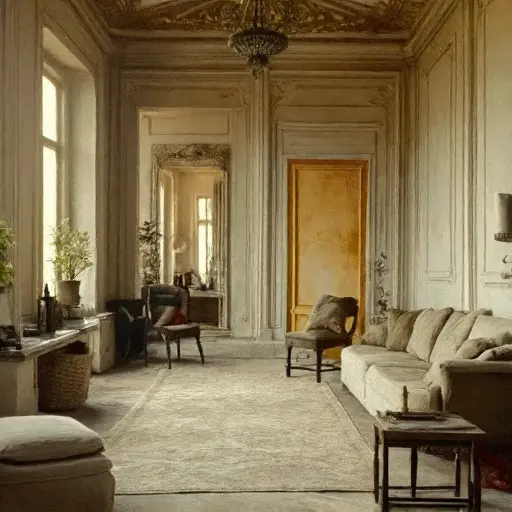
Interior glimpses: