A Quiet House Between Old Field Lines
An abandoned Victorian family house stands in a wide, gently undulating pasture where scattered stone ruins of old boundary markers and low dry-stone walls hint at a long-forgotten agricultural estate. The landscape is open and softly lit, with steady daylight, pale green grass, and a few distant stands of trees forming a loose horizon rather than an enclosing boundary.
The house is a compact two-story Victorian residence constructed from pale rendered brick that has weathered into a calm, desaturated palette of warm off-white and faint gray-beige. The exterior finish is smooth rather than heavily textured, giving the building a restrained and slightly refined rural character.
Its form is simple and balanced, with a central rectangular mass and a small rear extension that likely served as a kitchen or utility space.
The proportions are modest and functional, with no dramatic height or ornamentation—just a steady, familiar domestic presence within the field.
The roof is a straightforward pitched structure covered in aged clay tiles that have softened into muted tones of dusty red and weathered brown. The ridge line is clean and uninterrupted, with a single chimney stack positioned near one end, built from matching brick and capped with a plain stone slab.
The front façade is organized around a centered entrance framed by a shallow plaster surround, leading to a simple wooden door painted in a faded muted green. On either side, evenly spaced sash windows create a calm, predictable rhythm across the exterior. Their frames are thin and painted in a soft off-white, slightly darker than the walls, making them subtly legible without contrast overload.
A small stone step sits at the base of the entrance, leading directly into the grass rather than a formal path. Any former walkway has long been reclaimed, leaving only faint traces in the way the grass grows slightly differently near the threshold.
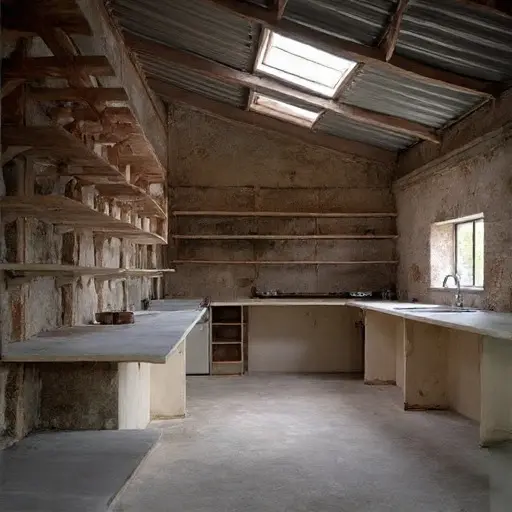
At the rear, a low single-story lean-to structure extends from the main house, likely once used for storage or cooking. It is simpler in construction, with corrugated roofing that has dulled into a soft gray and wooden supports that have aged to a gentle silvery tone.
The surrounding pasture is quiet and open, with wind moving through the grass in soft, continuous motion. The dry-stone remnants nearby suggest old field divisions now softened by time, but nothing feels broken or dramatic—only gradually reclaimed by nature.
The atmosphere is calm, realistic, and understated—an abandoned Victorian rural family house resting quietly in open countryside, defined by simplicity, proportion, and the slow blending of built form into the land.
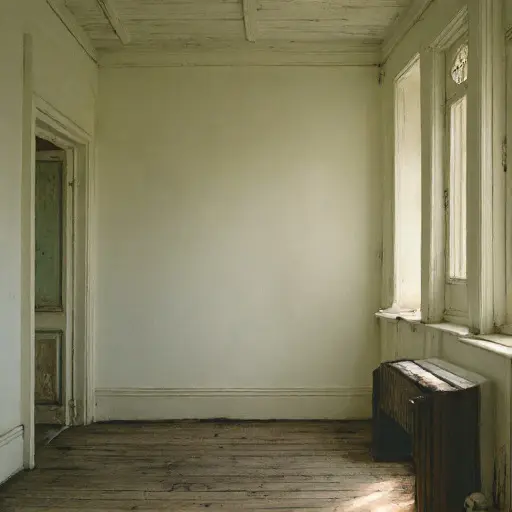
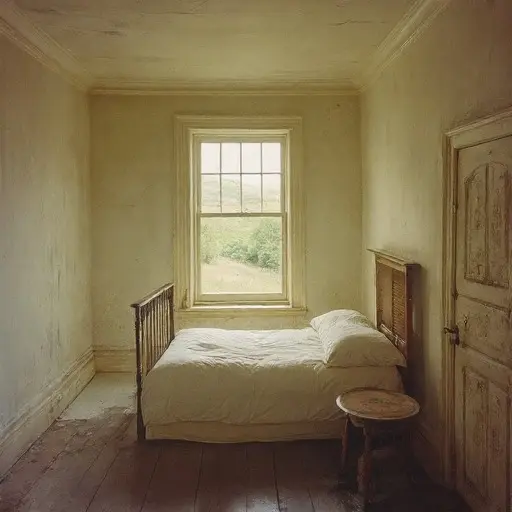
Interior glimpses: