The House on the Wind-Edge Headland
On a narrow coastal headland where grassy dunes roll toward low, weathered cliffs, an abandoned Victorian family house stands facing a calm, distant sea. The land here feels open yet restrained, shaped constantly by wind that moves through the grass in slow, steady waves. A soft ocean haze hangs at the horizon, flattening distance and giving the entire scene a muted, enduring clarity.
The house is a compact two-story Victorian cottage built from pale limewashed stone that has softened over time into chalky whites and sandy grays. Its proportions are low and sturdy, clearly designed for coastal endurance rather than ornament.
The footprint stretches gently along the shoreline rather than projecting outward toward it, as if the building learned early to align itself with the wind instead of resisting it.
The façade is balanced and understated. A central wooden door anchors the composition, framed by a simple stone surround worn smooth by salt air and weather. The door is painted a faded coastal blue-green, its pigment softened almost to memory. On either side, evenly spaced sash windows establish a quiet rhythm across the exterior walls, their glass dulled but intact, reflecting fragments of sky and sea in pale, washed tones.
The roof is shallowly pitched and covered in overlapping slate tiles that have aged into subdued blue-gray and green-gray hues. Two short chimney stacks rise at opposite ends of the ridge, built from slightly roughened brick that has weathered under constant wind exposure. The roofline remains simple and continuous, reinforcing the house’s emphasis on stability rather than decoration.
A narrow wooden deck extends along the seaward side of the house, raised slightly above the dune grass on simple stone supports. Its planks are worn and softened by years of salt air and shifting weather. From this platform, the view opens toward the ocean, though the house itself turns gently inward for protection, as if prioritizing shelter over exposure.
Subtle traces of past life remain embedded in the surroundings. A rain barrel sits beside the rear wall, its surface dulled by exposure. A weathered bench rests close to the house, positioned to shield it from the prevailing wind. Faint outlines of old garden borders can still be seen in the grass, though they have largely dissolved into the natural dune landscape.
The surrounding headland is quiet and expansive. Dunes rise and fall in slow curves toward the cliffs, while beyond them the sea stretches outward in a calm, steady horizon. Grass bends continuously in the wind, never still, yet never chaotic.
The atmosphere is cool, grounded, and peaceful—an ordinary Victorian coastal home shaped entirely by its environment, resting in quiet balance between land, wind, and ocean light.
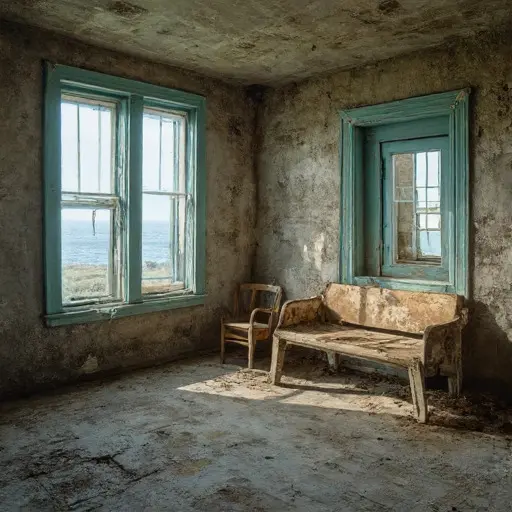
Inside, the sitting room is modest and functional. Light enters through tall sash windows, softened by salt haze and reflected sea brightness. Furniture remains arranged in simple, familiar groupings, shaped by long years of daily routine rather than display. The air feels still, but not heavy.
A narrow hallway runs through the center of the house, connecting rooms in a straightforward linear layout. Wooden floors show subtle wear patterns, and doorframes remain intact but softened at the edges. The interior feels coherent and lived-in, even in absence.
At the back of the house, a small kitchen space opens toward the dunes, where light is slightly cooler and more diffuse. Surfaces are simple and durable, designed for coastal life, with no unnecessary ornamentation—only function refined by time.
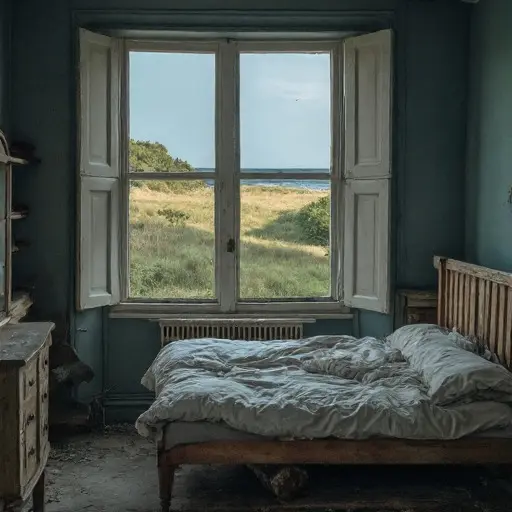
Upstairs, bedrooms sit quietly beneath the shallow roofline. Windows frame shifting views of grass, dunes, and distant water, changing with the movement of wind outside. Rooms remain intact, with simple furnishings and soft, weathered textures that suggest long familiarity rather than neglect.
And as the coastal wind continues to pass through the grass and the sea remains steady on the horizon, the house stands unchanged—quiet, grounded, and enduring at the edge of land and ocean.