The House by the Lily Pond
Hidden deep within an old-growth forest where towering maples weave their branches into a living canopy, a forgotten Victorian family house rests beside a narrow woodland pond. The water lies perfectly still beneath a drifting mosaic of lily pads, reflecting fragments of pale sky and emerald leaves in soft, broken patterns. Moss-covered stones line the shoreline, and faint footpaths disappear into clusters of ferns as though generations of quiet walks have slowly blended back into the forest floor.
The house itself is modest in scale, built not to impress strangers but to welcome family. Painted in a faded muted teal softened by decades of shade and rain, the structure seems to belong naturally among the greens and browns of the surrounding woods.
Bright white trim outlines every edge, window, and gable, creating gentle contrast that remains visible even beneath the filtered forest light.
A prominent front gable rises above the façade, its decorative wooden trim still remarkably intact despite years of abandonment. Beneath the roof peak, a circular attic window gazes quietly over the pond, like an unblinking eye that has watched countless seasons pass through the forest. Below it, two large bay windows project outward from the ground floor, their tall glass panes reflecting water, leaves, and drifting clouds with subtle distortion.
The covered porch wrapping around the front corner remains one of the home’s most inviting features. Cream-painted railings surround weathered floorboards worn smooth by time. Several old rocking chairs sit exactly where they were last left, facing the pond as if their occupants might return at any moment. The porch roof sags slightly along one edge, not from neglect but from the simple weight of years.
A steep roof clad in dark green slate shingles crowns the structure. Moss has settled comfortably across shaded sections, softening the roofline without obscuring it. Near the center rises a solitary brick chimney streaked with dark stains left by decades of rain and forest moisture. Along one corner of the house, ivy climbs carefully upward, threading itself around trim and window frames with surprising restraint.
The approach to the house is as memorable as the house itself. A narrow wooden footbridge spans a small stream feeding the pond, connecting the forest path to the front steps. Water slips quietly beneath the bridge before disappearing beneath lily-covered reflections. Beyond the crossing, the forest closes gently around the property, creating a sense of privacy so complete that the outside world feels impossibly distant.
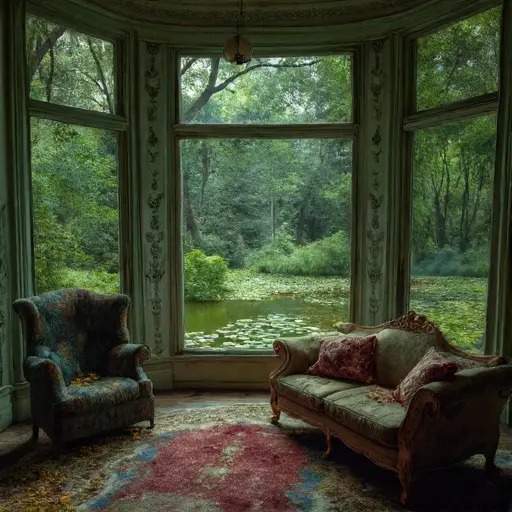
Inside, the house preserves the feeling of family life more strongly than any architectural feature. Dust rests lightly upon surfaces, yet nothing appears disturbed. Rooms remain orderly, as though the passage of time itself has chosen not to interfere.
The main sitting room occupies one of the projecting bay windows, where curved walls frame views of the pond and surrounding woods. Faded rugs soften the wooden floors, and shelves still hold forgotten books whose spines have slowly surrendered their colors to sunlight filtering through the glass. Every object feels settled rather than abandoned.
A central hallway runs through the heart of the house, connecting rooms designed for daily life rather than display. The scale is intimate and comfortable. Doorways are slightly worn at their edges, handrails polished by years of use, and corners rounded by countless ordinary moments now long past.
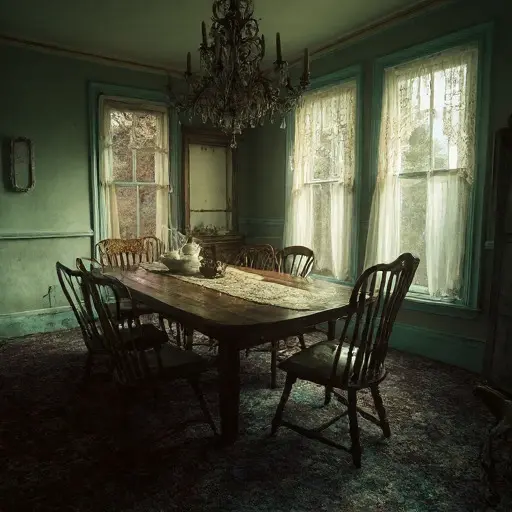
Upstairs, bedrooms overlook the pond and forest canopy. Morning light would have arrived gently through the trees, painting shifting patterns across walls and floors. Some rooms retain simple iron bedframes and handmade quilts, while others stand nearly empty except for a chair or small dresser left exactly where it belonged.
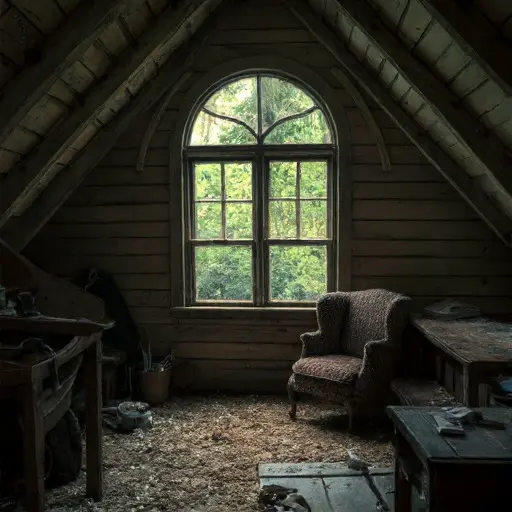
The circular attic window beneath the front gable illuminates a narrow upper room tucked beneath the roof slopes. Here, the house feels closest to the surrounding forest. Leaves, sky, and branches fill the view entirely, making the attic seem suspended among the trees rather than enclosed within a building.
Outside, nature continues its quiet companionship with the structure. Ferns cluster around the foundation stones. Moss softens the edges of pathways. Fallen leaves gather beneath porch steps. Yet nothing overwhelms the house. Instead, the forest appears content simply to share the space.
What lingers most strongly is not the architecture itself but the feeling of familiarity. The house carries the memory of ordinary summers, family gatherings, conversations on the porch, and afternoons spent watching sunlight drift across the pond. Its beauty comes not from grandeur but from the quiet evidence of lives once comfortably lived within its walls.
And as evening settles over the lily pads and the maple canopy darkens into shadow, the house remains beside the woodland water exactly as it has for years—patient, peaceful, and waiting—not for restoration, but simply for one more familiar footstep to cross the bridge and come home.