The House Beneath the Beech Canopy
Deep within a mature beech forest, where smooth silver-gray trunks rise like quiet columns and soft daylight filters through layers of leaves, an abandoned Victorian family house rests in a clearing scarcely larger than itself. The woodland seems to have opened gently around the structure rather than being cleared away, creating the impression that the house and forest arrived together and simply grew older side by side.
The home is modest in scale yet rich in character—a two-story Victorian residence crowned by a steep roof and a narrow attic tucked beneath its slopes. Painted timber siding wraps the exterior in a weathered dusty blue, its surface softened by decades of seasons. In places, the paint has peeled delicately, revealing traces of pale cream beneath and creating a natural patchwork of memory across the walls.
The most striking feature is the broad wraparound veranda stretching across the front façade and continuing along one side. Its weathered floorboards remain intact, while intricate wooden fretwork hangs beneath the porch roof like delicate lace carved from timber. Several slender porch columns lean almost imperceptibly, not from failure but from age, as though the house has relaxed into the forest’s slower rhythm.
The roof rises steeply above the structure, covered in dark slate shingles muted by moss and time. Three dormer windows emerge from the slopes, each subtly different in proportion, hinting at decades of additions and adjustments made by hands long gone. A tall brick chimney stands near one end of the house, partially embraced by ivy that climbs upward before surrendering to the roofline.
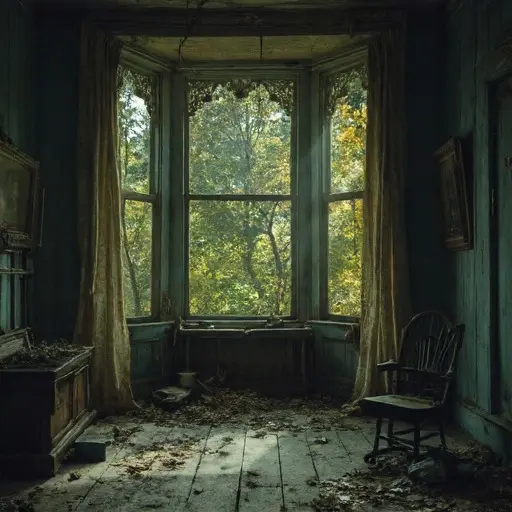
Large bay windows project from the ground floor, reflecting the shifting canopy overhead. Their glass remains remarkably clear, turning the surrounding forest into a living mural of leaves, branches, and sky. Behind several panes, faded lace curtains still hang in place, preserving a faint sense of domestic order despite the years of abandonment.
A narrow stone path approaches through the trees, winding between roots and patches of moss before reaching the front steps. Fallen leaves have softened its edges, blurring the boundary between pathway and forest floor. Nearby, a wooden swing hangs from the broad limb of an ancient beech tree. Its ropes remain intact, and although motionless, it feels as though it could begin moving with the next passing breeze.
Attached discreetly to one side of the house is a small greenhouse framed in worn sage-green wood. Ferns and woodland flowers gather around its base, while fog-softened glass conceals clusters of old planting tables and forgotten pots. The greenhouse appears less abandoned than patiently waiting for another season that never arrived.
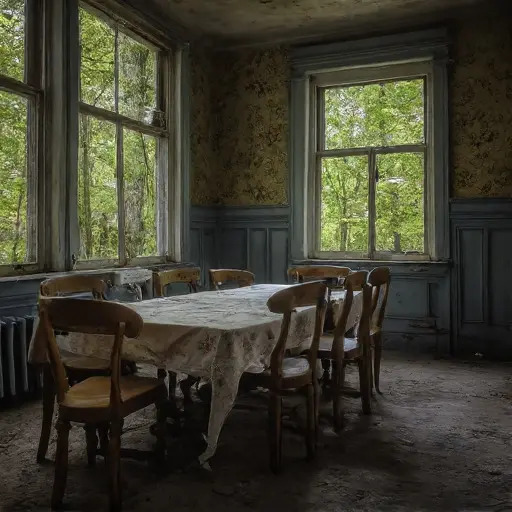
Inside, the house retains an unusual sense of calm. Rooms remain orderly, not preserved by intervention but by stillness. Dust gathers lightly on furniture surfaces while sunlight drifts slowly across walls that have watched generations come and go.
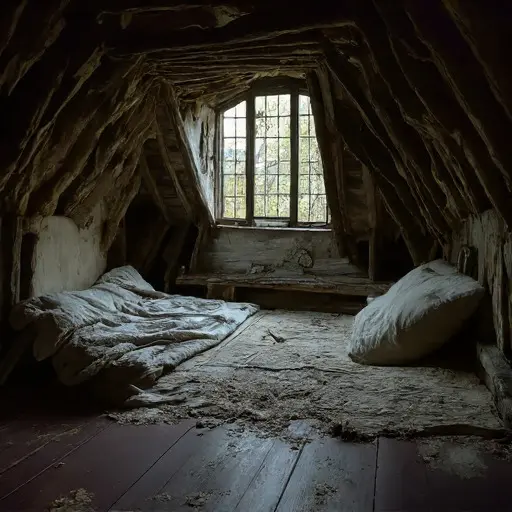
The upper floor follows the practical simplicity of the home’s design. Narrow hallways connect bedrooms tucked beneath sloping ceilings, where dormer windows frame fragments of forest canopy and sky. Time has weathered every surface but altered very little of the house’s essential character.
Outside, the clearing remains intimate and protected. Moss gathers around old stone borders, low ferns spread beneath shrubs, and fallen leaves collect against porch steps. The forest presses close enough to feel present, yet never so close as to threaten the house itself. Instead, trees and architecture seem to maintain a long-standing agreement of mutual respect.
What makes the house remarkable is not grandeur, rarity, or architectural spectacle. It is the sense of ordinary life still lingering quietly within its walls. Every porch board, curtain fold, and worn pathway suggests routines once repeated thousands of times—meals shared, books read, doors opened and closed, seasons observed from familiar windows.
And as evening settles beneath the beech canopy and the forest light softens into gold and shadow, the house remains where it has always been—quiet, intact, and deeply rooted—like a memory that never asked to be remembered and therefore never learned how to disappear.