The Crescent Chalk Manor Left Vacant Above the Coastal Fields
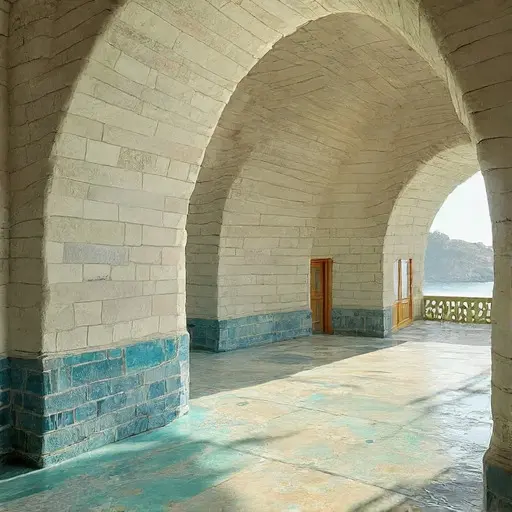
The Crescent Chalk Manor was constructed in the late Victorian period as a coastal architectural experiment in continuous curved domestic space, situated atop a raised chalk cliff overlooking an expansive sunlit plain. Unlike conventional estate design, the manor was formed as a fragmented crescent-shaped composition, built from interlocking curved wings that expanded outward over time like a growing shell. Each addition followed the logic of radial extension rather than linear planning, resulting in a structure that appears organically accreted rather than formally designed.
The primary building material was pale porcelain-white stone, carefully selected for its brightness under coastal light. Across its surface ran horizontal bands of glazed ceramic tiles in soft ultramarine, sea-glass green, and muted coral blush. These bands created subtle stratification across the entire structure, visually binding the irregular wings into a cohesive but non-uniform whole. As sunlight shifted across the manor, these colored layers produced faint iridescent reflections that changed with viewing angle and time of day.
The roof system consisted of overlapping shallow domes and curved slate vaults, each section slightly offset from the next. Tiled in variations of gray, pale violet, and washed teal, the roofline avoided any singular peak or ridge. Between these domes rose slender cylindrical chimneys wrapped in decorative ceramic rings that echoed the building’s chromatic layering. The result was a fragmented silhouette that blended into the cliff’s edge while still asserting its sculptural presence.
The manor functioned for several decades as a coastal residence for a family involved in maritime trade and regional land management. Internal circulation followed the curvature of the wings, with rooms arranged in continuous arcs rather than orthogonal grids. Life within the manor was defined by gradual spatial transitions, where interior spaces unfolded like segments of a circular journey rather than discrete chambers.
Gradual decline along the cliff residence
By the early 1930s, shifts in coastal infrastructure and trade patterns reduced the importance of the estate’s strategic location. Maintenance of the complex curved structure became increasingly difficult, particularly due to salt-laden winds affecting ceramic joints and bronze fittings. Sections of the outer wings were gradually closed off as repairs became less frequent.
Fragmentation of curved habitation
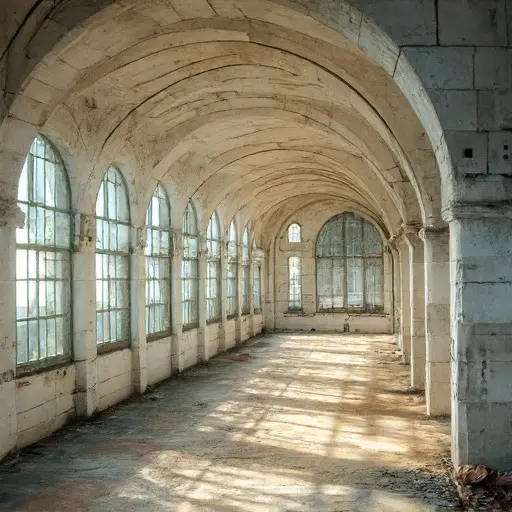
As occupancy declined, entire curved wings of the manor were progressively sealed while others remained intermittently in use. The architectural continuity of the crescent form made partial habitation difficult, as essential services and circulation depended on maintaining the entire looped structure. Over time, this led to increasing isolation of individual segments.
Eventually, the manor ceased functioning as a unified residence. Remaining occupants departed in phases, leaving behind a structurally intact but spatially fragmented coastal estate whose curved logic no longer served a practical domestic purpose.
Final abandonment of the crescent manor
By the late 1940s, the Crescent Chalk Manor was fully vacated. No redevelopment was undertaken due to its non-rectilinear curved architecture and cliffside position, which complicated adaptive reuse. The structure remained stable but unused, its porcelain stone and ceramic bands weathering slowly under constant sea air.
Final coastal stillness
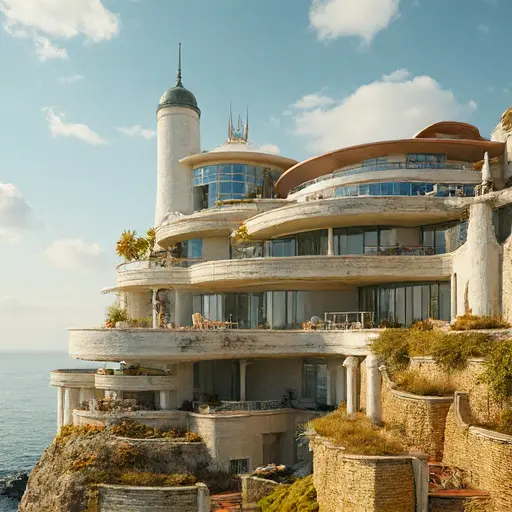
By the mid-1940s, no active ownership or functional use remained for the Crescent Chalk Manor. The surrounding coastal land remained open and undeveloped, leaving the structure isolated above the plain. No restoration followed, and the manor was left intact but uninhabited. Over time, it persisted as a sculptural coastal ruin, its curved architecture preserved in silence above the wind-swept landscape.