The Calverin Terrace Manor Left Vacant After Structural Replatforming
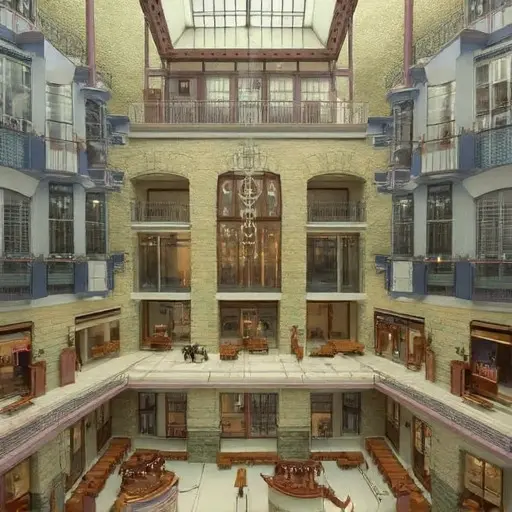
The Calverin Terrace Manor was constructed in 1911 as part of a short-lived architectural movement exploring horizontal expansion as an alternative to conventional vertical Victorian housing. Located on the edge of a gently wooded estate district, the manor was designed as a stacked terrace façade system composed of overlapping architectural platforms rather than uniform floors. Each level projected outward or inward independently, forming a layered composition that emphasized horizontal displacement over vertical ascent.
The lowest limestone platform formed the structural foundation of the manor, constructed from pale stone blocks with finely tooled surfaces. This base contained a continuous row of deeply recessed rectangular window bays, framed in thin weathered pale-blue timber. Above it, the second platform extended further outward and was finished in smooth plaster tinted desaturated cream and soft green-gray. Its irregular window spacing and horizontal metal latticework created a subtle visual rhythm that shifted across the façade depending on viewing angle.
The third platform introduced a more refined architectural expression, combining painted wood and stone veneer in muted lavender and pale sandstone tones. Arched multi-pane windows lined this level, with varying degrees of clarity and frosting that softened interior visibility while maintaining layered depth perception. Above all of this, the roof was not a unified structure but a collection of overlapping flat planes finished in slate tiles of cool gray, faint teal, and washed violet, creating a fragmented silhouette against the sky.
The manor functioned for several decades as a multi-level residence for a single extended household involved in architectural planning and estate management. Daily movement through the structure followed the logic of terraces rather than traditional floors, with circulation occurring both vertically and horizontally through light wells and connecting corridors. The design was intended to explore how domestic life could be distributed across layered outdoor-indoor thresholds.
Gradual decline of terrace-based habitation
By the late 1920s, the Calverin Terrace Manor’s experimental layout became increasingly impractical for maintenance and daily use. Shifting architectural standards favored simpler vertical structures, and the complexity of stacked platforms with offset projections required extensive upkeep. As a result, portions of the upper terraces were gradually decommissioned, and maintenance of façade elements began to decline.
Fragmentation of layered occupancy
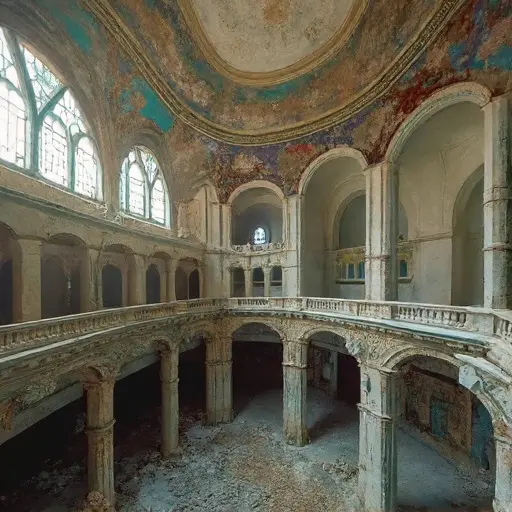
As occupancy declined, entire terrace levels were progressively abandoned while lower sections remained intermittently in use. The structure’s layered logic, once a deliberate architectural innovation, became a maintenance burden as water exposure, wind stress, and structural shifting affected the extended platforms. Thin vertical light wells continued to function but increasingly revealed empty or partially maintained interior zones.
Eventually, the manor ceased to operate as a cohesive residence. Remaining occupants relocated, leaving behind a structurally intact but functionally fragmented building composed of overlapping but disconnected domestic layers.
Final abandonment of the terrace manor
By the early 1940s, the Calverin Terrace Manor was fully vacated. No redevelopment or restoration efforts were undertaken due to the complexity of its layered overhanging design, which resisted standard adaptation. The structure remained stable but inactive, supported by its limestone base and reinforced terrace junctions.
Final layered stillness
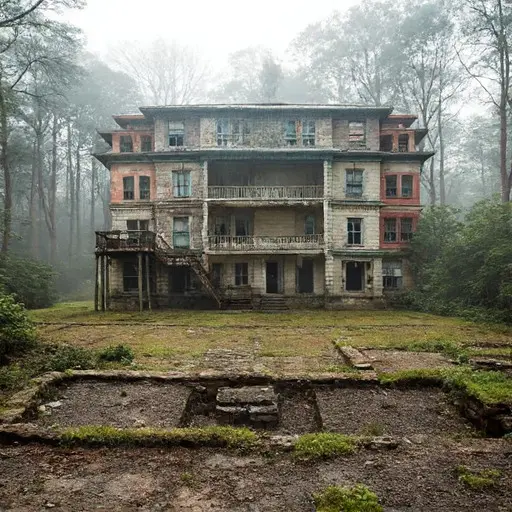
By the mid-1940s, no active ownership or functional use remained for the Calverin Terrace Manor. The surrounding estate lands were gradually reorganized, leaving the structure outside any redevelopment framework. No restoration followed, and the manor was left intact but unused. Over time, its layered platforms continued to weather uniformly under soft overcast light, while vegetation remained sparse and secondary. The manor persists today as a quiet architectural study in horizontal stratification, abandoned yet structurally coherent, preserving its stepped logic in permanent stillness.