The Octavian Radewood Manor Left Vacant After Radial Expansion Failure
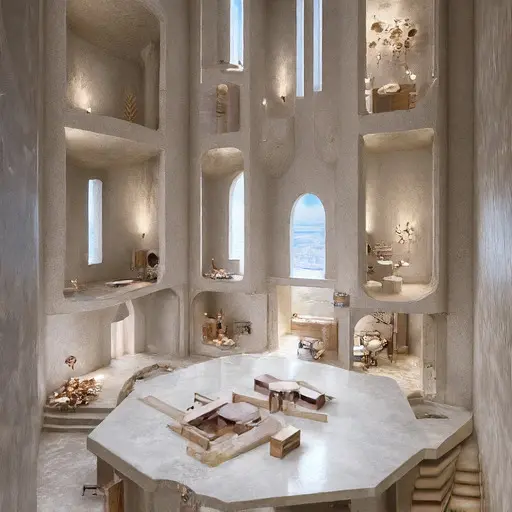
The Octavian Radewood Manor was constructed in 1906 as part of an experimental architectural initiative exploring radial domestic geometries as an alternative to conventional linear and grid-based Victorian layouts. Situated at the edge of a lightly wooded plain, the manor was designed around a central octagonal core constructed from pale carved stone with fine etched detailing. From this hub, multiple angled wings extend outward like structural spokes, each representing a distinct architectural interpretation of domestic space within a unified radial system.
The central octagonal core functioned as both structural anchor and communal hub. It rose higher than the surrounding wings and was capped with a shallow multi-faceted roof, each facet finished in subtly different slate tones—soft blue-gray, desaturated green, and pale violet. This created a subdued kaleidoscopic effect visible from both ground level and elevated vantage points. The core served as the primary circulation point, connecting all wings through narrow void corridors constructed of glass and thin metal framing.
Each wing expressed a distinct material and spatial logic. One extended as a triangular prism clad in smooth cream plaster with irregular vertical windows. Another curved outward in pale brick, incorporating hexagonal window modules that produced faceted interior reflections. A third wing stepped outward in muted lavender stone, with stacked rectangular volumes and horizontal slit windows emphasizing compression and extension. These variations were intended to explore how domestic space could adapt to radial expansion rather than linear hierarchy.
The manor was occupied for several decades as both residence and architectural research site. It housed a small collective of residents and researchers studying spatial perception within non-rectilinear environments. Daily movement followed radial pathways, reinforcing the conceptual framework of circular habitation. Despite its experimental design, the manor remained structurally stable and functionally coherent during its active period.
Gradual decline of radial habitation system
By the late 1920s, interest in radial domestic architecture declined as standardized rectangular housing models became dominant in regional planning. The Octavian Radewood Manor, with its complex multi-directional layout, became increasingly difficult to maintain and adapt to changing residential expectations. Occupancy gradually decreased, and portions of individual wings were left unused as maintenance resources were reduced.
Fragmentation of radial occupancy
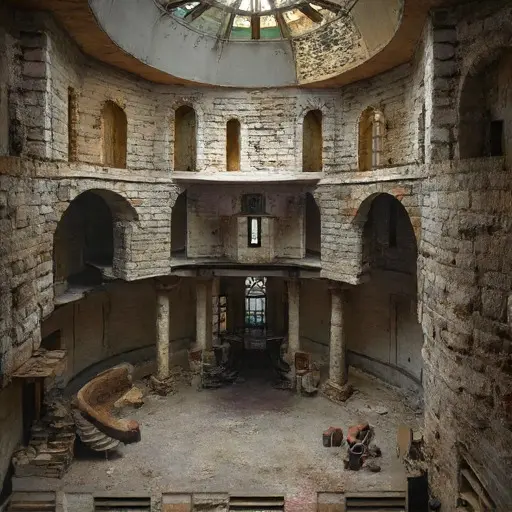
As institutional support for experimental housing declined, the manor’s radial system became increasingly impractical to sustain. Entire wings were gradually decommissioned as occupancy diminished, leaving the central octagonal core partially in use while outer sections fell into disuse. The void corridors, once active connective elements, became quiet transitional spaces carrying only light and wind.
Eventually, the manor ceased to function as a residential or research structure. Remaining occupants departed in phases, leaving behind a geometrically complex but functionally inactive building that no longer served its intended experimental purpose.
Final abandonment of the radial manor
By the early 1940s, the Octavian Radewood Manor was fully vacated. No redevelopment efforts were undertaken due to its non-standard radial configuration, which resisted conventional reuse strategies. The structure remained physically intact, stabilized by its central octagonal core and reinforced wing junctions, but no longer maintained for habitation.
Final radial stillness
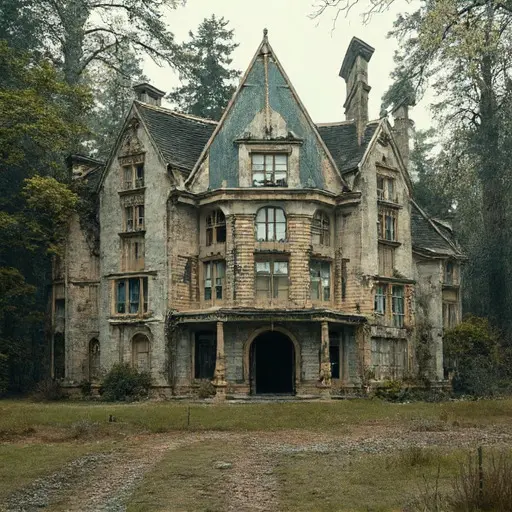
By the mid-1940s, no active ownership or functional use remained for the Octavian Radewood Manor. The surrounding forest edge remained stable, with no redevelopment pressure applied to the structure due to its unconventional radial design. No restoration followed, and the manor was left in place as a complete but inactive architectural system. Over time, its materials weathered uniformly under soft overcast light, while the radial geometry remained clearly legible. The manor persists today as a quiet architectural experiment suspended in abandonment, its circular logic intact but no longer inhabited.