The Viremont Rotunda Manor Left Vacant After Structural Estate Division
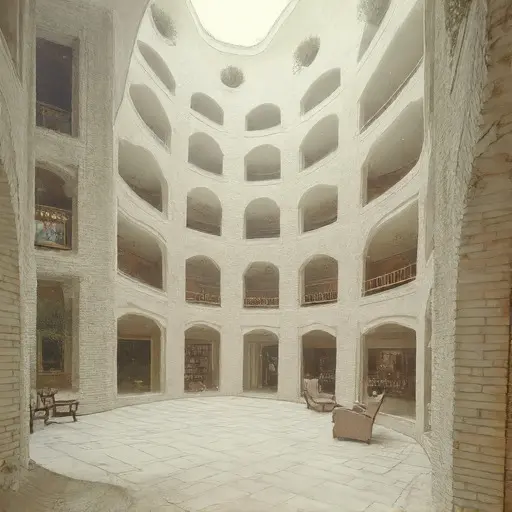
Viremont Manor was constructed in 1902 as an experimental Victorian residence designed to explore cylindrical domestic architecture rather than traditional rectilinear planning. Built from pale porcelain-white brick with a faint sky-reflective glaze, the manor was conceived as a cluster of interlocking circular and octagonal volumes organized around a dominant three-story central rotunda. The estate stood within a lightly wooded clearing, chosen specifically to emphasize its sculptural, non-angular silhouette.
The original architect, Henri Viremont, intended the manor to function as a “living circulatory structure,” where movement through space would be continuous and fluid rather than segmented into rooms. Four subsidiary turret-pods were attached asymmetrically around the central rotunda, each serving distinct domestic roles such as private sleeping quarters, study chambers, and observation lounges. The result was a residence that behaved more like a spatial organism than a conventional house.
During its early decades, the manor was occupied by the Viremont family and a small domestic staff. Life within the estate followed its circular logic—residents moved continuously between curved corridors, dome-lit rooms, and vertically stacked living levels. The glass atrium on the lower east side housed terraced plant arrangements that blurred the boundary between interior garden and architectural structure.
Emerging maintenance strain
By the late 1920s, the complexity of the building began to present increasing maintenance challenges. The curved masonry required specialized repair techniques, and the multi-dome roof system demanded constant attention due to water infiltration at overlapping ceramic seams. Although the structure remained sound, upkeep costs rose steadily each year.
A house defined by continuous curvature under strain
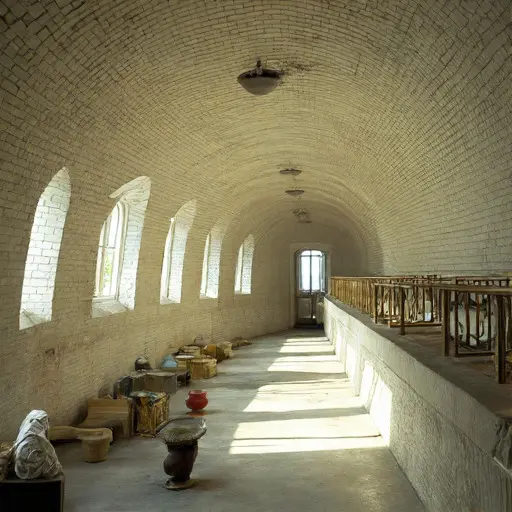
After the death of the Viremont family’s final direct heir in 1934, ownership of the estate became fragmented among distant relatives. None agreed on how to manage the unusually complex structure, and the cost of maintaining its specialized geometry discouraged potential buyers. Legal ambiguity prevented decisive action, leaving the manor in a state of administrative limbo.
As financial support ceased, sections of the residence were gradually closed. Entire turret pods were sealed to reduce heating costs, and portions of the atrium glass structure began to fog and fracture due to lack of upkeep. The once-continuous circulation pattern of the house became fragmented as internal access routes were blocked or left to deteriorate.
Final abandonment of Viremont Manor
By 1941, the remaining occupants vacated the property entirely. Without coordinated ownership or restoration funding, the manor was left intact but unused. No formal sale was completed, and no preservation effort was initiated despite its architectural significance.
The stillness of unresolved circular architecture
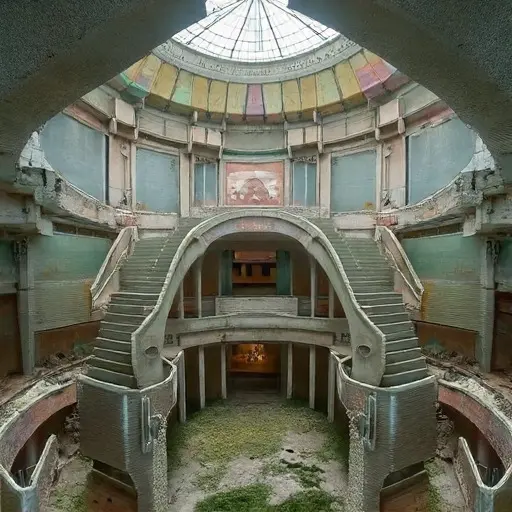
No restoration ever followed the abandonment of Viremont Manor. Ownership disputes dissolved into legal stagnation, and the estate remained physically preserved but functionally empty. The glass atrium continued to deteriorate, ceramic roof tiles slowly weathered, and interior circulation routes remained sealed or unused. Today the manor still stands in its forest clearing, a fully intact but abandoned experiment in circular Victorian architecture—no resolution reached, no restoration undertaken, and no return of inhabitants recorded.