The Caldwell Manor Left Vacant After Architectural Fragmentation Dispute
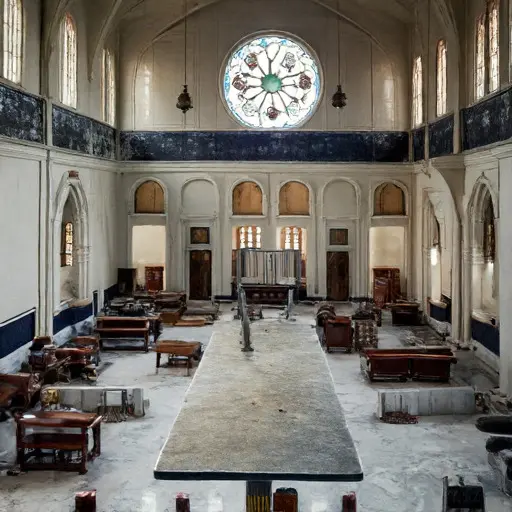
Caldwell Manor was constructed in 1898 on the edge of a quiet forest clearing, designed not as a conventional residence but as an architectural experiment in fragmented Victorian spatial design. Built from pale chalk-white stone and embedded ultramarine ceramic bands, the manor immediately stood apart from surrounding estates due to its unconventional zigzag structure composed of interlocking volumes. Each section was intended to function semi-independently while remaining part of a unified family residence.
The original owner, industrial architect Edmund Caldwell, envisioned the manor as a living study in asymmetry and domestic variation. Rather than a single unified hall, the house was divided into shifting wings of different heights and depths, each with its own lighting character, window rhythm, and internal circulation paths. The central volume housed formal gatherings, while side wings served as private studies, libraries, and experimental living quarters.
For the first decades of its existence, the manor operated successfully despite its unusual layout. Guests often described the experience of moving through the house as “walking through architectural thought,” with each transition between volumes feeling distinct yet connected. The adjacent conservatory, built as a near-detached glass structure, housed botanical collections that further emphasized the estate’s experimental nature.
Early signs of instability
By the 1920s, maintaining the complex structure became increasingly difficult. The irregular roof geometry and non-standard internal connections required specialized maintenance, and repair costs rose steadily. The fragmented design that once symbolized innovation began to present practical challenges for everyday use.
A house divided by its own structure
After Caldwell’s death in 1927, ownership passed to multiple heirs who disagreed over the purpose and future of the manor. Some wished to preserve it as an architectural landmark, while others argued for partial demolition to simplify maintenance and reduce costs. These disagreements led to years of delayed repairs and unresolved planning decisions.
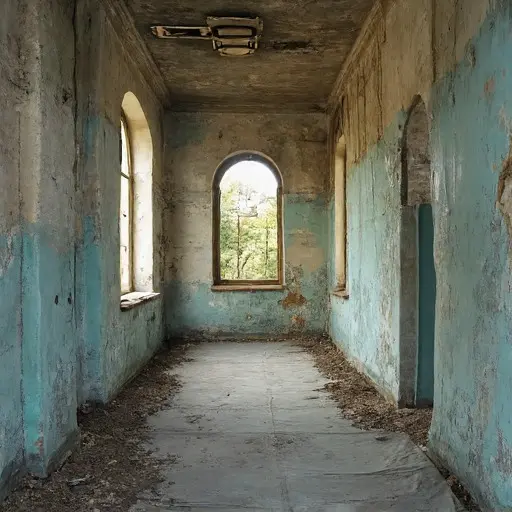
As financial pressures increased during the 1930s, sections of the manor were gradually closed off. Entire wings were abandoned to reduce heating and upkeep expenses. The conservatory suffered from deferred maintenance, resulting in condensation damage and structural weakening of its brass framing. Interior circulation between volumes became increasingly restricted as portions of the house were sealed.
Final abandonment of Caldwell Manor
By 1942, legal disputes over ownership had stalled any coherent restoration effort. The estate was effectively frozen in a state of partial occupation and partial abandonment. Remaining occupants eventually left, unable to maintain such a structurally demanding residence.
The stillness of unresolved architecture
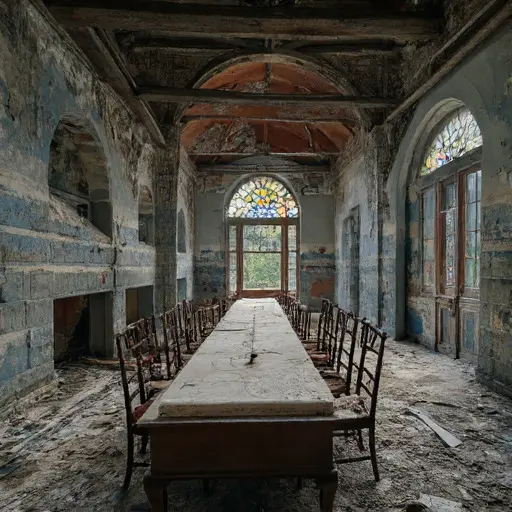
No restoration was ever completed. The Caldwell heirs abandoned claims to the property, and the manor remained structurally intact but unused. The conservatory continued to deteriorate, glass panels fogging and loosening over time, while interior wings slowly accumulated dust and moisture damage. Today Caldwell Manor still stands within the forest clearing, abandoned but uncollapsed, its fragmented architecture preserved exactly as it was left—no reconstruction undertaken, no single owner established, and no resolution reached regarding its divided design.