The Beached Sky That Forgot to Fly
A Vessel Anchored by Time
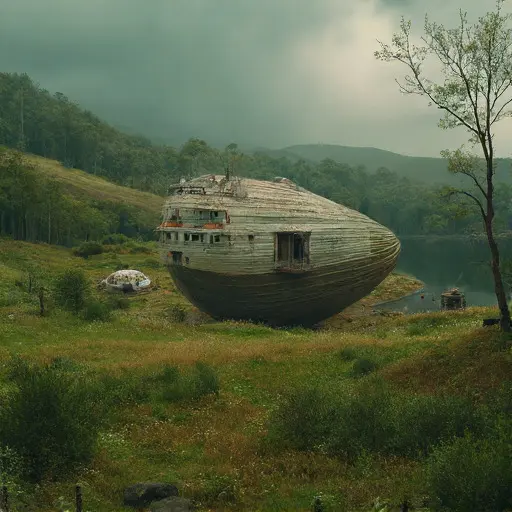
The mansion rests on the hillside like an airship that chose land over sky and then forgot why it ever moved at all. Its colossal hull stretches across the meadow slope in layered residential decks, each level carved from brass-reinforced ivory plating streaked with faded cobalt and ember enamel. From a distance, it still reads as a vessel—long, aerodynamic, impossible to mistake—but the sky no longer answers it.
Willow trees gather along the river below, and the water reflects a slate-green storm sky dissolving into pale peach near the horizon. Between them, tall meadow grass rolls in slow motion, pressing against the hull like waves that never fully broke.
The airship does not float.
It endures.
Decks Turned Into Rooms of Quiet Decay
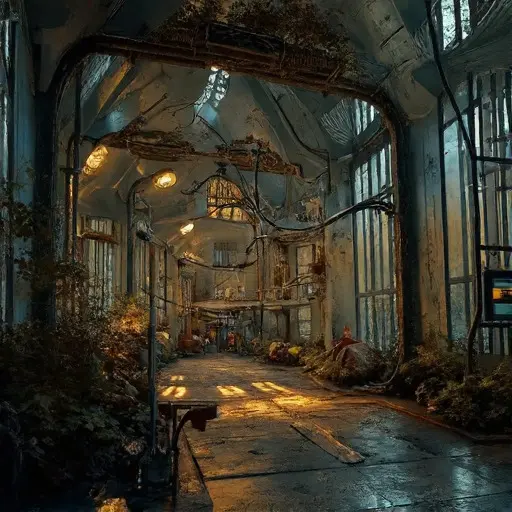
Inside, the vessel reveals itself not as machinery but as memory rearranged into architecture.
Skeletal observation gondolas—once meant to float beneath the sky—now function as glass-walled garden rooms. Their curved panes overlook the meadow and river, though nothing within them reflects life. Brass beams run along the interior like exposed bones, holding together spaces that feel more grown than built.
Every corridor is elongated, slightly tilted, as if the entire structure still believes in forward motion it can no longer achieve.
No lamps burn. No instruments hum.
Only the wind moves through broken seams.
The Compass That Fell First
Near the bow lies what remains of navigation.
A fractured compass monument has collapsed into the grass, its directional markings split into uneven stone segments half-swallowed by wildflowers. Broken telescopic rigging lies scattered around it, forming a constellation of metal and glass that points nowhere at all.
It is unclear whether the airship crashed here or simply decided to stop mid-journey.
The answer no longer matters.
The meadow has already accepted it as part of the ground.
Where Fabric Became Stone
Along the hull, torn sail-like awnings have fossilized into rigid folds of stone and wood. They no longer catch wind, yet still retain the memory of motion in their frozen curves. Ivy threads through riveted joints, and moss spreads across seams where craftsmanship once resisted corrosion but eventually learned to collaborate with it.
The architecture is not collapsing.
It is blending.
A Sky That No Longer Lifts Anything
From a cinematic wide angle, the entire structure feels like a paradox made physical: a flying machine that never left the earth, or a building that once dreamed of air travel and was gently persuaded otherwise by gravity and time.
The river below continues its slow reflection. The forest remains still. The sky fades from storm-green into a soft peach silence.
And the airship does not attempt to rise.
It only exhales—quiet, final, and unhurried—like a dethroned emperor remembering the garden that replaced the sky.
“`