The Lantern That Learned to Forget

A Structure Made of Soft Light and Silence
The abandoned Victorian mansion rises from the meadow basin like a memory that refused to fade completely. Shaped as a colossal folded paper lantern, it stands neither fully collapsed nor fully intact, but suspended in a permanent moment of softened origami tension.
Its translucent alabaster walls catch the last breath of daylight, diffusing it into a quiet haze of dusk-turquoise atmosphere.
Deep ruby and jade stained-glass accents pulse faintly with residual color—not illumination, but the suggestion of what light once meant when the structure was still alive with presence.
Above it, the sky dissolves into pale apricot near the horizon, as though the world itself is gently dimming the volume of the scene.
The Lantern That Forgot Its Flame
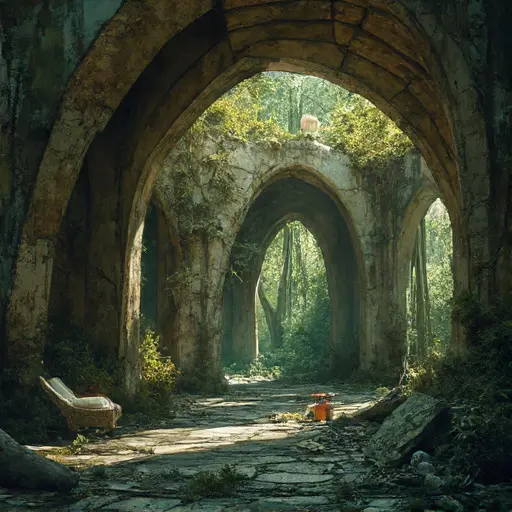
Inside, the mansion is not a room but a void shaped with intention.
The interior space opens upward in layered collapses of architectural geometry, where each folded segment of the lantern becomes a softened ceiling, wall, and corridor at once. Brass ribs arc through the emptiness like the skeleton of something once luminous, now reduced to structure alone.
No light source remains.
Instead, illumination arrives only through fractured alabaster panels and broken stained-glass seams, where faint environmental glow filters in from the fading sky outside.
Wild grass pushes through cracks in the flooring. Ivy threads itself through Victorian filigree joints. Even the boundaries between interior and exterior begin to dissolve, as if the building is slowly deciding it was never separate from the meadow at all.
The Courtyard Inside the Frame
At the wide circular base of the lantern, the structure opens directly into a grassy courtyard. This is the only place where the architecture fully yields to nature.
Stone paths curve through uneven grass, interrupted by clusters of wildflowers growing through fractured lantern panels that have fallen inward like broken pages of a glowing book. Along these paths lie remnants of crystal wind-chime systems—delicate shards of glass and metal that no longer move, no longer sing, no longer remember sound.
Willow trees encircle a still lake nearby, their reflections stretching into the water like soft ink bleeding across paper. The estate leans toward this lake without ever reaching it, as if the entire structure is perpetually mid-gesture.
A Geometry That Chose Stillness
The lantern’s upper segments collapse inward in softened origami layers, forming overlapping terraces that feel less built and more gently folded into existence. Weathered Victorian filigree is still visible within the brass joints, suggesting a craftsmanship so precise it survived even the abandonment.
Moss and ivy thread through every seam, not as decay, but as continuation—nature extending the architecture rather than consuming it.
The mansion no longer emits light.
It only receives it.
And as dusk deepens and the sky shifts from turquoise to quiet apricot, the folded lantern remains in the meadow basin like a vessel that once held illumination but now understands something quieter.
It exhales without sound.
And the meadow listens without reply.