The Larkwell Conservatory Manor Left to Botanical Collapse
→ 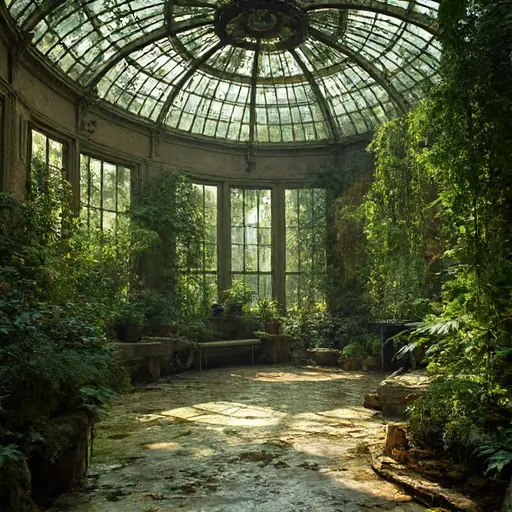
The Larkwell Conservatory Manor was constructed in 1889 as an experimental fusion of domestic residence and botanical conservatory, built for a family of horticultural patrons who believed architecture should function as a living extension of cultivated land. Its defining feature was a full circular greenhouse dome, supported by intricate iron ribbing and glazed with imported Victorian glass designed to maximize winter light retention. For several decades, the manor operated as both private home and semi-public botanical showcase, sustaining rare plant species alongside domestic life.
The decline began gradually in the early 1920s, when structural fatigue first appeared in the northern arc of the dome. Repeated seasonal storms weakened copper joints, and minor glass fractures went unrepaired due to rising maintenance costs. At first, the damage was cosmetic—small distortions in light, faint drafts moving through interior corridors—but over time, the greenhouse shell began to lose its uniform integrity.
SUBHEADING: Early Structural Failure and Botanical Overgrowth
→ 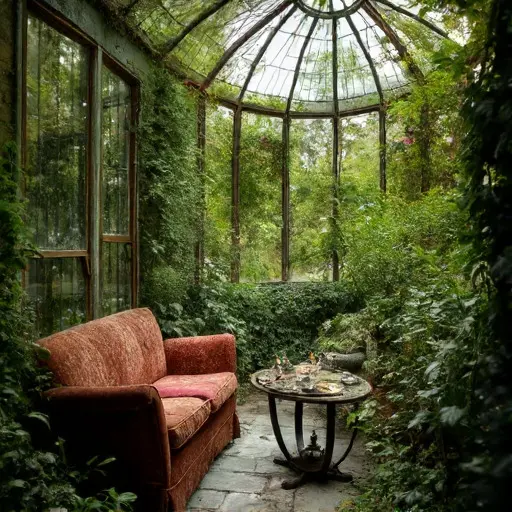
By 1927, the conservatory’s central dome had developed multiple compromised sections. Glass panels were replaced sporadically, often with mismatched panes salvaged from secondary structures. This introduced irregular lighting conditions that altered the internal ecosystem. Certain plant species began to thrive excessively in localized zones, while others receded entirely. The manor’s once-curated botanical arrangement dissolved into uncontrolled ecological layering.
The family attempted partial containment by sealing interior corridors between domestic rooms and greenhouse zones. Iron gates were installed within arched thresholds, and sections of the dome floor were reinforced with stone edging to prevent root spread. These interventions slowed but did not stop the transition. Vegetation continued to migrate inward, exploiting every structural weakness.
SUBHEADING: Final Abandonment and Architectural Reclamation
→ 
The final documented occupancy of Larkwell Manor ended in 1939, coinciding with the departure of the remaining custodial family during regional consolidation of rural estates. No formal restoration attempt was ever undertaken afterward. The cost of repairing the dome was deemed excessive, and the structure was left to stabilize on its own terms.
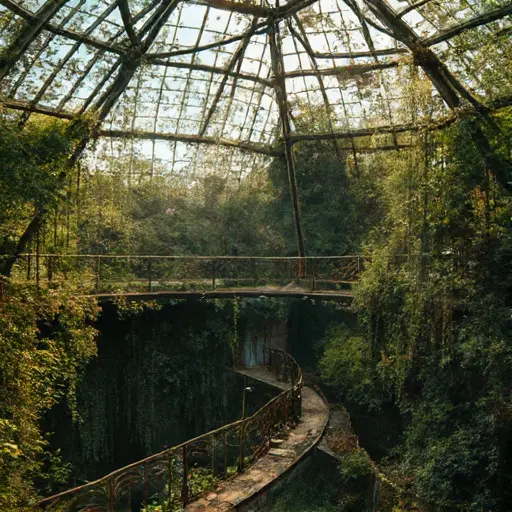
Over the following decades, the conservatory collapsed only partially, settling into a new equilibrium rather than complete failure. The dome did not fall; it deformed. Iron ribs bent but remained connected. Glass fractured but largely stayed in place. This incomplete collapse created a stable ruin environment in which vegetation accelerated its dominance.
Today, the Larkwell Conservatory Manor remains a fully intact but biologically transformed structure. The Victorian domestic ring persists at ground level, while the greenhouse dome above functions as a living canopy of uncontrolled botanical growth. No occupants returned, no redevelopment was initiated, and no preservation effort succeeded in reversing the ecological takeover.
The manor endures as a sealed circular ecosystem of architecture and plant life, where abandonment did not result in emptiness, but in permanent integration with the surrounding garden world.