The Halewick Quarry Manor Left Vacant After Stoneworks Closure
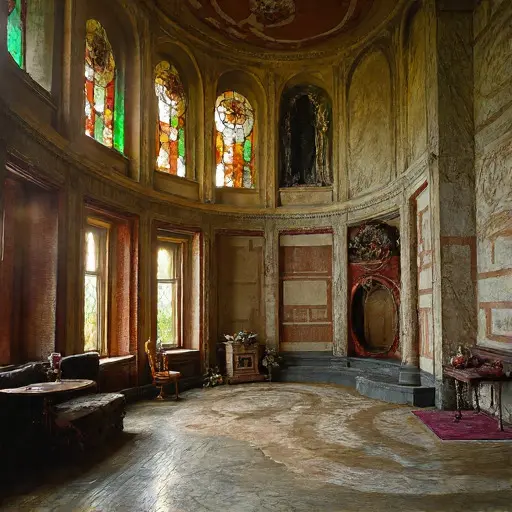
The Halewick Quarry Manor was constructed in 1903 at the base of a decommissioned stone quarry outside a small industrial village. It was commissioned by industrial architect Edward Halewick as both a private residence and a demonstration of compact geometrical living within excavated geological space. The first occupants were the Halewick family—Edward, his wife Margaret, and their daughter Louise.
Unlike conventional country estates, the manor was designed as a self-contained architectural core placed precisely at the center of a circular quarry floor. The surrounding stone walls were not hidden or landscaped but intentionally integrated into the visual composition of the home, forming a natural amphitheater of exposed rock.
For its early years, the manor functioned as both residence and informal exhibition space for architectural visitors and stone industry stakeholders.
EARLY SIGNS OF INDUSTRIAL DECLINE AND STRUCTURAL ISOLATION
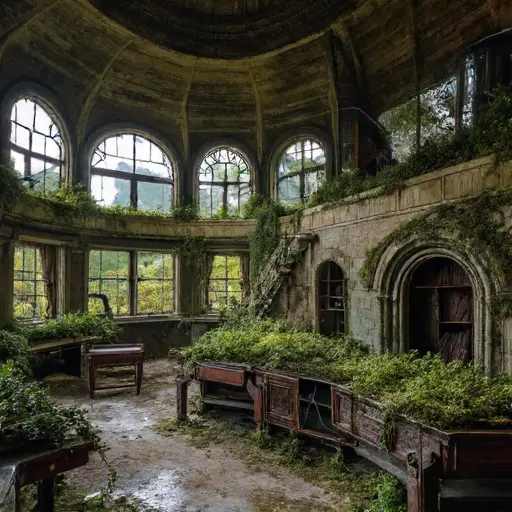
By 1928, the Halewick Quarry had ceased major stone extraction operations due to declining industrial demand and the exhaustion of accessible high-grade stone layers. The quarry company was gradually dissolved, leaving the manor isolated within an inactive industrial basin.
Edward Halewick attempted to maintain the property as a private residence, but funding for structural upkeep and conservatory maintenance was significantly reduced. Without quarry activity, drainage systems around the quarry floor began to shift, leading to intermittent water pooling near the manor’s radial courtyard.
Margaret Halewick documented increasing structural dampness along the lower limestone bands of the house, where moisture from the quarry floor slowly rose into the masonry. The stained-glass windows, once vibrant, began to lose clarity due to accumulated mineral residue and internal condensation.
By the early 1930s, access roads to the quarry had fallen into disrepair, and regular supply deliveries ceased entirely.
FINAL OCCUPATION AND QUARRY ENCLOSURE ABANDONMENT
By 1942, the Halewick family had fully abandoned the quarry manor. Edward Halewick died shortly after the closure of the quarry company, while Margaret relocated to a nearby town. Louise left the region for educational work and never returned.
With the complete shutdown of industrial operations, the quarry was officially decommissioned and left to natural reclamation. No redevelopment was pursued due to the structural complexity of the circular basin and its isolated geography.
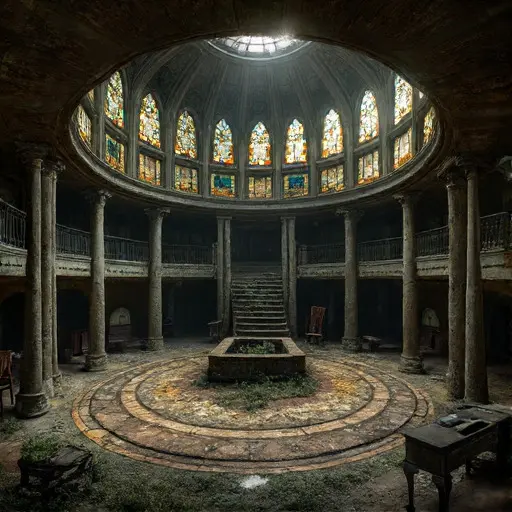
Over time, water accumulation in the quarry floor increased slightly, forming shallow reflective pools that altered the visual perception of the manor’s symmetry. Vegetation spread slowly along quarry ledges and courtyard seams, integrating the architecture further into the enclosed geological environment.
By 1949, the Halewick Quarry Manor was formally recorded as abandoned. It was never restored or repurposed. The structure remains precisely centered within the quarry basin, its stained glass dimmed, its courtyard fractured by growth, and its Victorian geometry slowly softened by stone, water, and time.