The Hillcrest Observatory Cottage Left Vacant After Estate Dissolution
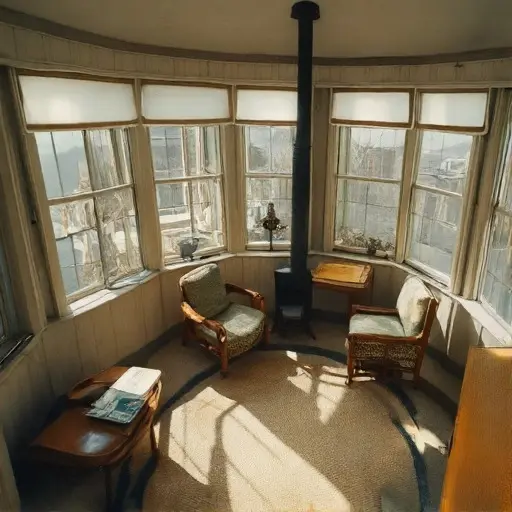
The Hillcrest Observatory Cottage was completed in 1902 on a solitary rise above a broad agricultural valley. It was commissioned by Edmund Rowe, a retired civil surveyor with a long-standing interest in meteorology and celestial observation. He lived there with his wife Clara Rowe and their nephew Thomas after adopting a quieter life away from regional infrastructure projects.
The design of the cottage reflected Rowe’s observational mindset. Its circular footprint allowed uninterrupted views in all directions, and the central roof cupola provided a controlled space for studying weather patterns and night skies. Though modest in scale, the house was carefully constructed and well maintained during its early decades, functioning as both residence and informal observation station.
For years, the Rowe household kept detailed journals of wind direction, rainfall, and seasonal changes, treating the house as a tool for understanding the surrounding landscape rather than simply inhabiting it.
EARLY SIGNS OF DISRUPTION AND DECLINE
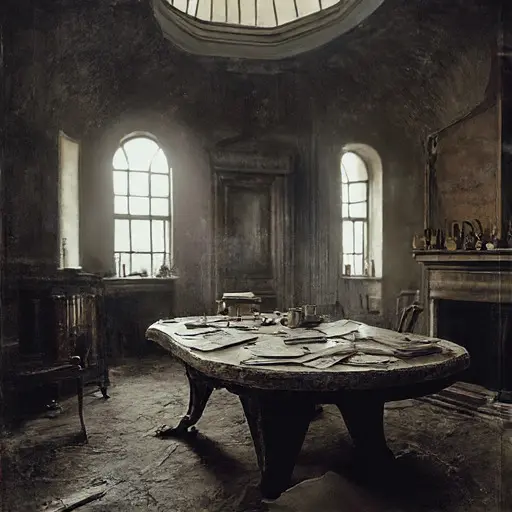
By 1929, Edmund Rowe’s health had begun to decline, and his ability to maintain the cottage and its observational duties diminished significantly. The surrounding estate, once modestly funded through savings and small investments, began to suffer during the broader economic downturn that followed the war years.
Clara Rowe attempted to maintain household order, but upkeep of the uniquely shaped building proved increasingly difficult. The circular design that once symbolized clarity of vision now made repairs expensive and complex, as no wall or room could be treated as standard geometry.
As income sources weakened, maintenance of the cupola and roofing was reduced, allowing moisture to enter during seasonal storms. Small leaks appeared in upper ceiling joints, and wooden trim began to swell and warp along the curved interior walls.
By the early 1930s, the observational records ceased entirely. The house remained inhabited, but its original purpose had effectively ended.
FINAL OCCUPATION AND LONG SILENT VACANCY
By the early 1940s, the Rowe family had fully dissolved from the property. Edmund Rowe passed away after years of declining health, and Clara relocated to relatives in a nearby town. Thomas, having left earlier for employment opportunities in another region, never returned to the cottage.
With no heirs willing or able to maintain the specialized structure, the estate fell into administrative limbo. The hilltop location, while scenic, offered no practical value for redevelopment, and the building’s unusual circular design discouraged commercial repurposing.
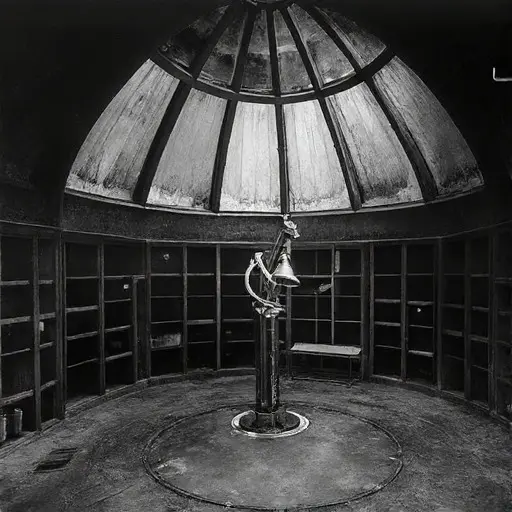
By 1948, the Hillcrest Observatory Cottage was formally recorded as vacant. No restoration was attempted, and no new occupants were assigned. The structure remained exposed on the hill, slowly deteriorating under wind, rain, and seasonal change.
The house still stands today in silence, its rooms empty, its cupola clouded, and its purpose long ended, continuing its slow decline as an unattended observer of the countryside it was once built to study.