The Violin Manor on the Hillside
Abandoned Victorian house shaped like a colossal violin resting gracefully across a flowering hillside, as though an impossibly large musician placed the instrument among the meadows centuries ago and nature slowly transformed it into a home. The architecture follows the exact anatomy of the violin: the vast curved body forms the main residence, crafted from rich mahogany-toned timber, cream-colored stone, and ornate Victorian detailing, while the elongated neck stretches across the landscape as an elevated gallery corridor suspended above the grass below.
From a distance, the structure appears both monumental and delicate. Warm sunlight glides across polished wood surfaces weathered by decades of abandonment, revealing subtle grain patterns, softened edges, and the patina of time. Carved stone accents frame windows and balconies, while stained-glass panels embedded throughout the architecture scatter fragments of ruby, emerald, amber, and sapphire light across the surrounding meadow.
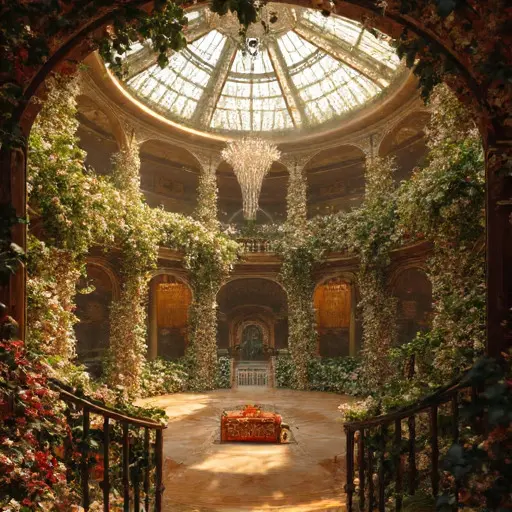
At the heart of the violin body lies a magnificent circular ballroom occupying the largest chamber within the instrument. Beneath a soaring glass ceiling, sunlight pours into the room, illuminating thousands of white climbing roses that have gradually overtaken the floor, balconies, and decorative iron railings. Crystal chandeliers remain suspended overhead, softened by flowering vines and drifting petals.
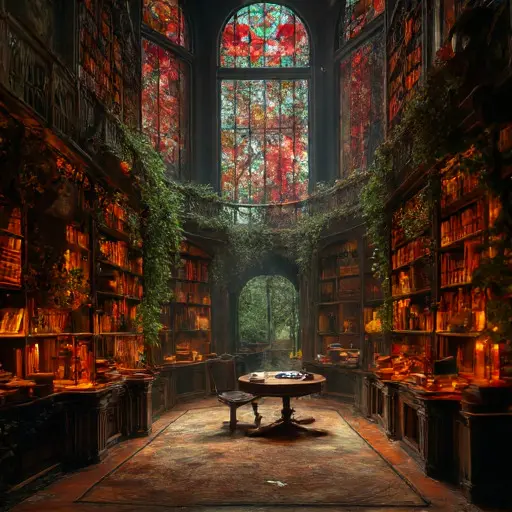
Along the inner curve of the instrument rests a breathtaking library shaped by the violin’s natural contours. Towering bookshelves bend gracefully with the architecture, following the flowing wooden walls as though grown from the same material. Ornate reading alcoves occupy curved recesses beneath stained-glass windows, where warm colored light falls across weathered books, carved furniture, and dust-covered writing desks left untouched for years.
The violin’s enormous strings remain suspended above the residence as shimmering silver cables stretching from body to scroll. Thick flowering vines spiral around them, transforming the strings into elevated gardens suspended high above the architecture. Some cables remain taut and intact, while others have snapped and drape elegantly across rooftops, balconies, and terraces like forgotten ribbons woven through the structure. Birds nest among the vines, and hanging blossoms sway gently in the breeze.
The neck of the violin forms a remarkable elevated corridor extending across the hillside. Lined with stained-glass windows on both sides, the passage offers sweeping views of the landscape below. Sunlight passing through the colored glass transforms the wooden floor into shifting patterns of jewel-toned reflections that stretch toward the distant scroll tower.
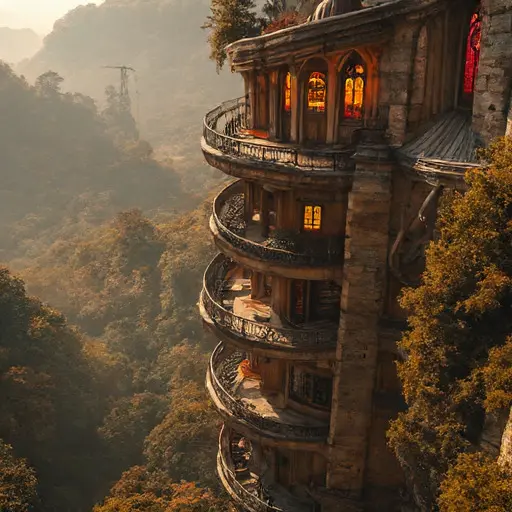
At the far end rises the scroll itself, transformed into an elaborate Victorian observation tower. Its elegant spiral geometry contains winding staircases, intimate viewing rooms, and stained-glass alcoves overlooking the countryside. The tower’s windows glow with vibrant color whenever sunlight strikes them, making the scroll appear almost luminous against the evening sky.
Surrounding the house is an extraordinary landscape of saturated natural beauty. Deep emerald grass rolls across gentle hills in broad waves. Vast rivers of wildflowers carve through the terrain—crimson poppies, bright yellow daisies, pale blue cornflowers, and endless lavender blooms stretching toward the horizon. Flower petals drift continuously through the air, collecting along windowsills, balconies, staircases, and pathways.
Beneath the violin’s body, a narrow stream winds through the meadow. Its calm surface reflects the unusual architecture with astonishing clarity, doubling the scale of the structure and transforming the house into something even more dreamlike. Small stone bridges arch across the water, their railings completely entwined with climbing roses and flowering ivy. Reflections of stained glass shimmer across the moving water like scattered fragments of music.
The abandonment feels gentle rather than sorrowful. Empty chairs remain arranged on balconies overlooking the valley. A grand piano sits beneath a pergola draped in roses, untouched but intact. Open windows reveal lace curtains moving softly in the breeze, creating the lingering impression that the inhabitants stepped away only moments ago.
Golden-hour sunlight bathes every surface in warmth. Long shadows emphasize the sweeping curves of the violin architecture, while stained glass scatters vibrant color across wood, stone, flowers, and water. The entire scene reads like an ultra-realistic architectural photograph of a forgotten Victorian dream—an impossible musical residence where beauty, craftsmanship, nature, and memory continue to resonate long after the music has ended.