The Lily Atrium Manor
Abandoned Victorian house shaped like an enormous flowering lily suspended above a secluded meadow, its architecture unfolding in vast petal-like structures rather than conventional walls and wings. From a distance the building appears less like a residence and more like a colossal botanical organism frozen at the peak of bloom. Massive petals of ivory stone, weathered emerald copper, and luminous stained glass radiate outward from a circular central core, creating a form that feels grown from the landscape rather than assembled by human hands.
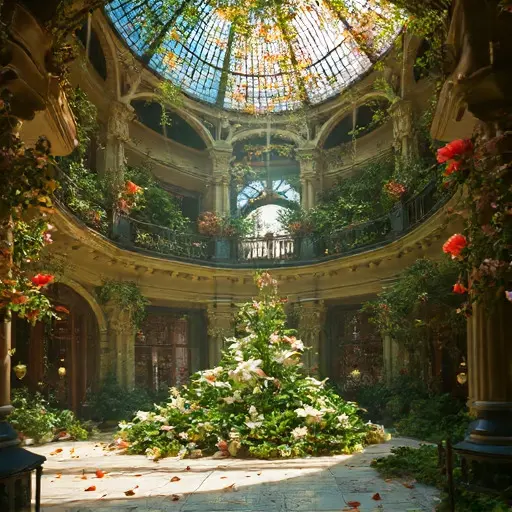
The central heart of the structure is a soaring Victorian atrium crowned by a grand glass dome. Beneath the dome hangs a suspended garden of climbing roses, cascading ivy, flowering vines, and wrought-iron trellises that spiral upward toward the glass.
Sunlight filters through curved stained-glass segments overhead, filling the atrium with shifting pools of amber, emerald, sapphire, and rose-colored light that move across stone floors throughout the day.
Around the atrium, the giant petals form individual living spaces. Each petal unfolds at its own angle and degree of openness, creating a house that never appears exactly symmetrical. Some petals stretch fully outward, exposing entire rooms to sunlight and sky, while others remain partially folded around sheltered interiors filled with shadow and overgrowth.
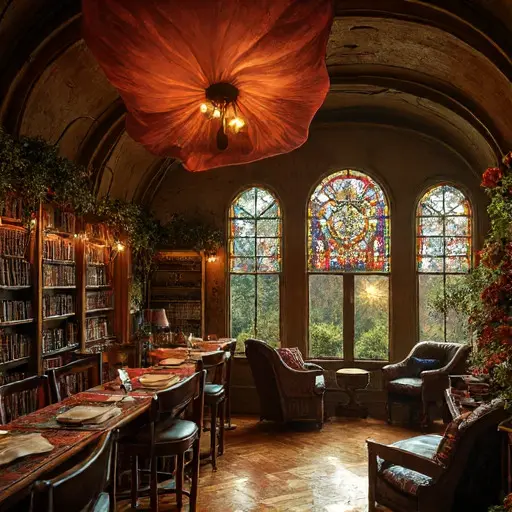
One petal houses a magnificent library whose curved walls follow the natural sweep of the floral architecture. Tall walnut bookshelves bend gracefully along the room’s perimeter, filled with weathered volumes coated in fine dust. Reading alcoves nestle between stained-glass windows overlooking the meadow below, while flowering vines creep gently across railings and forgotten desks.
Another petal serves as an abandoned greenhouse. Oversized orchids bloom among dense vegetation, their petals reaching toward fractured glass skylights overhead. Deep crimson flowers, giant lilies, and rare tropical plants have transformed the room into a lush enclosed ecosystem where architecture and horticulture are impossible to separate.
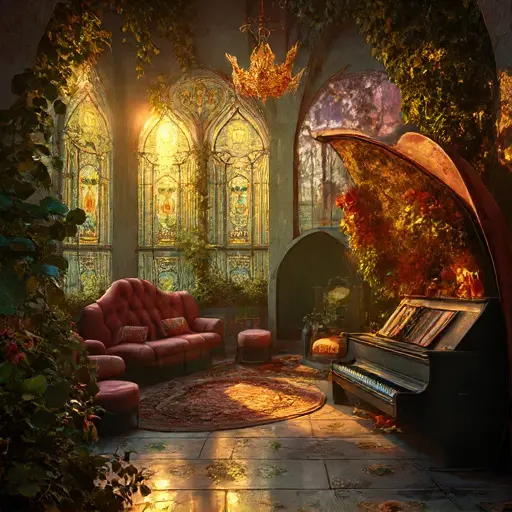
A third petal contains an elegant sitting room surrounded almost entirely by stained-glass walls. Amber and sapphire panels transform sunlight into rich color that washes across faded upholstery, ornate Victorian tables, and abandoned musical instruments. The room feels preserved rather than ruined, as though a gathering ended moments before silence settled permanently over the house.
Connecting these petals are delicate iron walkways suspended in open air around the atrium core. Their intricate Victorian latticework resembles leaf veins stretching between petals, allowing movement through the house while offering breathtaking views down toward the meadow far below. Time and weather have softened the metalwork, yet the pathways remain intact, suspended within the flower’s impossible geometry.
Below the floating structure, the meadow is extraordinarily vibrant. Deep emerald grasses ripple like waves beneath warm evening winds. Vast fields of scarlet poppies, golden buttercups, violet lupines, and white daisies spread outward in sweeping natural patterns that appear almost painted across the landscape. Flowering cherry trees ring the clearing, releasing pale pink blossoms that drift continuously through the air and gather along pathways, balconies, and copper ledges.
Long flowering vines descend from the petal architecture toward the earth. Some are covered in luminous blue blossoms, while others support pale peach roses that climb both downward and upward simultaneously, blurring the distinction between building and garden. These living connections anchor the floating structure visually to the landscape beneath.
At the exact center of the meadow rests a circular reflecting pond. Its perfectly calm surface mirrors the flower-shaped house above with astonishing clarity. Together, the structure and its reflection form a complete blossom suspended between sky and water, transforming the lily manor into something even larger and more surreal than its physical form alone.
Warm golden-hour sunlight illuminates every surface. Copper petals glow with rich metallic warmth, stained glass scatters jewel-like reflections across stone and vegetation, and the meadow radiates saturated natural color in every direction. The entire scene reads as an ultra-realistic architectural photograph of a forgotten Victorian flower palace—a place where architecture, horticulture, and memory merged into a single magnificent bloom that continues to flourish long after its inhabitants vanished.